 By
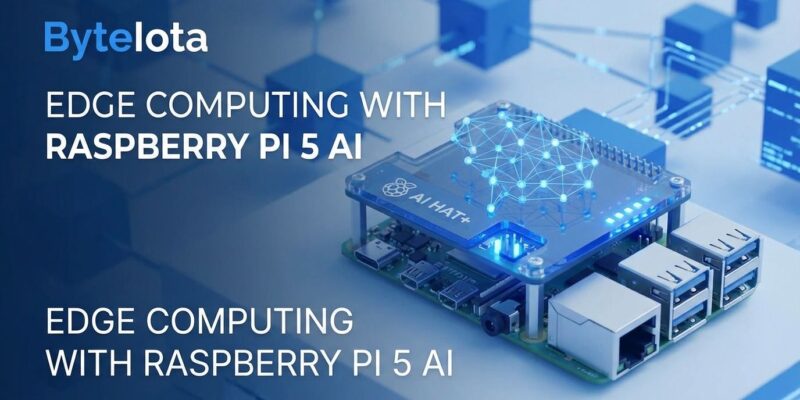
By Raspberry Pi Foundation announced the AI HAT+ 2 today (January 15, 2026), a $130 PCIe expansion board that enables local LLM inference on Raspberry Pi 5. The device combines a Hailo-10H AI accelerator delivering 40 TOPS with 8GB dedicated RAM to run models like Llama-3.2-3B and Whisper locally, without cloud connectivity. This launch comes as edge AI hits mainstream— 80% of AI inference now happens on local devices rather than cloud data centers, driven by privacy regulations and dramatic cost savings.
This isn’t just another Pi accessory. It represents the democratization of edge AI at consumer price points, challenging the cloud-first paradigm with a 3W power envelope compared to 700W cloud GPUs. For developers building privacy-focused applications, offline industrial IoT, or cost-sensitive robotics, this enables practical local AI that was previously enterprise-only territory.
CPU Beats NPU: The Unexpected Performance Paradox
Here’s the twist: independent testing by influential reviewer Jeff Geerling revealed the Raspberry Pi 5’s built-in CPU outperforms the dedicated Hailo-10H NPU on most LLM workloads. “The Pi’s built-in CPU trounces the Hailo 10H,” Geerling stated, noting the NPU only approached competitive performance with the Qwen2.5 Coder 1.5B model. This raises a critical value question: why spend $130 on an accelerator when the CPU performs better?
The answer has nuance. Power constraints limit the Hailo to 3W maximum while Pi’s CPU operates at 10W, creating an inherent disadvantage for LLM tasks. However, the HAT+ 2 dominates computer vision—delivering 10x speedup for YOLOv11m at 30fps compared to CPU processing. Moreover, early software shows immaturity: Geerling encountered segmentation faults when running vision and LLM workloads simultaneously. The HAT+ 2 isn’t universally superior; it wins on specific use cases, not general LLM inference.
Edge AI Hits Mainstream: 80% Local Inference by 2026
The Raspberry Pi AI HAT+ 2 arrives at a critical inflection point. Industry analysis shows 80% of AI inference now happens locally on edge devices rather than cloud data centers—a dramatic shift driven by three forces: economics ($0.05 edge vs $0.50 cloud per query equals 90% savings), privacy compliance (European regulators issued $2.1 billion in GDPR fines in 2025), and latency requirements (sub-50ms for robotics vs 1-2 seconds cloud roundtrip).
CES 2026’s dominant theme confirmed this trend: “Physical AI” and edge computing announcements from Nvidia, AMD, and others signal mainstream adoption. The hybrid architecture is becoming standard—train models in the cloud, deploy inference to the edge. Furthermore, industrial IoT provides proof: EK Robotics uses Pi-based systems for Automated Guided Vehicles, while manufacturing automation runs on similar edge AI platforms. This isn’t experimental anymore; it’s production reality.
The power consumption narrative matters beyond efficiency. Hyperscale AI data centers consume 650MW+, equivalent to a medium-sized power plant. In contrast, the HAT+ 2’s 3W envelope isn’t just economical—it’s philosophical. Edge-first AI architecture addresses sustainability concerns that cloud-only approaches can’t solve.
Where $130 Makes Sense: Privacy, Offline, and Robotics
The AI HAT+ 2 fills specific niches where cloud alternatives fail. Healthcare applications keep medical imaging analysis on hospital equipment for HIPAA compliance—patient data never leaves the building. Additionally, industrial IoT demands offline operation for remote locations and air-gapped networks. Robotics require sub-50ms latency for safety-critical autonomous systems, impossible with cloud roundtrips. Japanese farmers use similar Pi-based ML systems for cucumber sorting, saving 8-9 hours daily.
Cost analysis matters for fleet deployments. At 1000+ devices, the $0.50 vs $0.05 per query difference compounds dramatically—$500,000 vs $50,000 for a million queries. Therefore, combined with privacy compliance (avoiding those $2.1B GDPR fines) and offline capability, the math works for specific scenarios.
Computer vision remains the HAT+ 2’s strongest selling point: YOLOv11m at 30fps on 4K video delivers 10x CPU performance. Consequently, for developers building hybrid vision+LLM systems—factory quality control with natural language interfaces, or robotics with visual understanding—the NPU justifies its cost. However, for LLM-only workloads with internet access, a $80-$100 16GB Pi 5 or cloud inference might deliver better performance for less money.
Honest Trade-offs: When to Skip the $130
Both Geerling and The Register questioned the value proposition directly. Given CPU outperforms NPU on most LLMs, the $190 total cost (HAT+ 2 plus Pi 5) versus $80-$100 for a 16GB Pi 5 alone demands scrutiny. Geerling called it “a solution in search of a problem” outside niche use cases. Similarly, The Register noted “who this hardware is for remains ambiguous outside specific industrial edge-computing scenarios.”
Set realistic expectations about capability. The Raspberry Pi AI HAT+ 2 runs 1-7 billion parameter models like Llama-3.2-3B and Qwen2.5-VL-3B, not the 100B-2T parameter models cloud providers offer. Performance delivers 10+ tokens/second with <1 second first-token latency, but 4-bit quantization means 90-95% of cloud baseline accuracy. Therefore, this isn't a ChatGPT replacement—it's purpose-built for privacy-focused, offline, or cost-sensitive applications where cloud access isn't viable.
Buy the HAT+ 2 if: You need computer vision acceleration (10x speedup), ultra-low power for battery/industrial IoT (3W vs 10W CPU), privacy-critical applications (HIPAA, GDPR compliance), or offline operation (no internet access).
Skip it if: You’re running LLM-only workloads with internet available (16GB Pi 5 CPU or cloud inference likely faster and cheaper), need 7B+ parameter models (8GB RAM ceiling limits capability), or expect ChatGPT-level performance (1-3B models are fundamentally smaller).
Key Takeaways
- The Raspberry Pi AI HAT+ 2 democratizes edge AI at $130 consumer pricing, bringing enterprise capabilities to hobbyists and small-scale deployments
- Pi’s CPU beats the dedicated NPU for most LLM tasks due to power constraints (3W vs 10W), but the NPU dominates computer vision with 10x speedup
- 80% of AI inference shifted to local devices by 2026, driven by privacy regulations ($2.1B GDPR fines), 90% cost savings, and latency requirements
- Best use cases: Privacy-critical (healthcare, finance), offline industrial IoT, robotics requiring sub-50ms latency, and hybrid vision+LLM workloads
- Value depends on use case— 16GB Pi 5 or cloud inference may be better for LLM-only applications with internet access
The Raspberry Pi AI HAT+ 2 represents edge AI’s democratization moment, not universal hardware. Its 8GB RAM ceiling and power-constrained NPU create real limitations, but for developers building privacy-focused systems, offline deployments, or computer vision applications, it delivers enterprise-grade edge AI at accessible prices. The 3W vs 700W power narrative isn’t just efficiency—it signals a philosophical shift from cloud-centralized to edge-distributed AI architecture.