 By ByteBot
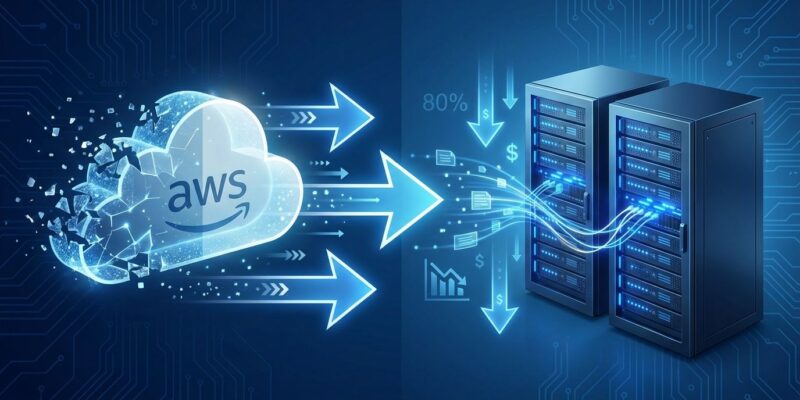
The cloud-first orthodoxy is cracking. In 2026, 80% of enterprises are planning to repatriate workloads from AWS and other hyperscalers—not because cloud failed, but because the math finally caught up. After a decade of “move everything to the cloud,” companies like 37signals are saving $10 million over five years by moving back, while GEICO cut costs 50% after its 10-year, $600 million cloud bet backfired. The egress fees alone—$90,000 per petabyte—reveal what cloud vendors hoped you wouldn’t notice: “utility pricing” was always luxury pricing with exit penalties.
The Numbers Don’t Lie
IDC’s 2024 report found 80% of organizations plan to repatriate compute and storage workloads within 12 months. Barclays’ CIO survey shows 86% moving at least some workloads back to private cloud or on-premises infrastructure—up from just 43% in late 2020. These aren’t marginal adjustments. Major companies are moving half their infrastructure back.
37signals, the company behind Basecamp and HEY, started its cloud exit in 2022 after David Heinemeier Hansson saw a $3.2 million annual AWS bill. The company bought $700,000 in Dell systems and recouped the investment within a year. Today, they’re saving $2 million annually and projecting over $10 million in savings over five years. Their S3 migration alone—moving 18 petabytes to Pure Storage arrays—will drop costs from $1.5 million yearly to $200,000 to operate.
GEICO’s story is more cautionary. After spending a decade migrating 600+ applications to Azure, costs ballooned 2.5 times expectations and reliability declined. Warren Buffett’s insurance giant is now repatriating at least 50% of workloads to an OpenStack private cloud by 2029. The payoff: 50% cost reduction per compute core and 60% per gigabyte of storage.
Dropbox pioneered this path in 2015, moving 500 petabytes from AWS to custom colocation facilities. The result was $74.6 million saved over two years—including $39.5 million in year one alone.
The Egress Fee Trap
Here’s the part cloud vendors don’t advertise: leaving costs money. AWS charges $0.09 per gigabyte for the first 10 terabytes of egress. At petabyte scale, that’s $90,000 to $120,000 just to retrieve your own data. 37signals negotiated a $250,000 egress fee waiver from AWS as a goodwill gesture—proof that the penalty exists and that it’s negotiable when the PR stakes are high enough.
Egress fees create data gravity. Once your data is in the cloud, moving it becomes prohibitively expensive, even when staying no longer makes economic sense. Call it what it is: strategic lock-in. Cloud vendors sold utility pricing—pay only for what you use—but delivered luxury pricing with exit penalties. Your data checks in but doesn’t check out without paying the toll.
Cross-availability zone transfers add insult to injury. Moving data between AZs in the same region costs $0.01 per gigabyte each direction, effectively $0.02 per gigabyte round-trip. For applications with heavy inter-service communication, these “hidden” costs accumulate fast.
The AI Budget Squeeze
Hyperscalers are spending $600 billion on infrastructure in 2026—a 36% increase over 2025—with 75% of that ($450 billion) earmarked for AI. AI workloads consume budgets at unprecedented rates, requiring specialized compute, GPUs, and vast storage. Enterprises are asking a rational question: why pay cloud premiums for stable, predictable workloads when AI is eating the infrastructure budget?
For applications with steady-state resource needs—databases that don’t autoscale, batch jobs with known schedules, storage that grows linearly—the cloud’s elasticity value proposition evaporates. The lower-cost option becomes running your own hardware. AI isn’t just driving cloud growth; it’s forcing companies to optimize costs everywhere else.
The Paradox Nobody Talks About
AWS is growing 20% annually. Azure is growing 33%. GCP is growing 35%. Yet 80% of enterprises are repatriating workloads. Both statistics are real, and both matter.
The explanation is nuanced. Only 8% to 10% of organizations are doing full cloud exits. Most are rebalancing—keeping variable workloads in the cloud while moving predictable ones back. New cloud-native startups continue launching, adding to hyperscaler growth. Total IT spending is rising as AI drives demand. The math works: cloud providers grow while existing customers optimize placement.
This isn’t cloud failure. It’s the market maturing past dogma. Cloud-first was the 2010s mantra: move everything, it’s always cheaper at scale. Cloud-smart is the 2026 reality: run workloads where the economics make sense, not where ideology dictates.
What Happens Next
Pressure is mounting on hyperscalers for pricing transparency and flexible egress policies. When AWS waives $250,000 in fees for a single customer to avoid bad PR, it proves the pricing model is arbitrary. The question is whether competition or regulation forces change first.
Workload mobility is becoming table stakes. Organizations need the operational discipline to move applications between cloud and on-premises based on economics, not inertia. The winners won’t be all-cloud or all-on-prem zealots. They’ll be the teams that can calculate total cost of ownership accurately and act on it.
For developers and infrastructure teams, the takeaway is simple: “cloud-first” was marketing, not strategy. The real question isn’t cloud versus on-premises. It’s which workloads belong where, and whether you’re paying luxury prices for utility infrastructure.