 By ByteBot
Anthropic donated Model Context Protocol (MCP) to the Linux Foundation’s new Agentic AI Foundation in December 2025, uniting rivals OpenAI, Microsoft, Google, and AWS under open governance. With 10,000+ servers and 97M+ monthly SDK downloads in its first year, MCP has become the de facto standard for connecting AI agents to tools and data. Now it’s no longer under any single vendor’s control.
This is the “Kubernetes moment” for agentic AI. Just as Kubernetes standardized container orchestration a decade ago, MCP is standardizing how AI models connect to external systems. The difference? Competition shifts from protocols to implementations.
What MCP Actually Does
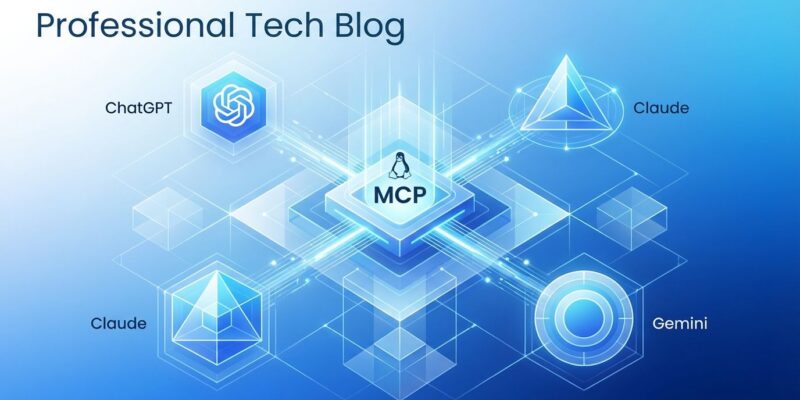
MCP is the standardized protocol for connecting AI models to external tools, data sources, and applications. Think of it as HTTP for AI agent interactions – a universal language that every AI platform can speak.
Before MCP, developers faced the “n×m integration problem.” Every AI client needed separate connections to every external system. Building an agent that worked across ChatGPT, Claude, and Copilot meant writing three different integration layers. MCP collapses this complexity into a single, vendor-neutral protocol.
The adoption numbers prove developers wanted this. Launched in November 2024, MCP reached 10,000+ active servers and 97 million monthly SDK downloads across Python and TypeScript within 13 months. GitHub Copilot alone generated 1M+ agent-authored pull requests in five months using MCP-based workflows. These aren’t demo metrics. These are production deployments.
Industry Consolidation Nobody Predicted
The Linux Foundation announced the Agentic AI Foundation (AAIF) on December 9, 2025, with founding contributions from three competitors who rarely agree on anything: Anthropic, Block, and OpenAI.
The Platinum member roster reads like an AI industry peace treaty: Amazon Web Services, Anthropic, Block, Bloomberg, Cloudflare, Google, Microsoft, and OpenAI. Eight companies. Most of them direct competitors. All betting on open standards over proprietary lock-in.
AAIF anchors on three founding projects. MCP provides the connectivity layer. Block’s goose offers an open-source agent framework. OpenAI’s AGENTS.md defines markdown conventions for coding agents (already adopted by 60,000+ open-source projects including GitHub Copilot and Cursor).
This isn’t charity. It’s strategic. Solo.io summarized it well: “Opening up the governance of these projects removes the fear of vendor lock-in, where expansion and decisions about the protocol could be changed at the whim of its owner.”
Why Vendor Lock-In Actually Matters
Enterprises building AI agent systems face a brutal choice: Commit to one vendor’s ecosystem and risk obsolescence, or build everything from scratch and burn engineering time.
Teams that committed early to proprietary platforms “often find themselves unable to adopt newer, better, or more cost-effective models without rewriting large portions of their stack,” as vendor lock-in analysis notes. Model performance gaps close and open, costs shift dramatically, and APIs change without warning. Proprietary integration debt compounds fast.
MCP’s neutral governance under Linux Foundation changes the calculus. GitHub explained it directly: “Neutral governance makes MCP a safer bet for enterprises requiring auditable, secure cross-platform integrations.” You can build on MCP today and switch between Claude, ChatGPT, Gemini, or whatever frontier model emerges next year without rewriting your tool connections.
Platform adoption proves this resonates. ChatGPT, Cursor, Microsoft Copilot, Gemini, Visual Studio Code, Claude, and GitHub Copilot all support MCP. Developers write integrations once. They run everywhere.
What 2026 Looks Like
Community consensus calls 2026 “the year of expansion” after 2025’s adoption phase. The MCP Registry grew 407% since its September launch. By 2026, expect the ecosystem layer to fill in: Server discovery tools, security and authentication services, monetization platforms, and faster development frameworks.
MCP Dev Summit hits New York City on April 2-3, 2026. Speaking calls, registration, and sponsorship opportunities are already open. Summit timing matters. It signals momentum past the “interesting experiment” phase into “critical infrastructure” territory.
Fortune 500 deployments are accelerating. In March 2025, OpenAI officially adopted MCP across ChatGPT, the Agents SDK, and the Responses API. That’s not a pilot. That’s production at scale.
The advice from infrastructure engineers is clear: Build on MCP now. Formal foundation governance reduces vendor lock-in risk. Competition will shift to who implements the standard best, not who controls it.
The Real Stakes
Open standards don’t guarantee outcomes. They guarantee choice. Kubernetes didn’t make containers work – Docker already did that. Kubernetes made container orchestration portable, predictable, and boring in the best possible way.
MCP is doing the same for agentic AI connections. It won’t make agents smarter. It will make agent development faster, cheaper, and less dependent on any single vendor’s roadmap.
Forty-seven founding members across Platinum, Gold, and Silver tiers suggests the industry sees this clearly. When OpenAI and Anthropic align on infrastructure standards, pay attention. When Microsoft, Google, and AWS join them, the decision is already made.
The competition now? Build better MCP servers. Optimize SDK performance. Create developer experiences that make integration trivial. Not who owns the protocol.
That’s how standards are supposed to work.