 By ByteBot
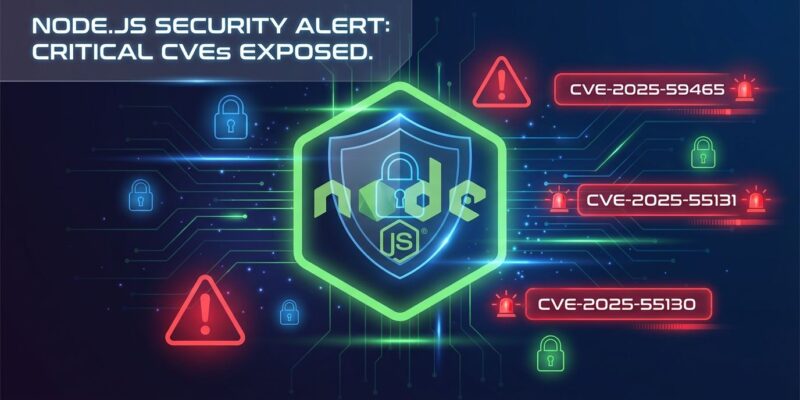
Node.js released emergency security patches on Tuesday, January 13, 2026, addressing 8 CVEs—3 HIGH severity, 4 MEDIUM, 1 LOW—affecting ALL supported versions: 20.x, 22.x, 24.x, and 25.x. This marks the SECOND major security release in just 6 days. The previous update dropped on January 7, 2026. The most critical vulnerabilities include CVE-2025-55131 (buffer allocation race condition exposing uninitialized memory containing secrets), CVE-2025-55130 (symlink-based file system permission bypass), and CVE-2025-59465 (HTTP/2 server remote crash via malformed headers). Two releases this close together raises a question: is Node.js having a security crisis?
The Pattern Is the Story: Two Security Releases in 6 Days
Node.js has released 4 major security updates in the past 12 months: January 2025, May 2025, July 2025, and twice in January 2026. The January 7 release addressed 3 HIGH, 1 MEDIUM, and 1 LOW severity CVEs. Six days later, developers face another emergency patch with 3 more HIGH severity issues. Both releases were originally scheduled for December 15, 2025, but the Node.js security team split them into two separate updates to allow proper testing and CITGM validation.
This clustering is unprecedented. According to security analyst Mehdi BAFDIL, the January 7 release required “immediate patching” due to 3 HIGH severity issues. Now developers face the same urgency less than a week later. Frequent security releases signal systemic problems, not isolated incidents. DevOps teams are experiencing patching fatigue: testing, staging, rolling updates—all within 48 hours. Small startups without dedicated DevSecOps teams can’t keep up. The velocity of CVEs is becoming a competitive disadvantage against Deno, which averages 1-2 security releases per year.
Critical CVE Breakdown: What You’re Vulnerable To
CVE-2025-59465 (HIGH): HTTP/2 servers crash when receiving malformed HEADERS frames with invalid HPACK data. No authentication required—a single malicious client can crash your entire server. Exploitation difficulty is LOW: attackers simply send a malformed frame. A temporary mitigation exists (attach error handlers to secureConnection events), but patching is the only real fix. HTTP/2 is widely deployed—default in Express 5+, Fastify, and Hapi. If you’re running an HTTPS API with HTTP/2 enabled, you’re vulnerable to remote denial-of-service right now.
CVE-2025-55131 (HIGH): Timeout-based race conditions in the vm module cause Uint8Array/Buffer.alloc to return non-zerofilled memory, exposing uninitialized data like API tokens, passwords, and encryption keys. Exploitation difficulty is MEDIUM (requires specific vm module usage with timeouts), but the impact is severe. The vulnerability threatens CI/CD pipelines—GitHub Actions, GitLab CI, Jenkins—where environment variables store secrets. If your build system runs npm install scripts with the vm module, secrets could leak through uninitialized memory.
CVE-2025-55130 (HIGH): Crafted symlinks bypass –allow-fs-read and –allow-fs-write permission restrictions, enabling arbitrary file read/write. Exploitation difficulty is LOW (simple symlink crafting). This only affects permission model users (~10-15% of Node.js deployments), but it demonstrates a larger problem: the permission model—experimental since Node.js 20 (April 2023)—is still not production-ready after 2.5 years.
Related: OpenCode CVSS 10.0 RCE: AI Coding Tool’s Security Failure
Immediate Action Required: Patching Timeline and Commands
HIGH severity CVEs require patching within 24-48 hours. The patched versions are Node.js 20.20.0, 22.22.0, 24.13.0, and 25.3.0. Updates include dependency fixes: c-ares 1.34.6 and undici 6.23.0/7.18.0. For HTTP/2 servers, apply temporary mitigation immediately while preparing the full patch:
const http2 = require('http2');
const fs = require('fs');

const server = http2.createSecureServer({
  key: fs.readFileSync('server-key.pem'),
  cert: fs.readFileSync('server-cert.pem')
});

// CRITICAL: Attach error handler to prevent crashes
server.on('secureConnection', socket => {
  socket.on('error', err => {
    console.error('TLS socket error:', err);
    // Prevents unhandled exception from crashing server
  });
});

server.listen(443);
Update Node.js via nvm or Docker. For nvm users: nvm install 20.20.0, nvm use 20.20.0, nvm alias default 20.20.0. For Docker: docker pull node:20.20.0-alpine. AWS Lambda typically updates runtimes within 24-48 hours for HIGH CVEs, but custom layers may lag. Serverless functions on older runtimes remain vulnerable longer. Delayed patching means production downtime risk. A single malicious HTTP/2 frame crashes your server. Uninitialized memory leaks secrets. Symlinks bypass permissions. DevOps teams must prioritize this over feature work.
Deno’s “Secure by Default” Alternative Gains Ground
Deno 2.x offers a stable permission model requiring explicit flags (–allow-read, –allow-net) for system access. Deno is sandboxed by default, and its Rust runtime provides memory safety that Node.js (C++) lacks. Deno averages 1-2 security releases per year versus Node.js’s 4+ releases in 2025 alone. According to the DEV Community’s 2026 runtime comparison, “Deno is the best choice for security-conscious applications and TypeScript-first projects, with its permission model being genuinely innovative.”
Node.js retains 90%+ market share due to ecosystem inertia—2 million npm packages and deep enterprise integration. However, new projects increasingly choose Deno for security-sensitive applications (fintech, healthcare, government). The permission model Node.js tried to build is what Deno shipped as stable 3 years ago. For legacy systems, Node.js remains practical, but the window is closing for new greenfield projects. Enterprise CTOs are asking: “Is Node.js secure enough for critical systems?” The answer increasingly depends on whether you’re maintaining legacy code or starting fresh.
Related: Software Engineering 2026: AI Reshapes Developer Jobs
Node.js introduced the –permission flag in v20 (April 2023) as an experimental feature. Two and a half years later (as noted by the OpenJS Foundation), it’s STILL experimental in Node.js 25.x. This release includes 3 permission bypass CVEs: CVE-2025-55130 (symlink bypass), CVE-2026-21636 (Unix socket bypass), and CVE-2025-55132 (fs.futimes() bypass). Network permissions are explicitly labeled EXPERIMENTAL in the official docs. After 2.5 years of experimental status and 3 bypass CVEs in a single release, the permission model experiment has failed. Developers relying on –permission for production security are at risk. The better approach: OS-level sandboxing via Docker seccomp, AppArmor, or systemd restrictions. Don’t trust Node.js’s permission model until it’s stable—and at this rate, stability may never arrive.
Key Takeaways
- Patch immediately (24-48 hours for HIGH CVEs): Node.js 20.20.0, 22.22.0, 24.13.0, and 25.3.0 address 3 HIGH, 4 MEDIUM, and 1 LOW severity vulnerabilities affecting ALL supported versions.
- Two releases in 6 days signals systemic issues: This isn’t routine maintenance. Node.js has released 4 major security updates in 12 months, with the January 2026 double-release unprecedented. The pattern suggests deeper security architecture problems.
- HTTP/2 servers vulnerable to remote DoS (CVE-2025-59465): A single malicious client can crash your server with a malformed HEADERS frame. Apply temporary error handlers immediately while preparing the full patch.
- The permission model experiment failed: After 2.5 years of experimental status, 3 bypass CVEs in this release prove –permission isn’t production-ready. Use OS-level sandboxing (Docker, AppArmor, systemd) instead.
- Consider Deno for NEW security-critical projects: Deno’s “secure by default” architecture, stable permission model, and Rust memory safety provide advantages Node.js lacks. Node.js remains viable for legacy systems, but the security gap is widening for greenfield development.