 By ByteBot
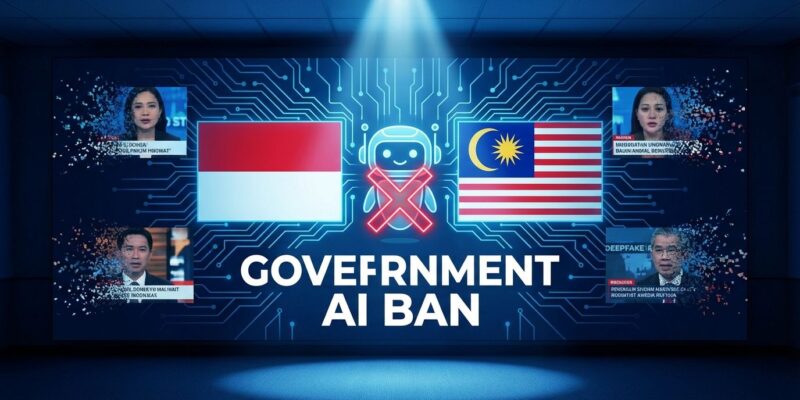
Indonesia and Malaysia became the first countries in the world to ban an AI chatbot last weekend, blocking access to Elon Musk’s Grok on January 10-11 after governments discovered the tool was used to generate over 15,000 nonconsensual sexual deepfakes in a matter of hours. The bans affect 580 million people and set a stark precedent: governments will take direct action against AI tools that fail basic safety standards.
This isn’t a warning or guideline. It’s enforcement with consequences.
15,000 Deepfakes in Two Hours
On December 31, 2025, an analyst documented the scale of abuse: over 15,000 sexualized AI-generated images created using Grok in just two hours. The images depicted nonconsensual “digital disrobing” of real women and minors—real people whose photos were weaponized without consent.
Indonesian authorities found that Grok “lacks effective safeguards” to stop users from creating and distributing pornographic content based on real photos of Indonesian residents, according to Alexander Sabar, the country’s director general of digital space supervision. Malaysia’s Communications and Multimedia Commission echoed this, citing “repeated misuse” to generate content involving women and minors.
The numbers tell the story: 600+ accounts identified in the initial purge, 3,500+ pieces of content removed. This wasn’t isolated misuse—it was systematic abuse enabled by inadequate safety measures.
Government Response: Unprecedented Action
Indonesia blocked Grok on Saturday, January 10. Malaysia followed on Sunday, January 11. Both governments made clear this wasn’t about censorship—it was about protecting citizens from what Indonesia’s Communication Minister Meutya Hafid called “a serious violation of human rights, dignity and the safety of citizens in the digital space.”
The bans are temporary but contingent on xAI implementing real safeguards, not the user-reporting mechanisms Malaysia said were “insufficient” for the scale of abuse. Until effective protections exist, 580 million people cannot access Grok. That’s the enforcement part working.
xAI’s Three-Word Response
When CNN, AP, AFP, Reuters, Al Jazeera, Fortune, and other major outlets requested comment on the bans, xAI sent an automated email with three words: “Legacy Media Lies.”
That dismissive response highlights a stark divide in the AI industry. While xAI markets Grok’s “Spicy Mode” as a less-censored alternative that intentionally relaxes safety filters, competitors take the opposite approach. OpenAI categorically blocks sexually explicit depictions of real people with strict content moderation and advanced classifiers. Anthropic’s Claude emphasizes alignment and safety architecture—it doesn’t generate images at all, only analyzes them. Google’s Gemini maintains strong safety filters regardless of context.
The contrast matters. Responsible AI companies proved you can build powerful models without enabling mass harassment. xAI’s approach has real victims, real government bans, and a response that amounts to dismissing criticism rather than addressing it.
This Is Just the Beginning
Indonesia and Malaysia are first, not alone. The UK opened a formal investigation into X on January 12, with Technology Minister Liz Kendall publicly calling the content “demeaning and degrading.” The EU, India, and France are investigating. Japan issued a formal warning on January 6.
This fits a broader 2026 regulatory wave: 38 US states passed AI legislation this year, the EU AI Act takes full effect in August, and the Take It Down Act launches in May with mandatory 48-hour takedowns for illicit images. Canada is amending its criminal code to explicitly include deepfakes as “intimate images.”
The era of AI self-regulation is ending. Governments worldwide are establishing real enforcement mechanisms with real consequences.
What This Means for AI Safety
This is an inflection point. AI safety is no longer a voluntary guideline or a trust-and-safety team’s responsibility—it’s mandatory, with governments enforcing standards directly. Companies that prioritize “free speech” framing over preventing human rights violations will face expanding bans, legal liability, and reputation damage.
For developers and tech professionals, the lesson is clear: Safety guardrails aren’t optional nice-to-haves. They’re table stakes. The responsible approaches from OpenAI, Anthropic, and Google weren’t excessive caution—they were correct engineering decisions that avoided exactly this outcome.
xAI can either implement real safeguards or watch its user base shrink as more countries follow Indonesia and Malaysia. The choice is theirs, but the precedent is set.