 By ByteBot
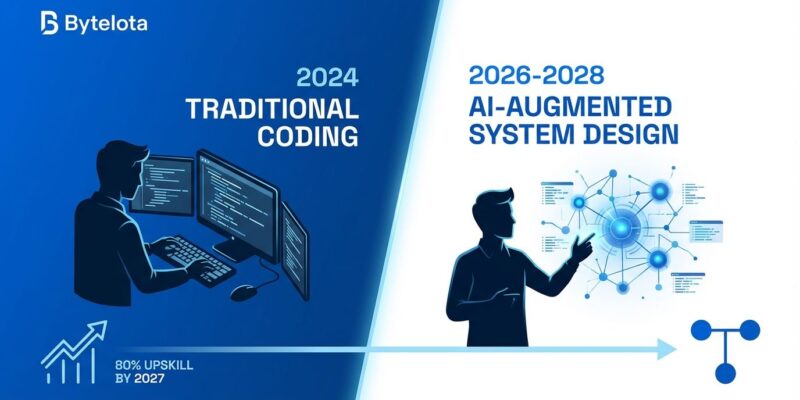
Software engineering faces a data-backed paradox: Harvard research shows companies adopting AI cut junior developer hiring by 9-10% within six quarters, and Big Tech hired 50% fewer fresh graduates over the past three years. Yet the U.S. Bureau of Labor Statistics projects 15% job growth for software developers through 2034—five times faster than the average occupation. The resolution lies not in job displacement, but role transformation. Developers are transitioning from code writers to AI-augmented system designers, with Gartner predicting 80% of engineers must upskill by 2027.
This isn’t speculation. It’s backed by studies analyzing 62 million workers, official BLS projections, and analysis from Google Chrome team’s Addy Osmani (trending on Hacker News with 241 points, 248 comments). Every developer and tech leader needs a data-driven understanding of where the industry is heading.
Why Junior Hiring Drops While Jobs Grow
The numbers paint a clear picture. Harvard’s study of 62 million workers found companies adopting generative AI reduce junior developer hiring by 9-10% within six quarters of implementation. Big Tech amplifies this trend: fresh graduate hiring fell 50% over three years. Meanwhile, unemployment for recent computer engineering grads sits at 7.5%—nearly double the 4.3% national rate.
Yet software developer jobs are expanding, not contracting. BLS data projects 15% growth from 2024 to 2034, creating 129,200 annual openings. That’s five times the 3% average growth rate across all occupations. Starting from 1.7 million developers in 2024, the industry will add roughly 250,000 jobs by 2034.
Both trends are real because AI enables software expansion into new industries. Healthcare systems, agricultural operations, manufacturing plants, and financial services are all building software teams—domains that traditionally employed few developers. Entry-level roles in these sectors require different skills than traditional tech companies: domain expertise, communication, and problem decomposition matter more than pure coding ability. Junior competition intensifies in traditional tech while opportunities emerge in non-traditional sectors.
Gartner’s Three-Phase AI Transformation Timeline
Gartner predicts AI will transform software engineering in three distinct phases. Phase one (2025-2026) brings modest productivity gains as AI tools complement existing workflows. Senior developers in mature organizations see the primary benefits—AI handles boilerplate while humans focus on architecture.
Phase two (2026-2027) marks the shift to “AI-native software engineering.” AI agents automate tasks end-to-end, generating most code while humans review and guide. This is when 80% of engineers must complete upskilling, according to Gartner’s survey of 300 US and UK organizations. Already, 84% of developers use AI assistance regularly. By 2027, non-adoption means career risk.
Phase three (2027 onward) establishes “AI engineering” as a distinct discipline requiring software engineering, data science, and machine learning expertise combined. New roles solidify: AI engineers (56% of leaders cite this as their top hiring priority), prompt engineers, and RAG specialists. Philip Walsh, Gartner’s analyst, emphasizes: “Human expertise and creativity will always be essential to delivering complex, innovative software.” The role changes, but doesn’t disappear.
Related: AI Verification Bottleneck: 96% Don’t Trust AI Code
The Skills That Actually Matter in Software Engineering 2026
Addy Osmani’s analysis identifies the critical skill shift. Becoming obsolete: rote coding, language syntax mastery, routine debugging. Gaining value: system design, architecture, security analysis, code review, communication, domain expertise, and—crucially—understanding when AI is wrong.
The winning profile is “T-shaped”: deep expertise in ONE specialty (the vertical bar) plus broad capabilities across many areas (the horizontal bar). AI accelerates horizontal learning. A backend specialist can now rapidly learn frontend, infrastructure, or security basics using AI as a learning tool. But the deep vertical expertise remains irreplaceable. As Osmani puts it: “Anyone can generate code. Not everyone can design systems that work well over time. The ability to design systems that are maintainable, scalable, and clear becomes more valuable when code is cheap.”
For junior developers, the strategy shifts from code memorization to AI-augmented productivity. GitHub’s guidance is clear: “New learners are well positioned to thrive because they’re coming into the workforce already savvy with AI tools.” The formula: master AI tools like Cursor and Claude Code, build a public portfolio demonstrating understanding (not just copy-paste), and develop communication skills to translate technical concepts. Forty-five percent of engineering roles now expect proficiency in multiple domains—specialization alone doesn’t cut it.
Senior developers face role evolution, not obsolescence. The traditional 80% coding, 10% meetings, 10% planning split inverts to 60% architecture and code review, 30% mentoring and collaboration, 10% hands-on coding. Seniors become quality guardians and complexity experts. CIO Magazine frames it: “The best software engineers will be those who know when to distrust AI, validating output and checking for edge cases, security risks, and logic gaps.”
Career Strategies and the Slow Decay Risk
Companies face a critical decision: cut junior hiring for short-term efficiency, or maintain the talent pipeline despite AI productivity gains. Addy Osmani warns of “slow decay”—cut juniors today, face a leadership vacuum in 5-10 years when there are no mid-level engineers to promote. Today’s juniors are tomorrow’s tech leaders. Institutional knowledge doesn’t transfer through AI.
The data supports his concern. Big Tech’s 50% reduction in graduate hiring over three years prioritizes experienced engineers who can immediately leverage AI tools. Smaller teams accomplish more: three AI-fluent engineers match ten traditional hires’ output. But this creates downstream risk. Without junior developers learning from seniors, who mentors the next generation? Who maintains legacy systems when current experts retire?
Smart organizations adopt a balanced approach. Maintain junior hiring at reduced but sustainable levels. Create apprenticeship programs where new developers learn by working alongside AI-augmented seniors. Invest in mentorship despite productivity pressures. And shift hiring criteria: 45% of companies now eliminate bachelor’s degree requirements, favoring portfolio-first evaluation. Demonstrated AI-assisted work with clear explanations matters more than credentials.
For individual developers, the strategy depends on career stage. Juniors must position themselves as “one junior plus AI equals a small team”—demonstrating they’re productivity multipliers, not junior-level-only contributors. Contribute to open source, build real projects (not tutorials), and explain every design decision. Seniors should sharpen architecture and security expertise, becoming the humans who spot what AI misses. Jellyfish’s survey shows 67% of organizations predict 25%+ velocity increases from AI in 2026—but only for teams that deeply integrate these tools, not those who resist adoption.
Related: Platform Engineering ROI in 2026: Business Metrics Win
Key Takeaways
- The paradox is real: junior competition intensifies (9-10% hiring drop) while overall jobs grow (15% through 2034). AI enables software expansion into healthcare, agriculture, and manufacturing—new domains need developers with domain expertise over pure coding skills.
- Gartner’s three-phase timeline provides concrete planning milestones: AI complementarity now, AI-native workflows by 2027, AI engineering discipline by 2028. Eighty percent of engineers must upskill by 2027—non-adoption means career risk.
- T-shaped profiles win: deep expertise in one specialty plus broad capabilities across many areas. AI accelerates horizontal learning while humans maintain irreplaceable vertical depth in system design, architecture, and knowing when AI is wrong.
- Junior strategy: master AI tools, build public portfolios with clear explanations, develop communication and domain expertise. Senior strategy: evolve from coder to conductor, spending 60% on architecture/review, 30% on mentoring, 10% on coding.
- Engineering leaders must resist short-term efficiency pressures that cut junior hiring entirely. The “slow decay” risk is real: no juniors today means no senior engineers in 5-10 years, creating leadership vacuums and institutional knowledge loss.
Software engineering isn’t dying—it’s evolving faster than most anticipated. The data shows both challenge and opportunity. Those who adapt by combining AI fluency with uniquely human skills will find expanding opportunities, not shrinking ones.
—