 By ByteBot
On January 5, researchers from UC San Diego and Cornell published findings that should make AI coding vendors nervous: in a study of 99 professional developers, zero participants allowed AI agents to operate autonomously. Not one. Every single experienced developer maintained strict control, with nine out of thirteen reviewing AI-generated code line-by-line. This directly contradicts the billion-dollar narrative that AI can autonomously generate production code.
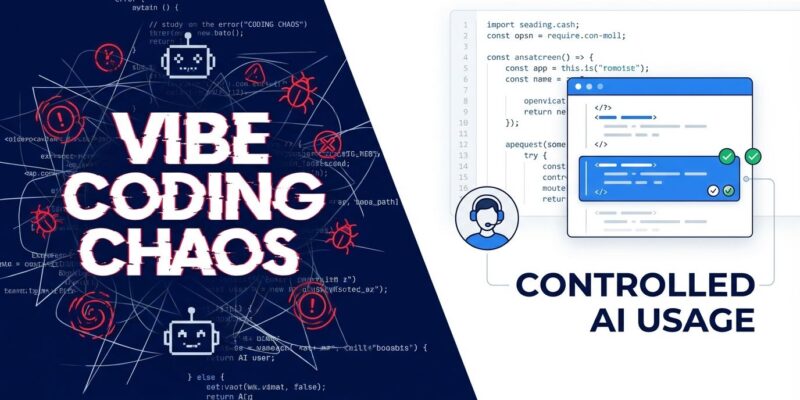
The researchers’ conclusion cuts through the marketing hype: “Professional developers do not vibe code. Instead, they carefully control the agents through planning and supervision.” When 85% of developers use AI tools daily but 48% insist on staying hands-on for core tasks, something doesn’t add up. Either developers are resisting progress, or the industry is overselling what AI coding tools can actually do.
What “Vibe Coding” Actually Means (And Why It’s Being Hyped)
“Vibe coding” means delegating design decisions to AI—essentially closing your eyes and trusting the algorithm to handle implementation. Cursor’s CEO describes it as developers who “don’t look at the code at all” and just prompt AI to build features. The promise is seductive: autonomous code generation, faster delivery, democratized development. AI as autopilot, not copilot.
But here’s the problem. When researchers observed actual professional developers using AI agents, they found the opposite behavior. Developers used extensive context in prompts—UI elements, technical terms, domain objects, specific libraries. They planned meticulously. They validated everything. One developer captured the consensus perfectly: “I like coding alongside agents. Not vibe coding. But working with.”
Where AI Coding Tools Fail: Business Logic and Legacy Code
On the same day the research dropped, Pedro Domingos—University of Washington professor and author of “The Master Algorithm”—posted a blunt assessment: “AI coding tools don’t work for business logic or with existing code.” The research backs him up with hard numbers.
Business logic tasks? Fifteen developers reported AI agents unsuitable, only two found them suitable. That’s a 7.5-to-1 failure ratio. Legacy code integration fared worse: seventeen developers struggled, three succeeded. Complex tasks, performance optimization, security-critical code—all failed at similar rates.
What actually works? Tests, documentation, and simple refactoring. In other words, AI coding tools excel at the boilerplate nobody wants to write anyway. But business logic—the code that generates revenue—remains firmly in human hands. If AI can’t handle the work that matters, calling this a “productivity revolution” is generous.
Even AI Coding CEOs Warn About Vibe Coding
When the CEO of an AI coding tool warns against overusing his own product, pay attention. Michael Truell, who runs Cursor with a million daily users, cautions that vibe coding builds “shaky foundations” that eventually “crumble” as features pile up. He compares it to constructing a building without understanding the foundation—it looks fine until you add weight.
Stack Overflow’s data confirms the problem: 66% of developers using AI coding tools hit a “productivity tax”—spending more time fixing AI-generated code than they saved generating it. One Stack Overflow engineer built a bathroom-rating app through vibe coding. The code worked initially but was a mess: no security protections, inlined styling, oversized components, missing tests. It would violate GDPR the moment it touched user data.
This is the technical debt nightmare everyone’s warning about. Vibe coding might ship features fast, but maintenance becomes exponentially harder when nobody understands the generated code. Refactoring is painful. Testing requirements explode. Complex bugs multiply. And system design flaws force expensive rewrites down the road.
Expert Skepticism Is Professional Wisdom, Not Resistance
The narrative that experienced developers are “resisting change” by refusing to vibe code is backwards. They’re not afraid of AI—85% use it daily. They’re skeptical because they understand the limitations. When you’ve debugged enough production incidents, you learn that code without understanding creates disasters.
Sixty-seven survey respondents prioritized software quality attributes like correctness and readability. Sixty-five cited existing development expertise as essential for validating AI outputs. Twelve emphasized that AI “cannot replace human expertise or decision making.” One developer’s warning to junior engineers captures this perfectly: “It’s still really important to know what you’re doing.”
That last point matters. Vibe coding assumes AI can replace expertise, but the opposite is true. Junior developers need more training to validate AI-generated code, not less. When non-technical creators build applications handling sensitive data through vibe coding, they create security nightmares—apps with zero protections touching personal information, violating regulations they don’t understand.
The Real Productivity Boost: Copilot, Not Autopilot
Expert developers aren’t rejecting AI coding tools. They’re rejecting the “close your eyes and trust” approach. The research shows they value AI for specific tasks—generating tests, writing documentation, handling boilerplate. But they maintain control over architecture, business logic, and design decisions. They review outputs. They validate correctness. They treat AI as an assistant, not a replacement.
This is the sustainable path forward. Use AI to accelerate the tedious parts of development. Let it handle repetitive patterns. But don’t delegate understanding. Don’t outsource judgment. And definitely don’t vibe code your way into production.
The researchers studied late 2025 AI models—GPT-5, Claude Sonnet 4. Future models might improve, but the fundamental challenges remain. AI can’t understand your business domain. It can’t grasp decades of architectural decisions embedded in legacy code. It can’t weigh trade-offs the way an experienced developer can.
So when expert developers maintain strict control over AI agents, they’re not being stubborn. They’re being professional. The real question isn’t why experienced developers won’t vibe code. It’s why anyone thought they would.