 By
By Enterprises are wasting $200 billion annually on cloud infrastructure—a staggering 32% of total cloud budgets that hit $723.4 billion in 2025, according to cloud wastage statistics. Despite widespread FinOps tool adoption and growing cost awareness, baseline waste persists at 28-35% across organizations. The problem isn’t lack of tools or visibility. Instead, FinOps has shifted from a finance-led initiative to a platform engineering responsibility, yet 40% of practitioners say getting engineers to act on cost optimization remains their biggest challenge, as revealed in the State of FinOps 2025 report.
Moreover, the cultural shift from finance-owned to engineering-owned cost optimization is happening now in 2026, but organizations lack the processes and accountability frameworks to make it work. Only 43% have full visibility into idle cloud resources, and even those with visibility struggle to translate cost awareness into action. Consequently, tools exist, visibility exists, but waste persists because this is a people and process problem—not a tooling problem.
Where the $200B Goes: Breaking Down Cloud Waste
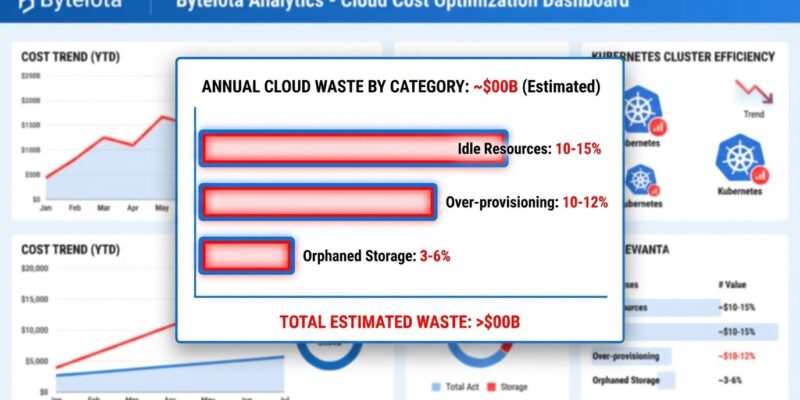
Cloud waste breaks into four categories, each representing billions in preventable spending. First, idle resources account for 10-15% of monthly cloud spend—development environments running outside business hours, abandoned test clusters, forgotten instances. The numbers are brutal: 44% of compute spend goes to non-production resources that sit idle 76% of the time (128 out of 168 hours per week).
Second, over-provisioning contributes another 10-12% in waste. Forty percent of instances run at least one size larger than needed, while companies analyzing Kubernetes spend find applications over-provisioned by 30% on average. The root cause? Conservative autoscaling, a “better safe than sorry” mentality, and zero feedback loops on rightsizing decisions. Engineers provision resources for peak load that never comes, then forget to scale back down.
Third, orphaned storage represents 3-6% of avoidable spend—detached volumes, abandoned snapshots, unattached disks that persist indefinitely because no one’s checking. Storage lifecycle policies alone yield 45-55% savings, yet most organizations don’t implement them. Meanwhile, data transfer waste shows 45-55% optimization potential in cross-region and cross-AZ charges that appear invisible until the bill arrives.
Each category demands different solutions. Idle resources need scheduling automation, over-provisioning requires rightsizing feedback loops, orphaned storage needs lifecycle policies, and data transfer requires architecture review. However, you can’t fix what you don’t measure, and most organizations only track one or two of these categories systematically.
The Kubernetes Attribution Nightmare
When 50 services share a Kubernetes node pool, traditional cloud billing reports become worthless, as explained in the FinOps tools evaluation for 2026. You can’t attribute costs to teams, services, or projects because containers fundamentally break the assumptions underlying traditional infrastructure accounting. Furthermore, this isn’t a minor inconvenience—it’s why platform engineers inherit cost optimization responsibility but lack the tools finance teams had for VMs.
Three factors kill cost attribution in Kubernetes environments. First, ephemeral infrastructure means containers spin up and disappear within minutes, making CPU, memory, and disk aggregation nearly impossible with traditional tools. Second, dynamic scaling creates chaos: CI/CD pipelines scale automatically based on demand, and pinpointing which tenant used specific resources becomes “even trickier,” as one platform engineering analysis put it. Third, multi-tenant clusters share infrastructure across teams, but without sophisticated metering, it’s nearly impossible to answer the fundamental question: who’s driving spend, and by how much?
Modern solutions exist but require discipline most teams lack. AWS launched Split Cost Allocation Data in 2025, letting you import Kubernetes labels as user-defined cost allocation tags. Additionally, Kubecost and OpenCost track usage by namespace or labels like cost-centre=finance or tenant=acme-corp. The best practices sound simple: organize workloads into namespaces reflecting team boundaries, tag every namespace consistently with cost centers and ownership, automate attribution so monitoring platforms use labels automatically.
The gap? Label discipline. Without consistent tagging schemes rigorously maintained, label drift makes attribution impossible again within months. Finance teams get monthly bills 30 days after over-provisioned resources hit production. By then, it’s too late to prevent the spend—you’re just documenting the damage.
Finance Teams Can’t Optimize What They Don’t Understand
FinOps underwent a radical ownership shift between 2024 and 2026: from centralized, finance-driven activity to what one analysis calls “a core capability of the platform engineer’s toolkit.” The old model is broken. Finance teams owned procurement and cost management when infrastructure was static and predictable. Engineering submitted requests, Finance approved or denied. That worked for on-prem data centers with three-year hardware cycles.
However, it fails spectacularly for Kubernetes. Finance teams cannot optimize Kubernetes costs because they don’t understand the technical decisions driving spending. Why do engineers need 50 cores for this service? What’s a reasonable memory allocation for that workload? When finance asks these questions, engineers struggle to translate technical requirements into financial terms. Conversely, when engineers explain their needs, finance teams can’t evaluate if the resource request is appropriate or wasteful.
The new reality in 2026: platform engineers own cost optimization whether they want to or not. Self-service cloud platforms enable engineers to provision resources independently, which is powerful—and dangerous. Ungoverned self-service leads to infrastructure sprawl. Nevertheless, engineers don’t prioritize financial concerns amid focus on performance, reliability, and feature delivery.
The State of FinOps survey reveals the magnitude of this problem: 40% of FinOps practitioners say getting engineers to act on cost recommendations is their #1 challenge. Moreover, 52% address this through “Culture, Change and Collaboration” tactics, with 30% specifically citing “Celebrating Successes” as a technique to improve responsiveness. The cultural divide runs deep. Finance teams frame problems as “Your service costs too much” (blame-focused). Engineering teams hear this as criticism, not actionable feedback. Consequently, the FinOps Foundation recommends reframing: “Your service is generating waste” shifts the focus from blame to efficiency, making engineers more receptive to optimization efforts.
Why FinOps Tools Alone Don’t Work
Despite 10+ mature FinOps tools and growing cost visibility, baseline waste remains stuck at 28-35% of cloud spend. The visibility paradox is real: only 43% have full visibility into idle cloud resources, only 39% into unused or orphaned resources, and only 33% into over or under-provisioned workloads. Furthermore, even teams with comprehensive visibility struggle to translate it into optimization actions.
Tools fail for structural reasons. Most cloud cost tools show bills 30 days later, after over-provisioned resources already hit production—this is pure documentation, not prevention. Dashboard fatigue sets in when cost information lives in separate tools requiring context switching and dedicated logins. Engineers want cost feedback embedded in their workflows (IDEs, CI/CD pipelines), not another dashboard to check. Additionally, expertise barriers compound the problem: tools like Kubecost require deep Kubernetes knowledge for effective use, creating obstacles for smaller teams without dedicated platform engineering.
The 2026 FinOps tool landscape spans three tiers. Enterprise solutions like IBM’s suite (Cloudability plus Turbonomic plus Kubecost), Flexera, and CloudHealth from Broadcom offer comprehensive coverage and satisfy finance teams with strong executive reporting. Meanwhile, cloud-native platforms like Datadog, Cast AI, and CloudZero prioritize developer experience with API-first architectures and Kubernetes integration. Finally, emerging specialists like Finout (real-time monitoring), Wozz (pre-deployment cost linting), and ProsperOps (AI-based rate optimization) tackle specific pain points with innovative approaches.
Yet waste persists across all three tiers. AI-based optimization claims to reduce waste by “up to 30%” through tools like ProsperOps and Turbonomic, but adoption doesn’t equal results. The community’s frustration shows in Hacker News discussions where developers complain that tools “only show bills 30 days later, after over-provisioned resources are already in production.” What developers actually want: prevention over detection, real-time cost feedback before deployment, automated rightsizing that doesn’t require manual review of dashboards.
The Path Forward: Shared Responsibility and Embedded Cost Awareness
The solution isn’t more sophisticated tools or better visibility dashboards. Instead, it’s shared responsibility frameworks that make cost optimization everyone’s job, with automated guardrails and real-time feedback loops. Organizations succeeding at FinOps in 2026 aren’t the ones with the most expensive tools—they’re the ones with the clearest ownership and the strongest cultural alignment.
Shared responsibility means Finance brings budget constraints, forecasting, and reporting. Engineering owns technical decisions, resource sizing, and architecture choices. Platform Engineering provides cost visibility tools, automation, and guardrails. Product teams make trade-offs between user value and cost. Meanwhile, Leadership must prioritize financial governance alongside operational agility—without executive buy-in, FinOps initiatives stall regardless of tool quality.
Embedding cost awareness into workflows matters more than centralized reporting. Real-time cost feedback in CI/CD pipelines catches expensive configurations before they hit production. Pre-deployment cost linting (tools like Wozz) prevents waste rather than documenting it. IDE integrations surface cost impacts during development, not weeks later during billing reconciliation. Furthermore, automated rightsizing recommendations that engineers can accept with a single click beat lengthy reports requiring manual analysis.
The dialogue shift matters too. Stop saying “Your service costs too much” and start saying “Your service is generating waste.” The first sounds like blame and triggers defensiveness. The second frames the problem as efficiency and invites collaboration. Therefore, celebrate engineering teams that reduce waste instead of only flagging overspending. Recognition drives behavior change faster than finger-pointing.
Looking ahead to 2027, governance and policy enforcement will overtake workload optimization as the #1 FinOps priority—a signal of maturity from reactive cost-cutting to proactive guardrails. Additionally, AI-powered autonomous optimization will reduce manual FinOps overhead. Multi-scope complexity will increase as teams must handle Cloud, SaaS, AI infrastructure, licensing, and data centers with different optimization approaches for each.
Key Takeaways
- $200B wasted annually (32% of cloud spend) proves FinOps tools alone don’t solve the problem—organizations need cultural change and shared responsibility frameworks where Finance, Engineering, and Platform teams collaborate instead of working in silos.
- Kubernetes breaks traditional cost tracking: When 50 services share node pools, standard cloud billing becomes useless. Label-based attribution works (Kubecost, OpenCost, AWS split cost allocation) but requires consistent tagging discipline that most teams lack.
- The ownership crisis is real: Finance teams can’t optimize Kubernetes costs they don’t understand technically, while platform engineers inherit cost responsibility without training or accountability. Forty percent of FinOps practitioners say getting engineers to act is their #1 challenge.
- Visibility doesn’t equal action: Only 43% have full visibility into idle resources, and even those struggle to translate cost awareness into optimization. The gap: 30-day delayed bills, dashboard fatigue, and lack of real-time feedback in developer workflows.
- Embed cost awareness everywhere: Real-time feedback in CI/CD pipelines and IDEs beats separate dashboards. Shift dialogue from blame (“costs too much”) to efficiency (“generating waste”). Build shared responsibility where everyone owns their cloud usage with central best-practices support.