 By ByteBot
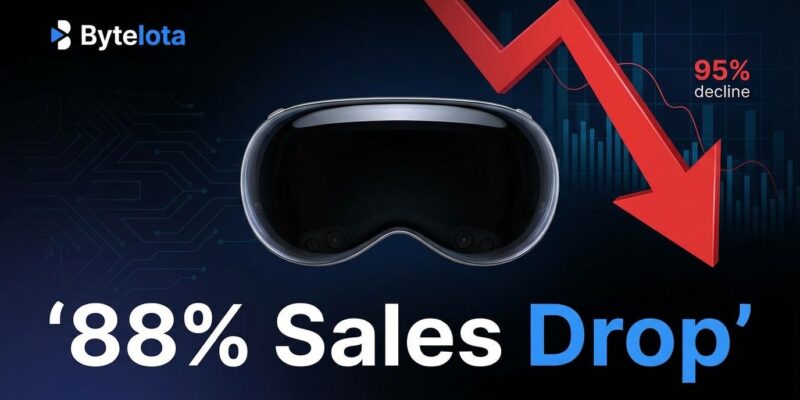
Apple Vision Pro Sales Plunge 88%—95% Budget Cut
Apple has effectively admitted defeat on the Vision Pro. The company slashed its marketing budget by 95% and halted production after shipping just 45,000 units in Q4 2025—an 88% collapse from the 390,000 units sold in all of 2024. Manufacturing partner Luxshare stopped production entirely at the start of 2025, with existing inventory deemed sufficient to meet demand through the year.
For a company that turned smartphones, tablets, and smartwatches into multi-billion dollar markets, this is a rare and spectacular failure. The numbers tell you everything you need to know about why Apple Vision Pro sales collapsed.
The Three Reasons Vision Pro Failed
Morgan Stanley analyst Erik Woodring nailed the post-mortem: “The cost, form factor and the lack of VisionOS native apps are the reasons why the Vision Pro never sold broadly.” Let’s break down each failure point.
Cost: $3,499 Is an Insurmountable Barrier
Apple bet that consumers would pay premium pricing for spatial computing the same way they paid for premium smartphones. However, they were wrong. IDC’s data shows the market exists—Meta shipped 1.7 million Quest headsets in just the first three quarters of 2025. But Meta Quest sells for $349, one-tenth the price of Vision Pro.
The VR market isn’t dead. Apple just priced itself out of it.
Form Factor: Nobody Wants to Wear a Brick
Vision Pro’s bulky design was uncomfortable for extended use. Moreover, the M5 chip upgrade in October 2025 boosted performance by 35% and extended battery life to 2.5 hours, but it didn’t make the headset lighter or more wearable. Sales impact was minimal—IDC still projected only 45,000 units for the holiday quarter.
This proves the problem wasn’t technical specs. Instead, nobody wanted to strap a $3,500 computer to their face for more than a few minutes.
Apps: Where’s the Ecosystem?
Vision Pro launched with approximately 3,000 native visionOS apps. For comparison, the iPhone App Store had tens of thousands of apps within its first year. Furthermore, developers didn’t rush to build for Vision Pro because the installed base was too small to justify investment. It’s a classic chicken-and-egg problem, except Apple usually solves this by shipping millions of devices at launch. They didn’t.
Meta Quest Won Because It Was Accessible
Here’s the market reality that torpedoes the “spatial computing is dead” narrative: Meta Quest dominates with 84% market share. Meanwhile, Vision Pro captured just 5.2%. Meta shipped 1.7 million units in nine months while Vision Pro shipped 45,000 in a quarter.
The difference? Meta sold a $349 gaming console for VR enthusiasts. Conversely, Apple sold a $3,499 productivity tool for… who, exactly? The data shows 75% of Vision Pro buyers are businesses, not consumers. Apple built an enterprise device but marketed it as a consumer product. That’s a positioning failure, not a technology failure.
The M5 Upgrade Proved Apple Misunderstood the Problem
Apple’s October 2025 refresh brought the M5 chip with 35% better performance, ray tracing, mesh shading, and improved battery life. However, sales didn’t budge. Why? Because faster processing doesn’t solve any of the core problems. The device was still too expensive, too bulky, and lacking essential apps.
Apple tried to solve a specs problem when they had a market positioning problem. That’s expensive mistake number one.
Apple’s Pivot to Smart Glasses Admits the Obvious
In 2025, Apple paused Vision Pro updates and shifted engineering resources to smart glasses and AI-enabled wearables. This pivot tells you everything: Apple now understands that form factor matters more than specs for wearables.
Smart glasses address the bulk problem Vision Pro never solved. Consequently, they’re lighter, more wearable, and crucially, they don’t require consumers to strap a computer to their face. Apple learned this lesson the expensive way—after shipping 500,000+ units that few people wanted.
Key Takeaways for Developers
Vision Pro’s failure offers three critical lessons for anyone building hardware or new platforms:
Premium doesn’t always win in immature markets. Apple’s brand power works when the category is proven. Nevertheless, in new categories, accessible beats premium until the market matures.
Form factor beats specs for wearables. Vision Pro’s technical superiority was commercially irrelevant because nobody wanted to wear it for extended periods. Meta understood this; Apple didn’t.
Ecosystem is everything. Without apps, the best hardware is just an expensive paperweight. Apple usually bootstraps ecosystems by shipping millions of devices. Vision Pro’s high price prevented that critical mass.
Spatial Computing Isn’t Dead—Just Apple’s Version of It
The broader VR market is struggling—global shipments fell 14% year-over-year in 2024, the third consecutive annual decline. However, Meta Quest’s success proves demand exists at the right price point. Apple bet that premium would create a new category. Instead, they learned that in emerging markets, accessible wins first, premium comes later.
Vision Pro’s failure is rare for Apple, but it’s instructive. Sometimes the market tells you that your product-market fit is wrong. Apple just spent $3,499 per unit to learn that lesson.