 By ByteBot
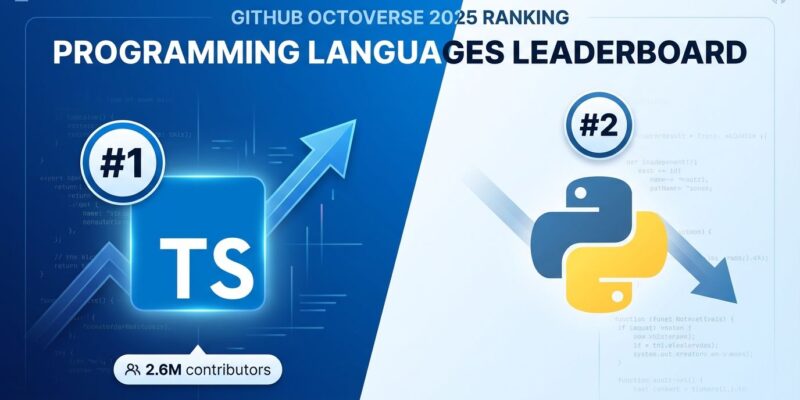
In August 2025, TypeScript overtook Python to become GitHub’s most-used language—the first time the ranking has shifted in over a decade. But here’s what actually matters: 94% of errors from AI coding assistants are type-related. TypeScript catches them automatically. Python doesn’t. That’s not correlation—that’s causation. AI didn’t just make TypeScript popular. It made type safety non-negotiable.
The Numbers Don’t Lie
TypeScript hit 2.6 million monthly contributors on GitHub, surpassing Python by roughly 42,000 developers. That’s a 66% year-over-year spike—adding 1.05 million contributors in a single year. This isn’t a gradual shift. It’s a structural change in how production code gets written.
Enterprise teams saw this coming. TypeScript adoption among enterprise applications jumped to 69%, with 78% of enterprise teams now using it as their primary language. Major frameworks made the decision for developers: Next.js 15, Angular 18, SvelteKit 2, and Astro 3 all default to TypeScript. When you scaffold a new project today, you start with TypeScript—not JavaScript. That’s not a preference. That’s the new baseline.
The error reduction metrics tell the real story. Airbnb found that 38% of their production bugs would have been caught by TypeScript’s compiler. A MedTech startup that migrated in 2026 saw a 73% reduction in production bugs within six months. These aren’t edge cases. They’re the new normal for teams that take reliability seriously.
AI Changed the Game
Here’s the part most coverage misses: academic research from 2025 found that 94% of LLM-generated compilation errors are type-check failures. When GitHub Copilot or ChatGPT writes your code, it hallucinates types constantly. In JavaScript, those errors ship to production. In TypeScript, they get caught at compile time.
Anders Hejlsberg, TypeScript’s creator, put it plainly: the project evolved from a “human collaboration tool to a machine-assisted coding platform.” Type constraints don’t just help developers—they give AI models clearer guardrails. Typed languages reduce ambiguity. They make hallucinated code fail fast instead of failing silently in production.
With 80% of new developers using Copilot in their first week and 47% of codebases incorporating AI tools, this isn’t theoretical anymore. Type safety crossed from “nice to have” to “table stakes.” When AI writes half your code, choosing a dynamically-typed language for frontend work is like refusing to wear a seatbelt.
Python Isn’t Losing—It’s Dominating Its Own Lane
Let’s kill the false narrative: this isn’t “TypeScript beats Python.” Python grew 48.78% year-over-year, adding 850,000 contributors. It gained 582,000 new AI repositories—a 50.7% jump. Python’s position as the king of AI and machine learning is unassailable. TensorFlow, PyTorch, pandas, NumPy—none of that is moving. Python’s TIOBE Index score of 26.14% is the highest any language has ever achieved.
The real story is specialization. TypeScript makes AI-generated frontend and API code safer. Python powers the AI models themselves. Most production teams use both. Best practice is crystallizing: TypeScript for user-facing applications and APIs, Python for ML pipelines and data processing. These languages aren’t competing—they’re complementary.
What This Means for Your Career
The job market reflects this shift. Senior TypeScript roles listing it as non-negotiable are climbing past $120K. Python averages $112,382 with 64,000+ open US positions. Full-stack developers who know both consistently rank in the top three most-hired roles.
Developer productivity metrics back the investment. TypeScript’s IntelliSense and auto-completion deliver a 35% productivity boost. Experienced JavaScript teams adapt in 2-3 weeks. ROI shows up in 3-6 months. Stack Overflow’s 2023 survey put TypeScript satisfaction at 73% versus JavaScript’s 61%.
The guidance is straightforward: use TypeScript for production apps, team projects, anything involving money, and AI-assisted workflows. Use Python for AI/ML development, data science, rapid prototyping, and backend services. Learn both if you’re serious about staying relevant.
Type Safety Isn’t Optional Anymore
TypeScript’s rise isn’t about hype cycles or developer preferences. It’s about production teams choosing languages that catch AI errors before they ship. The 94% statistic isn’t just data—it’s a forcing function. AI coding assistants made type safety essential, and framework defaults made TypeScript the path of least resistance.
JavaScript projects don’t feel modern anymore. They feel legacy. TypeScript isn’t the future—it’s the present. And if you’re building production systems in 2026 without type safety, you’re choosing to trust AI hallucinations over compiler guarantees. That’s not a strategy. That’s risk management failure.