
 By ByteBot
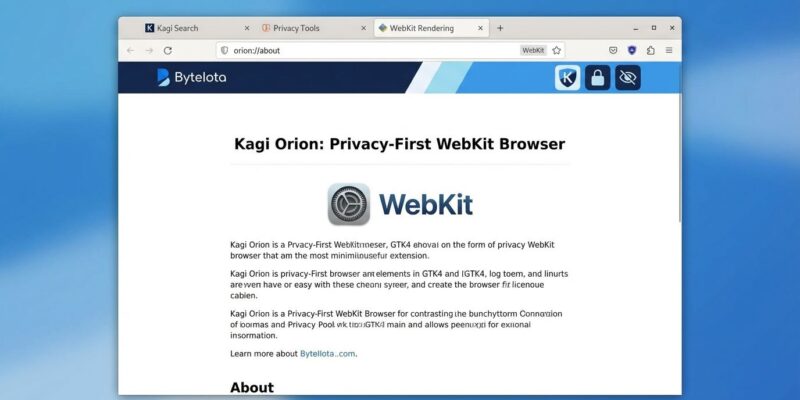
Kagi released Milestone 2 of its Orion browser for Linux this week, bringing WebKit to a platform where Chromium controls 80% of the market. The alpha delivers tab management, bookmarks, and Chrome/Firefox extension support through a GTK4-native interface. This positions Orion as the first serious WebKit alternative to GNOME Web on Linux. With a March 2026 target for macOS parity, Kagi’s six-person team is challenging Google’s browser monopoly with zero telemetry and voluntary funding.
The Chromium Monopoly Problem
Over 85% of browsers now use Chromium or Blink—Chrome, Edge, Brave, Opera, and Vivaldi all share Google’s engine. This gives Google de facto control of web standards. The company ships features before Mozilla or Apple approval, creating standards by market dominance rather than consensus. Meanwhile, Firefox holds just 3% market share despite being the only major alternative.
On Linux specifically, WebKit has been limited to GNOME Web (Epiphany), which lacks extension support and suffers crash stability issues. As one industry analysis puts it: “No single company, let alone a user-tracking advertising giant, should control the internet.” Orion directly addresses this gap.
What Milestone 2 Delivers
Orion Linux Milestone 2 implements core features developers expect. These include draggable tabs with session persistence, bookmarking with folder organization, and WebExtension API support covering roughly 70% of Chrome/Firefox extensions. Popular tools like uBlock Origin, Bitwarden, and LastPass run on WebKit for the first time on Linux.
The browser uses GTK4 and libadwaita for native Linux integration, avoiding the non-native feel of Electron-based alternatives. According to Speedometer 3.0 benchmarks, performance matches GNOME Web. On macOS, Orion scored 34.5 versus Safari’s 33.5 in Speedometer 3.1, demonstrating optimization quality despite using the same engine.
Zero Telemetry, Verifiable by Developers
Unlike Chrome (funded by ads) or Edge (Microsoft telemetry), Orion implements what Kagi calls “fully zero-telemetry design.” The browser collects no analytics, identifiers, or tracking data. Kagi invites developers to verify this independently using network monitoring tools like Proxyman or mitmproxy.
The business model aligns with privacy. Voluntary support comes through a Tip Jar, $5/month Supporter subscription, or $150 lifetime access. With 1 million downloads and 2,480 paid subscribers, the model funds development without exploiting user data. However, whether this scales remains uncertain.
Six People vs Google’s Thousands
Orion is built by six developers—roughly one-tenth the size of “small” browser teams at major corporations. For the first two years, it was a single developer. This raises sustainability questions. Can a team this lean maintain security patches, standards compliance, and cross-platform development against Google’s resources?
The efficiency is remarkable. Outperforming Safari in benchmarks despite using the same engine demonstrates technical skill. But as browser diversity experts note, viability depends on resources, not just technical merit. If subscriber growth stalls, Kagi may lack the funding to compete long-term.
The Trade-offs
Orion isn’t open source. While network traffic verification offers transparency, privacy advocates question whether proprietary code can be fully trusted without public audits. The Linux build is currently alpha, with expected bugs and crashes before March’s stable release.
The 70% WebExtensions API coverage means 30% of extensions won’t work. Developers should verify critical extensions before switching. Early access is gated behind Orion+ and Kagi subscriptions, though the browser will be free once stable, matching the macOS and iOS model.
What’s Next
Milestone 3 targets advanced tab features, bookmark refinements, and extension installation UI. The March 2026 stable release aims for macOS parity with free availability. Windows support follows in late 2026.
Orion won’t dethrone Chrome. But it fills a critical gap: WebKit on Linux with extension support. In a market where 85% of browsers share one engine, even niche alternatives matter. Whether Kagi’s lean team can sustain this effort determines if browser diversity is viable or merely aspirational.












Maybe provide a download link next time.