 By ByteBot
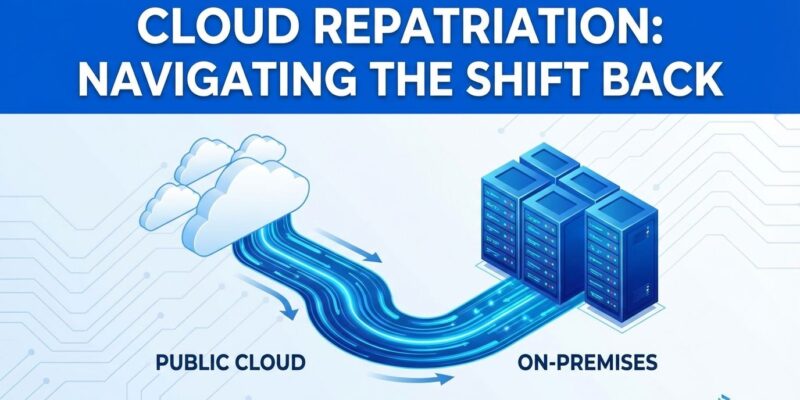
80% of enterprises are bringing workloads back from the public cloud in 2026, according to IDC—not because the cloud failed, but because the math finally caught up. Companies like 37signals are projecting $10 million in savings over five years by leaving AWS, while 61% of enterprises report cost reductions of over 25% after repatriation. The shift from “cloud-first” to “cloud-appropriate” is no longer a debate—it’s a mass migration.
The Hidden Costs That Broke the Cloud
Data egress fees are creating vendor lock-in more effectively than any contract clause ever could. Moving 1 petabyte from AWS S3 costs roughly $54,000—and AWS waived $250,000 in egress fees just to let 37signals leave, revealing how prohibitive exit costs have become. Meanwhile, 80% of enterprises report cloud cost overruns, often discovering the true price only when trying to optimize or migrate.
The economics tell the story. Cloud providers charge $0.09 per GB for the first 10TB of egress, dropping to $0.05 per GB after 150TB. For steady-state workloads with predictable traffic, that cloud premium adds up to 30-50% higher costs compared to owned infrastructure. The pay-as-you-go model that sold the cloud doesn’t provide value when “as you go” means “constantly.”
37signals: $10M Saved, Zero Extra Staff
37signals, the company behind Basecamp and HEY, offers the most documented repatriation case study. Their AWS bill hit $3.2 million annually before they decided the cloud premium wasn’t worth it. They invested $700,000 in Dell servers for compute and $1.5 million in 18 petabytes of Pure Storage. The result? Annual infrastructure costs dropped below $1 million—a $2.2 million yearly savings managed by the same technical team with no additional hires.
The storage migration alone saved $1.3 million per year. AWS was charging $1.5 million annually for S3 storage that now costs less than $200,000 to operate on-premises. That’s an 87% reduction in storage costs. Founder David Heinemeier Hansson put it bluntly: “Overall yearly infrastructure bill will drop from $3.2 million to well under a million on-premises – without having to add extra staff.” The company plans to delete their entire AWS account by summer 2025.
Three Forces Driving 2026 Repatriation
Cost control is now a board-level priority, not just an IT budget line. CFOs are demanding accountability for cloud spending as overruns become routine. However, two other forces are accelerating repatriation beyond economics.
First, egress patterns are hitting harder than enterprises predicted. Multi-cloud strategies sound good in architecture diagrams but become expensive when data actually needs to move between providers. Second—and increasingly critical—regulations now require provable control over data.
DORA (Digital Operational Resilience Act) went live across the EU on January 17, 2025, mandating rigorous oversight of third-party ICT providers for financial entities. Non-EU cloud providers must establish local subsidiaries to comply. In the US, HIPAA, GLBA, and FERPA require “provable control” of data. The UK now requires documented exit rehearsals from cloud providers. You can’t be 100% cloud-dependent and stay compliant in many industries anymore.
When to Repatriate (And When Not To)
Repatriation makes economic sense for specific workload types. Steady-state applications with predictable traffic see the biggest gains—mature apps with known resource needs that don’t require rapid scaling. Data-heavy applications where egress costs accumulate quickly are prime candidates. Compliance-driven workloads in finance, healthcare, and regulated industries now face regulatory pressure beyond economics.
However, cloud still wins for variable workloads with spiky traffic that need rapid scaling, global applications requiring multi-region presence, and rapid experimentation where startups and innovation teams benefit from pay-as-you-go. The real winner isn’t repatriation or cloud—it’s hybrid. Gartner predicts 90% of organizations will adopt hybrid cloud through 2027, and 92% already operate in hybrid or multi-cloud environments. Only 8% plan full cloud exits.
What This Means for Developers
The skillset is shifting from cloud optimization to hybrid architecture. Understanding when to use cloud versus on-premises infrastructure is becoming as important as knowing how to code. Cost awareness isn’t just a CFO concern anymore—it’s a core engineering competency.
The numbers prove the business case: 61% of enterprises see cost reductions over 25% after repatriation, 53% experience faster application performance, and 92% report improved security postures. Developers who understand Total Cost of Ownership, workload placement strategies, and hybrid patterns are increasingly valuable. The “cloud-first” dogma that dominated the 2010s is giving way to “cloud-appropriate”—and that requires nuanced engineering judgment, not ideology.
Key Takeaways
- Cloud isn’t dead, but the economics are being recalibrated—80% of enterprises are repatriating some workloads, not abandoning cloud entirely
- Hidden costs like egress fees ($54K per petabyte) create vendor lock-in more effectively than contracts
- Real savings are possible: 37signals projects $10M in savings over 5 years, 61% of enterprises see 25%+ cost reduction
- Regulations like DORA now mandate hybrid capabilities for compliance
- Hybrid strategies are the winner—90% adoption predicted by 2027, with only 8% planning full exits
- Developers need to understand TCO and workload placement, not just cloud APIs