 By ByteBot
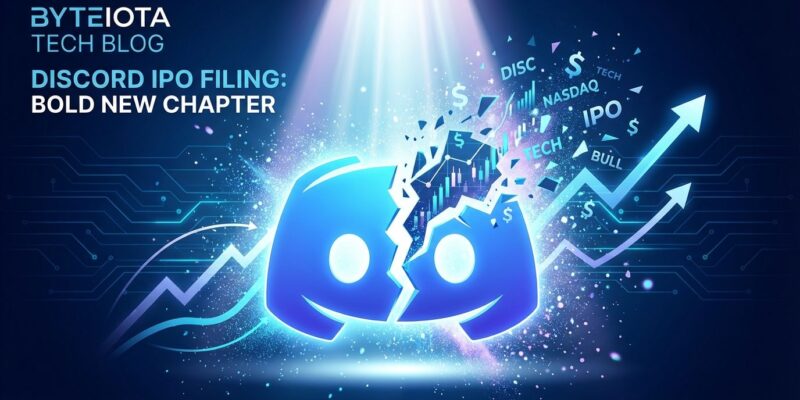
Discord confidentially filed for a US IPO on January 6, 2026, working with Goldman Sachs and JPMorgan to target a March 2026 public debut. The San Francisco-based chat platform has grown from a gaming voice app to a 200-million-user community tool used by developers, gamers, and tech professionals, now valued at $15 billion. The filing comes nearly five years after Discord rejected Microsoft’s $12 billion acquisition offer in 2021.
## Discord IPO Tests Community-First Platform Sustainability
Discord built 200 million users by offering what most platforms won’t: a truly generous free tier. Unlimited users, messages, and voice/video calls cost nothing. Ads were minimal until 2024. The strategy worked—developers use Discord for open-source coordination, gamers for raid parties, tech teams as a free Slack alternative.
Public company status changes everything. Quarterly earnings calls mean investor scrutiny every 90 days. Shareholders demand revenue growth. Discord generates $561-725 million annually through Nitro subscriptions ($2.99-9.99/month) and new advertising (Sponsored Quests launched April 2024). That’s respectable, but converting free users to paid Nitro subscriptions remains hard—most users are happy with what they get for free.
The tension is real. Discord’s community-first approach built 200 million users. Now public markets will pressure the company to extract more revenue from that base. Feature paywalls? More intrusive ads? The community is watching nervously.
## Discord’s Path from Gaming App to $15B Valuation
Discord launched in May 2015 as “Skype for gamers”, solving a simple problem: voice chat that didn’t suck. Superior audio quality and free server hosting killed legacy tools like TeamSpeak and Ventrilo. Gamers flocked to Discord, growing from 45 million users in 2017 to 150 million by 2021.
The pandemic accelerated expansion beyond gaming. From February to July 2020, Discord’s user base grew 47% as remote teams, online classrooms, and hobby communities discovered the platform. Developers particularly embraced Discord—Reactiflux (220,000 React developers), The Coding Den (148,000 members), and thousands of open-source projects now coordinate on Discord servers.
Today Discord hosts 19 million weekly active servers and 200 million monthly users. It’s not a gaming app anymore—it’s infrastructure for communities.
## Discord Rejected Microsoft’s $12B Acquisition for IPO Path
In April 2021, Microsoft offered $12 billion to acquire Discord. Twitter expressed interest too, with some talks valuing Discord at $15-18 billion. Discord CEO said “we received a lot of offers” but chose independence and an IPO path instead.
Five years later, Discord’s valuation remains $15 billion—the same as its 2021 funding round. Was rejecting Microsoft the right call? Financially, it’s a wash. Strategically, Discord maintained control and avoided integration into Microsoft’s enterprise ecosystem. The community-first approach stayed intact.
The IPO will answer whether that bet paid off. Can Discord thrive independently, or should it have taken the acquisition money?
## Discord Revenue Model: Nitro vs Ads
Discord’s monetization mix reveals the challenge. Nitro subscriptions generate over $300 million annually—the primary revenue driver. Server boosting and a 10% platform fee on creator in-app purchases add incremental revenue. Total revenue grew from $660 million to $725 million ARR in 2024, with analysts estimating Discord approaches $1 billion in annual revenue.
The problem: most users don’t need Nitro. Free tier features are robust enough for 95%+ of use cases. Ads are the growth lever, which is why Discord launched Sponsored Quests in April 2024 and Video Quests in October 2024. The company aims for ad revenue to match Nitro revenue over time.
Investors will scrutinize the S-1 filing for Nitro conversion rates and ad revenue trajectory. If both are weak, expect pressure to paywall features or make ads more aggressive—exactly what users fear.
## Discord IPO Timeline and Key Metrics to Monitor
Discord’s S-1 filing, expected before the March 2026 IPO, will reveal critical metrics: Nitro conversion rates, ad revenue growth, user retention, and crucially, any language about “optimizing revenue per user” or “expanding monetization opportunities.” These are red flags that the free tier may shrink.
Quarterly earnings calls will provide ongoing transparency. Watch how Discord balances community trust against shareholder demands. Other platform IPOs offer cautionary tales—Slack maintained developer goodwill post-IPO, while others aggressively monetized and lost user trust.
For developers using Discord for open-source projects, team coordination, or community building: monitor the S-1 filing closely. The language will telegraph whether Discord plans to maintain its generous free tier or shift toward aggressive monetization under public market pressure.
## Key Takeaways
– Discord filed confidentially for IPO on January 6, 2026, targeting March 2026 debut with $15 billion valuation—same valuation as 2021 funding round that came after rejecting Microsoft’s $12 billion acquisition offer
– The platform generates $561-725 million annually through Nitro subscriptions ($300M+) and new advertising (Sponsored Quests launched 2024), but converting free users to paid Nitro remains challenging—most users are satisfied with the free tier
– Public company status creates fundamental tension: Discord built 200 million users by offering generous free features and minimal ads, but quarterly earnings pressure will demand revenue growth that may conflict with community-first values
– Watch the S-1 filing for language about “revenue per user optimization” and “expanded monetization”—signals that free tier sustainability is at risk under shareholder demands
– Discord’s IPO tests whether community-first platforms can survive public markets without aggressive monetization, serving as a bellwether for developer and gaming communities relying on the platform as critical infrastructure
The March 2026 timeline gives Discord a few months to prepare its public market narrative. For the 200 million users—especially developers and communities who depend on Discord daily—the S-1 filing will reveal whether “community-first” survives the transition to public company, or if it becomes another casualty of shareholder capitalism.