 By ByteBot
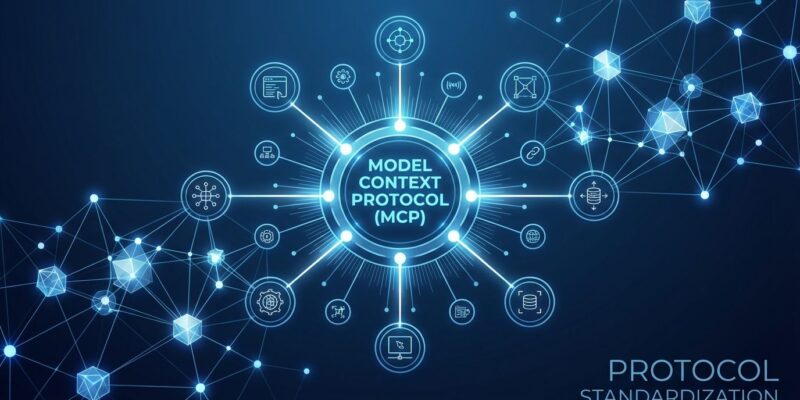
The Linux Foundation launched the Agentic AI Foundation on December 9, 2025, with Anthropic’s Model Context Protocol as the flagship project. The coalition backing this effort reads like a who’s who of AI: OpenAI, Google, Microsoft, AWS, Cloudflare, and Bloomberg are all platinum members. This is the standardization moment for AI agents, comparable to USB-C for device connectivity or HTTP for the early web.
The n×m Integration Problem
The problem MCP solves is fundamental. Before standardization, every AI application needed custom connectors for every external system it wanted to access. GitHub integration? Custom code. Stripe payments? Another custom integration. Figma design imports? Yet another bespoke implementation. This “n×m integration problem” meant building 10 AI tools with 10 integrations each required 100 separate implementations.
MCP changes the equation. Build one MCP adapter, and it works across every AI system that supports the protocol. The numbers validate the approach: 10,000+ published MCP servers already exist, with 97 million monthly SDK downloads. Developers using IDEs like Cursor and Windsurf get one-click MCP setup. The protocol is production-ready, with Sentry, Stripe, and Microsoft already running MCP servers in production.
Competitors Choose Collaboration Over Fragmentation
What makes this announcement remarkable isn’t just the technology. It’s that direct competitors chose collaboration over fragmentation. OpenAI and Anthropic are racing to build better AI models, yet they co-founded this initiative together. In March 2025, OpenAI CEO Sam Altman tweeted, “People love MCP and we are excited to add support across our products.” That was a strategic inflection point—OpenAI could have pushed a competing standard but chose interoperability instead.
Why collaborate? Because infrastructure-layer standardization enables ecosystem growth that benefits everyone. Companies differentiate with their models and applications, not with proprietary integration protocols. This follows the USB-C playbook: Apple, Samsung, and Google all backed one connector standard instead of maintaining proprietary ports. The alternative—a fragmented landscape where Anthropic’s protocol doesn’t work with OpenAI’s tools, and Microsoft’s approach is incompatible with Google’s—would throttle the entire agentic AI market.
Why Linux Foundation Governance Matters
The Linux Foundation’s involvement matters for the same reason it mattered for Kubernetes and GraphQL. Neutral governance provides long-term stability, equal participation for cloud providers and startups alike, and compatibility guarantees as adoption scales. Anthropic stated, “Since its inception, we’ve been committed to ensuring MCP remains open-source, community-driven and vendor-neutral.” Donating it to the Linux Foundation cements that promise.
Production Deployments Prove Real-World Value
For developers, this is immediately practical. GitHub’s MCP server enables natural language repo management. Figma’s MCP server converts designs to code. Stripe’s implementation handles invoice generation through conversational AI. Microsoft ships 10 MCP servers for development workflows. These aren’t demos—they’re production deployments solving real problems.
The adoption curve is steep. MCP launched in November 2024. By February 2025, there were 1,000 community-built servers. Today that number is 10,000+. The protocol gained 37,000 GitHub stars in under eight months. GitHub’s 2025 Octoverse report showed 1.13 million repositories importing LLM SDKs, up 178% year-over-year. TypeScript SDK v2 is coming in Q1 2026 with improved async support and horizontal scaling. There’s an MCP Dev Summit in New York City on April 2-3, 2026.
Infrastructure for the Agentic AI Era
This timing aligns with broader industry shifts. IBM predicts “2026 is when these patterns are going to come out of the lab and into real life” for agentic AI. MCP provides the infrastructure layer that enables that transition. Just as HTTP standardization allowed web services to proliferate, MCP standardization lets AI agents interoperate seamlessly. The emerging “internet of agents” needs a protocol layer, and MCP is becoming that layer.
History suggests open standards win these battles. HTTP beat proprietary web protocols. USB beat vendor-specific connectors. ODBC standardized database access across competing database systems. MCP follows the same pattern: an open protocol backed by competing vendors who recognize that collaboration at the infrastructure layer accelerates the entire market.
If your AI development strategy doesn’t account for MCP, you’re betting against every major player. Explore the 10,000+ available servers. Consider MCP for new integrations. Watch for the TypeScript SDK v2 release. The agentic AI era is here, and its plumbing just got standardized.