 By ByteBot
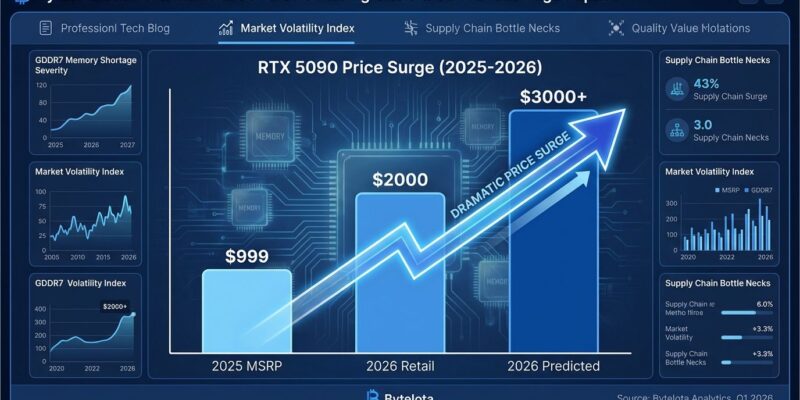
Nvidia’s RTX 5090 launched at $1,999 MSRP in January 2025. One year later—as CES 2026 unfolds in Las Vegas this week—retail prices have exploded to $3,000-$4,000, with industry sources predicting $5,000 by late 2026. Developers, ML engineers, and content creators face a brutal choice: pay double MSRP for a GPU that’s perpetually sold out at Nvidia’s official store, pivot to cloud compute that costs 5x more over two years for continuous workloads, or gamble on used RTX 4090s with no warranty.
The root cause isn’t scalpers—it’s a memory shortage driven by AI’s insatiable appetite for DRAM. AI is consuming 20% of global wafer capacity in 2026, and relief won’t arrive until 2028 when Micron’s new HBM manufacturing comes online.
Memory Shortage Drives the Crisis, Not Scalpers
GDDR7 memory accounts for 70-80% of GPU manufacturing costs, and the supply crunch is structural, not temporary. According to a TrendForce report from December 26, 2025, AI is consuming 20% of global DRAM wafer capacity in 2026. GDDR7 requires 1.7x the wafer capacity of standard DRAM, while HBM for AI data centers requires 4x. SK hynix’s advanced packaging lines are at capacity through 2026, and Micron meets only 55-60% of customer demand.
Nvidia is reportedly cutting gaming GPU production by 30-40% to prioritize higher-margin data center chips like the H100 and H200. DRAM prices are forecast to rise 40% by Q2 2026. ASUS sent a price adjustment notice to partners on January 5, 2026, citing increased memory costs. This isn’t the 2021 crypto mining boom—it’s a permanent shift. AI demand is growing faster than manufacturing capacity can scale, and new supply won’t materialize until 2028 when Micron’s HBM facility begins production.
Scalpers are exploiting the shortage, but even without them, GDDR7 costs are skyrocketing. Developers waiting for “prices to normalize” need to accept a harsh reality: normal is $3-4K now, not $2K.
Retail Reality: $3-4K Now, $5K Predicted
As of January 2026, RTX 5090 prices at major retailers range from $3,059 to $4,800, with Newegg listing the Founders Edition at $3,695—an 85% markup over the $1,999 MSRP. Amazon averages $3,359, with the cheapest TUF model at $2,999 for Prime members only. Custom AIB models from ASUS, MSI, and Gigabyte sell for $4,500-$4,800. eBay scalpers are asking $3,000-$7,000, up to 3.5x MSRP.
Nvidia’s official store maintains the $1,999 Founders Edition price, but it’s perpetually sold out. Access is limited to Verified Priority Access, essentially a lottery system. Microcenter is the only retailer with MSRP stock, available for in-store pickup only in limited quantities.
Industry sources predict prices will hit $5,000 by late 2026. The $5K prediction isn’t fearmongering—ASUS already sent price adjustment notices citing memory costs.
Nvidia’s “MSRP maintained at $1,999” claim is marketing fiction. The actual price developers pay is $3-4K, not $2K. If you’re budgeting for ML hardware or game dev workstations in 2026, assume 2x MSRP for planning purposes.
Cloud vs Local: When Each Makes Sense
For continuous heavy workloads (8+ hours/day), a local RTX 5090 at $4,000 (plus $2K PC build + $1K electricity over 2 years = $7K total) is still 5x cheaper than AWS Reserved Instances ($127K over 2 years) and 2.5x cheaper than Lambda Labs ($17K over 2 years). However, budget cloud providers like RunPod or VAST.ai cost $0.40/hr, totaling $3.5K over 2 years for continuous use—but with shared resources and no guaranteed availability.
For sporadic workloads (a few hours/week), cloud always wins. If you’re training ML models 8+ hours/day every day, buying local pays off in 5-6 months versus premium cloud. But if your workload is sporadic—LLM experiments, occasional rendering—cloud is 10x cheaper.
Related: Kubernetes vs PaaS 2026: Why Most Teams Choose Wrong
The decision isn’t binary—it’s about usage pattern and budget flexibility. Calculate your local versus cloud TCO for your specific workload over a 2-year horizon. The math determines the answer, not vibes.
Alternatives Are Limited and Flawed
AMD has no competitive alternative. The RX 9070 XT targets mid-range (competes with RTX 5070, not 5090), and the UDNA flagship won’t launch until late 2026—and may still not match RTX 5090 performance. More critically, AMD’s ROCm platform lacks the ML/AI ecosystem maturity of CUDA. PyTorch, TensorFlow, and JAX all optimize for Nvidia first.
Used RTX 4090s ($1,500-$2,200) offer a middle ground with 24GB VRAM and ~70% of RTX 5090 performance, but carry mining wear risks (degraded thermal pads), limited warranty transfer, and eBay scam potential. RTX 4090 mining profitability is down (35+ months to break even), but thermal pad wear is common on used cards.
Developers hoping “AMD will save us” or “used market is the answer” need reality: AMD’s CUDA moat is insurmountable for ML/AI (ROCm support is spotty), and used GPUs are a gamble. If you can’t stomach $4K for a new RTX 5090, cloud compute is safer than sketchy used cards.
What Developers Should Do Now
Nvidia CEO Jensen Huang is presenting at CES 2026 today (January 5, 2026 at 1PM PT) for 90 minutes, focusing on AI, robotics, simulation, and gaming. RTX 50 Super Series is likely postponed, with the keynote emphasizing next-generation AI infrastructure over consumer GPUs.
Regardless of announcements, here’s what to do. First, calculate local versus cloud TCO for your specific workload over a 2-year horizon. Second, budget 2x MSRP for any 2026 GPU purchases—$4K is the market price, not $2K. Third, consider used RTX 4090 only from reputable sellers with return policies. Fourth, don’t panic-buy at $4K—CES may shift market dynamics, though Nvidia’s priority is AI data center chips (higher margins), not helping developers get affordable RTX 5090s.
Key Takeaways
- RTX 5090 prices have doubled from $1,999 MSRP to $3,000-$4,000 retail in one year, with $5,000 predicted by late 2026 due to GDDR7 memory shortages
- Memory shortage is structural, not temporary—AI consuming 20% of global DRAM capacity, with relief not arriving until Micron’s 2028 HBM facility
- Local RTX 5090 at $4K is 5x cheaper than AWS over 2 years for continuous workloads but loses to cloud for sporadic use—run your own TCO analysis
- AMD has no competitive alternative (UDNA delayed to late 2026, CUDA moat insurmountable), and used RTX 4090s carry warranty and mining wear risks
- Budget 2x MSRP for 2026 GPU planning, avoid eBay scalpers, and calculate cloud versus local based on your actual usage pattern