 By ByteBot
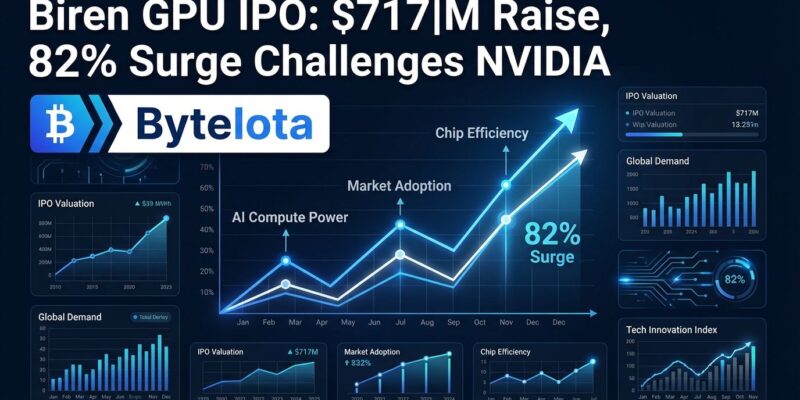
Shanghai-based Biren Technology raised $717 million and surged 82% on its Hong Kong trading debut today, January 2, 2026. The AI chipmaker priced its IPO at HK$19.60 per share—the top of its range—and shares climbed to HK$34.46 by market close. The retail portion was oversubscribed 2,300 times. Biren is now the first GPU stock on the Hong Kong Stock Exchange and the first company to go public in Hong Kong this year.
The numbers signal massive investor appetite for NVIDIA alternatives. However, they also reveal a deeper trend: the AI hardware landscape is fragmenting along geopolitical lines. Biren’s successful debut validates China’s domestic GPU ecosystem as viable for public markets, even though Chinese GPUs collectively hold less than 3% of global market share. For developers, this is less about one company’s IPO and more about the emerging reality of dual AI hardware stacks.
Why US Chip Bans Created This Opportunity
Biren didn’t choose to compete with NVIDIA. Washington forced the competition. In August 2022, the US government banned exports of NVIDIA’s A100 and H100 chips to China. By October 2023, restrictions expanded to include NVIDIA’s China-specific workarounds like the A800 and H800. Chinese AI developers lost access to the world’s best AI training hardware overnight.
This created forced demand for domestic alternatives. Biren Technology is one of China’s “Four Little Dragons” in the GPU sector, alongside Moore Threads, Iluvatar CoreX, and Enflame Technology. All four were founded between 2015 and 2020 by former NVIDIA and AMD executives. Moore Threads raised $1.1 billion on Shanghai’s STAR Market. Biren just raised $717 million in Hong Kong. Iluvatar and Enflame are expected to follow. China’s Silicon Sovereignty push isn’t a free market bet—it’s a strategic necessity driven by US export controls.
Hardware Specs Approaching Parity, Software Still Lags
Biren’s flagship BR100 GPU packs 77 billion transistors on TSMC’s 7nm process, with 64GB of HBM2E memory and 256 FP32 TFLOPS of performance. The company claims 2.6× speedup over NVIDIA’s A100. Reality is more nuanced. The BR100 outperforms NVIDIA’s Ampere architecture but falls 2-2.5× behind Hopper. For inference, it’s viable. For large-scale AI training, it’s catching up.
But hardware specs aren’t the real challenge. NVIDIA holds 86% of the AI GPU market share not because its transistor counts are higher, but because its software ecosystem is unassailable. CUDA has 15 years of investment, millions of developers, and deep integration with PyTorch, TensorFlow, and every major AI framework. Biren’s BIRENSUPA platform supports PyTorch and TensorFlow through ROCm compatibility layers, but driver stability and ecosystem maturity lag years behind.
The CUDA Moat Remains Real
Here’s the uncomfortable truth for Biren and every NVIDIA competitor: code written for CUDA doesn’t easily port to alternatives. Years of optimization in libraries like cuDNN and TensorRT, developer familiarity with tooling, and production deployment inertia all favor sticking with proven stacks. Chinese GPUs collectively hold less than 3% global market share despite billions invested. Moreover, the IPO wave doesn’t change that overnight.
Biren’s strategy is pragmatic. It uses ROCm for CUDA compatibility, supports mainstream frameworks, and bets on IPO proceeds funding aggressive software engineer hiring. Furthermore, the company reported 336.8 million yuan in revenue for 2024 and 58.9 million yuan in the first half of 2025. It has 2.1 billion yuan in pending orders. Current customers include state-backed entities like China Mobile and China Telecom. This isn’t organic demand—it’s strategic demand created by the Chinese government’s need for viable domestic GPUs.
What This Means for Developers
If you’re building AI applications today, CUDA remains the safe bet for global deployments. NVIDIA’s ecosystem isn’t going anywhere. However, if you’re working in China or with Chinese clients, dual ecosystem fluency is becoming necessary. That means learning BIRENSUPA or Huawei’s MindSpore alongside CUDA. It means navigating compatibility quirks when migrating PyTorch models. It means accepting that the AI hardware world is splitting along geopolitical lines.
The long-term scenario isn’t global competition. It’s parallel stacks. NVIDIA dominates globally. Chinese GPUs serve the domestic market. Biren’s $717 million IPO and 82% stock surge signal that China’s GPU ecosystem is viable enough for public investors, even if it never achieves global dominance. The question isn’t whether Biren will beat NVIDIA. It’s whether Biren can achieve “good enough” status for a China-only market worth hundreds of billions.
Production Roadmap and IPO Wave
Biren plans to focus on mass production of its BR200 series in 2026, using IPO proceeds for R&D and commercialization. The BR200 represents the next generation after the BR100 and BR104. With 2.1 billion yuan in pending orders and customers like China Mobile and China Telecom, the company has near-term revenue visibility.
Additionally, Biren’s IPO kicks off what industry watchers are calling China’s GPU gold rush. Moore Threads already raised $1.1 billion. Iluvatar CoreX and Enflame Technology are expected to follow. All four “Little Dragons” are betting that US-China tech decoupling creates a sustainable, captive market for domestic GPUs. The investor enthusiasm—2,300× retail oversubscription for Biren—suggests the market agrees, at least for now.
The Verdict
Biren Technology’s successful IPO validates China’s domestic GPU ecosystem as a public market investment, not just a state-backed R&D project. The $717 million raised and 82% stock surge prove investor appetite for NVIDIA alternatives in a world where US export controls force Chinese AI developers to seek homegrown solutions. Nevertheless, NVIDIA’s CUDA moat remains formidable. Chinese GPUs hold less than 3% global market share. Hardware specs are catching up, but software ecosystems take decades to mature.
For developers, the takeaway is clear: the AI hardware world is fragmenting. CUDA for global work. BIRENSUPA, MindSpore, or PaddlePaddle for China-specific deployments. The question isn’t whether Biren will compete globally—it won’t. The question is whether a China-only market is large enough to sustain four domestic GPU vendors going public. Based on today’s IPO performance, investors think it is.