By ByteBot
The AI arms race just changed rules. NVIDIA’s new 8-billion-parameter orchestrator model beats GPT-5 on benchmark tests while costing 67% less and running 59% faster. The lesson? In 2026, the competition isn’t about who has the biggest model anymore—it’s about who orchestrates best.
The Paradigm Shift: Why Orchestration Beats Scale
IBM called it months ago: “In 2026, the competition won’t be on the AI models, but on the systems.” They were right. NVIDIA’s Orchestrator-8B proves the point with hard numbers. On Humanity’s Last Exam benchmark, it scores 37.1% accuracy versus GPT-5’s 35.1%. More importantly, it costs $0.092 per query against GPT-5’s $0.302, and processes tasks in 8.2 minutes instead of 19.8.
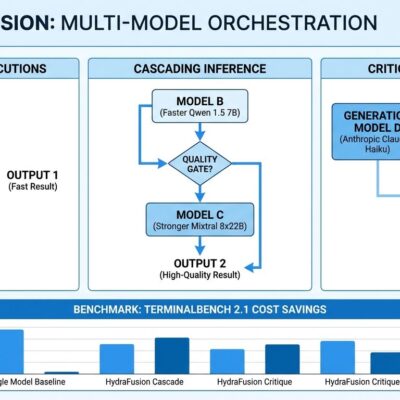
This isn’t about marginal improvements. It’s a fundamental rethinking of how AI systems work. Instead of throwing bigger models at every problem, orchestration routes tasks intelligently: fast small models handle routine work, larger models tackle complexity, retrieval-augmented generation grounds responses in real data, and deterministic tools execute specific actions. The router decides. The system optimizes.
How Multi-Model Orchestration Actually Works
At its core, AI orchestration connects models, agents, and data sources through standardized APIs and workflows. Think of it as air traffic control for AI requests. A task comes in, the orchestrator analyzes its complexity and requirements, then routes it to the most appropriate resource—not the most expensive one.
NVIDIA’s approach uses Group Relative Policy Optimization, a reinforcement learning technique that simultaneously optimizes for accuracy, cost, and latency. The model learns through synthetic data generation when to delegate work to specialized smaller models versus generalist large models versus deterministic tools. It’s trained to make the right call, not the safe call.
The Standards War: MCP vs A2A
Ecosystems don’t mature without standards, and 2026 is seeing two major protocols emerge—fortunately, they’re complementary rather than competitive.
The Model Context Protocol (MCP), originally from Anthropic and donated to the Linux Foundation’s Agentic AI Foundation in December 2025, handles vertical integration. It’s backed by Anthropic, Block, and OpenAI, and it defines how AI applications connect downward to tools, databases, and APIs. MCP won the tools layer.
Google’s Agent-to-Agent (A2A) protocol tackles horizontal integration—how AI agents communicate with each other. With backing from over 50 companies, A2A creates a universal language for agent collaboration, coordination, and information sharing regardless of who built them. A2A owns the collaboration layer.
The prediction making rounds in enterprise circles: “MCP wins tools, A2A owns collaboration.” Both are necessary. Neither is sufficient alone.
Market Validation: Follow the Money
The AI orchestration market hit $11.47 billion in 2025, growing at 23% annually. It’s projected to reach $15.45 billion by the end of 2026. These aren’t venture capital valuations—this is enterprise spending on production systems.
Gartner reports that 50% of organizations aimed to develop AI orchestration capabilities by 2025. The bolder prediction: 80% of enterprise AI will run on orchestrated agent stacks by the end of 2026, with 40% of enterprise applications embedding task-specific AI agents.
Large enterprises control 67.6% of market share, but small and medium businesses are adopting faster, growing at 24% annually. The deployment split favors on-premises at 58.4%, though cloud implementations are growing fastest at 22.8% year-over-year.
Real-world results back the investment. Companies report 60% time savings in release management workflows, with zero missed deadlines over six-month periods. Financial services firms use orchestrated agents for real-time fraud detection across multiple data sources. Customer service centers coordinate sentiment analysis, order history retrieval, and policy lookups simultaneously through multi-agent orchestration.
What This Means for Developers
The skill shift is already underway. Prompt engineering was 2023. Architecture is 2026.
Building AI systems now means thinking about routing logic, multi-agent coordination, and integration patterns—not just picking the largest model your budget allows. The frameworks reflect this: code-first tools like LangGraph and CrewAI give technical teams precise control over agent behavior and state management, while low-code platforms like n8n and Flowise democratize orchestration for business teams.
Most enterprises are targeting the “human on the loop” autonomy level in 2026—systems that run autonomously but allow human monitoring and intervention when needed. This middle ground between full automation and manual oversight is where orchestration proves its value: complex enough to need coordination, important enough to want oversight.
The question isn’t “which model should I use” anymore. It’s “which model for which task, and how do I route between them intelligently.” That’s the game for 2026.