 By ByteBot
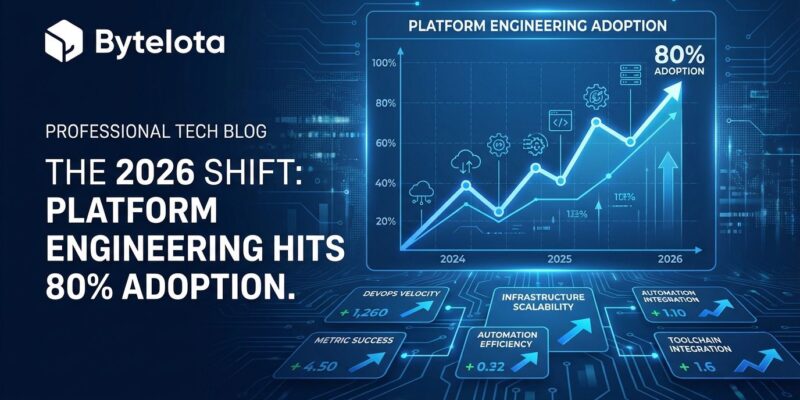
Gartner predicts that by 2026, 80% of software engineering organizations will have platform teams. This isn’t a slow trend – it’s a rapid transformation happening right now. In 2025 alone, 55% of organizations already adopted platform engineering, and the momentum is accelerating. Platform engineering is shifting from competitive advantage to fundamental requirement for modern software delivery.
The Developer Friction Crisis
The driver behind this explosive growth? A developer friction crisis that’s become unsustainable. 75% of developers currently lose six or more hours weekly to tool fragmentation – context-switching between disconnected systems, waiting for manual provisioning tickets, and wrestling with infrastructure complexity that has nothing to do with their actual work. DevOps gave us faster deployments, but it also gave us sprawling toolchains that developers have to navigate daily.
What Platform Engineering Actually Solves
Platform engineering solves this by moving from ticket-driven manual provisioning to self-service Internal Developer Platforms, or IDPs. Think of an IDP as a curated layer sitting on top of your organization’s infrastructure and development tools. It bundles CI/CD pipelines, monitoring, secrets management, and environment provisioning into “golden paths” – self-service templates that let developers spin up what they need in minutes, not days. Security and compliance guardrails are built in by design, so self-service doesn’t mean the wild west.
This is DevOps evolution, not replacement. Platform engineering takes DevOps principles and adds the self-service layer that makes them scale across large organizations. Companies like Netflix, Shopify, Uber, Airbnb, and Stripe have already proven this model works at scale.
The Measurable Impact
The data backs up the hype. High-maturity platform teams report 40-50% reductions in cognitive load for developers, freeing them to focus on building features instead of managing infrastructure. That’s not incremental improvement – it’s transformative. Organizations that pair platform engineering with end-to-end process transformation see 25-30% productivity boosts, far exceeding the 10% gains from basic tool adoption alone.
GitOps Becomes the Foundation
GitOps has become the foundation of this shift. 93% of organizations plan to continue or increase their GitOps use in 2025, and adoption has already reached two-thirds of organizations. Among adopters, 80% report higher reliability and faster rollbacks. Argo CD, the CNCF-graduated GitOps tool, now manages application delivery in nearly 60% of surveyed Kubernetes clusters. These aren’t experimental technologies anymore – they’re the new standard.
The Platform Engineering Tech Stack
The platform engineering tech stack has crystallized around a few core technologies. Kubernetes and Terraform (or OpenTofu) form the baseline infrastructure layer. For GitOps, Argo CD dominates in Kubernetes-native environments, while GitLab and GitHub Actions handle broader continuous delivery needs. On the developer portal side, Backstage leads adoption, though Port and Cortex are gaining ground among teams that want faster implementation. These tools have moved from innovation to norm, providing the automated, auditable, and consistent workflows that platform teams need.
AI Acceleration and Future Trends
AI is accelerating this transformation faster than anyone predicted. 76% of DevOps teams have already integrated AI into CI/CD pipelines as of late 2025. By 2026, AI agents will become first-class platform citizens with role-based access controls, resource quotas, and governance policies – treated just like human users but operating at machine speed. By 2027, IDC predicts that 70% of organizations will run multi-agent systems where specialized agents handle security, architecture, and testing in concert. Fifty percent of enterprises will use AI agents to drive core workflows by 2027, which means platform teams need to build the scalable, secure infrastructure to support model execution and orchestration right now.
FinOps Evolution
FinOps is evolving alongside platform engineering in equally dramatic ways. The old model – reactive dashboards that tell you how much you overspent last month – is giving way to preventive controls. By 2026, platforms will implement pre-deployment cost gates that automatically block services exceeding unit-economic thresholds before they go live. As AI workloads proliferate, platforms are introducing AI-specific budgets to manage token and inference costs with the same precision as compute resources. FinOps is becoming a critical discipline integrated directly into CI/CD pipelines, ensuring cost efficiency is central to every engineering decision, not an afterthought.
What This Means for 2026
The convergence of platform engineering, AI automation, and FinOps integration is why 80% adoption by 2026 isn’t just plausible – it’s inevitable. Organizations that treat this as “just another DevOps trend” are misreading the scale of transformation. This is a fundamental restructuring of how software gets built and delivered, driven by measurable improvements in developer experience, deployment velocity, reliability, and cost control.
For developers, platform engineering means less friction, more flow, and genuine self-service power instead of ticket purgatory. For organizations, it’s faster time-to-market, lower operational costs, and better retention of engineering talent who can focus on solving problems instead of fighting tooling. The 2026 question isn’t whether to adopt platform engineering – it’s whether you can afford to be in the 20% that hasn’t.