 By ByteBot
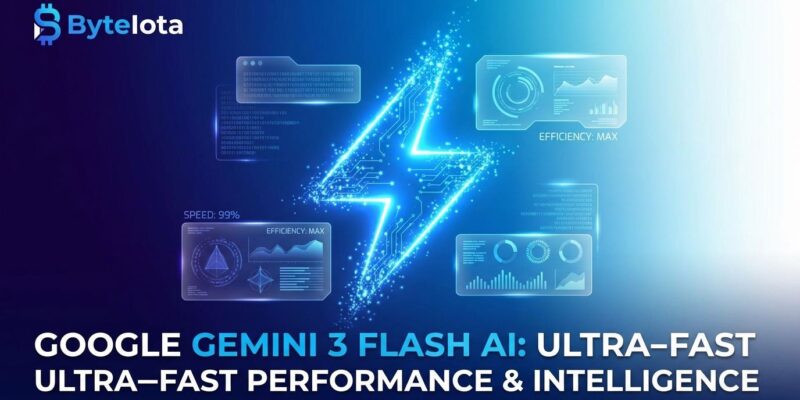
Google launched Gemini 3 Flash on December 17, positioning it as the default model in the Gemini app and delivering Pro-grade AI reasoning at less than 25% the cost of premium competitors. At $0.50 per million input tokens, it undercuts Claude Opus 4.5 by 6x and GPT-4o by 10x—while matching or exceeding their performance on key benchmarks. The counterintuitive twist: this “Flash” variant actually beats Google’s own “Pro” model on coding tasks (78% vs 76.2% on SWE-bench Verified), challenging fundamental assumptions about AI model tiers.
This isn’t just another model release. It’s a market disruption that forces OpenAI and Anthropic to justify why developers should pay 6-10x more for comparable—or worse—performance.
The Price Disruption That Changes Everything
The numbers are stark. Gemini 3 Flash costs $0.50 per million input tokens and $3 per million output tokens. Claude Opus 4.5 charges $3 per million input—a 6x premium. GPT-4o sits at $5 per million input—10x more expensive. For high-volume applications processing billions of tokens, this price difference isn’t marginal. It’s transformative.
Performance metrics validate the aggressive pricing. Gemini 3 Flash scores 71.3 on the Intelligence Index compared to Claude Sonnet 4.5’s 62.8, while running 3x faster than its predecessor Gemini 2.5 Pro. Industry analysts are calling it “the most significant value disruption in AI since GPT-3.5 Turbo’s 2023 launch.” Premium pricing now requires clear justification beyond “slightly better benchmarks”—and many premium models can’t deliver that justification.
For developers building production applications, the economic implications are immediate. Use cases previously uneconomical at $5 per million tokens become viable at $0.50. Google isn’t just competing on price; they’re redefining what frontier AI should cost.
When “Flash” Beats “Pro”: The Performance Paradox
The most surprising aspect isn’t the low price—it’s the high performance. On SWE-bench Verified, a rigorous coding benchmark, Gemini 3 Flash achieves 78% accuracy. Gemini 3 Pro, the premium tier costing 5x more, scores 76.2%. The cheaper model wins.
This pattern repeats across benchmarks. Gemini 3 Flash hits 90.4% on GPQA Diamond, testing PhD-level reasoning and knowledge. It scores 81.2% on MMMU Pro, comparable to Gemini 3 Pro. Meanwhile, it processes requests 3x faster than Gemini 2.5 Pro while using 30% fewer tokens—meaning lower costs and faster responses.
Developer reactions on Hacker News capture the surprise: “Don’t let the ‘flash’ name fool you, this is an amazing model,” wrote one user. Another noted it’s “genuinely my new favorite; it’s so fast and has such vast world knowledge that it’s more performant than Claude Opus 4.5 or GPT 5.2 extra high, for a fraction of the inference time and price.”
The performance paradox raises an uncomfortable question for Google’s own product team: when is the Pro tier worth 5x the cost if Flash beats it on coding? And for competitors charging even more, the question becomes existential.
Enterprise Adoption Validates Production Viability
Within days of launch, major enterprises integrated Gemini 3 Flash into production systems—Salesforce, Workday, Box, JetBrains, Figma, and Bridgewater Associates. These aren’t experimental deployments. They’re mission-critical applications with measurable results.
Box reported a 15% accuracy improvement on document extraction tasks involving handwriting, long-form contracts, and complex financial data. JetBrains found quality approaching Gemini 3 Pro while significantly reducing latency and staying within per-customer credit budgets. Cognition, the company behind Devin AI, saw a 10% baseline improvement on agentic coding tasks and made Gemini 3 Flash their go-to model for latency-sensitive experiences.
Resemble AI discovered Gemini 3 Flash processes complex forensic data for deepfake detection 4x faster than Gemini 2.5 Pro. Salesforce integrated it into Agentforce to deploy intelligent agents faster with stronger reasoning. Workday uses it to deliver sharper inference in customer-facing applications.
These production deployments matter because they prove the model handles demanding enterprise workloads. The pricing isn’t a loss leader for an inferior product—it’s legitimate frontier performance at Flash-tier economics.
The Market Shift: Value Over Brand Loyalty
Google made Gemini 3 Flash the default model in the Gemini app, instantly affecting millions of users. The strategic message is clear: this performance tier should be the baseline, not a premium option.
Competitors face uncomfortable choices. OpenAI and Anthropic can cut prices to match Google, sacrificing margins. They can justify premium pricing by demonstrating clear performance advantages—but current benchmarks don’t support that story. Or they can cede the value-conscious segment to Google while defending high-end use cases.
The developer community is already shifting. As one analysis noted, “The value equation has shifted dramatically in ways that favor developers willing to think beyond brand loyalty.” When a model 6-10x cheaper outperforms premium options on key benchmarks, brand preference needs concrete justification.
For enterprises optimizing cloud costs, the calculation is straightforward: if Gemini 3 Flash delivers comparable results at 10% the cost of GPT-4o, switching saves millions annually on AI infrastructure. Google sweetens the deal with context caching (90% cost reduction on repeated tokens) and Batch API support (50% savings on non-real-time workloads).
Key Takeaways
Gemini 3 Flash delivers frontier AI performance at $0.50 per million input tokens—6-10x cheaper than Claude Opus 4.5 and GPT-4o—while matching or exceeding their benchmarks on coding, reasoning, and multimodal tasks.
The Flash variant outperforms the Pro variant on coding benchmarks (78% vs 76.2% SWE-bench Verified) while costing 75% less, challenging fundamental assumptions about AI model pricing tiers.
Major enterprises including Salesforce, Workday, Box, JetBrains, and Figma deployed Gemini 3 Flash to production within days, reporting measurable improvements in accuracy, speed, and cost efficiency.
Google’s aggressive pricing forces competitors to justify premium costs or cut prices, shifting the AI market from brand loyalty to value-based decision making—a fundamental change in how developers select models.