 By
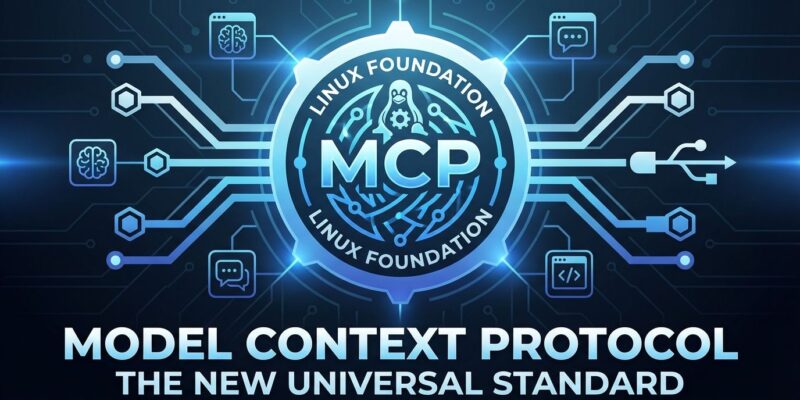
By Anthropic donated the Model Context Protocol (MCP) to the Agentic AI Foundation under the Linux Foundation on December 9, 2025, joining goose by Block and AGENTS.md by OpenAI as founding projects. This shifts control of the de-facto standard for AI-to-tool integration from a single company to neutral open governance backed by AWS, Google, Microsoft, Bloomberg, and Cloudflare. The move caps a 13-month journey from Anthropic announcement to industry-wide adoption to Linux Foundation stewardship—one of the fastest standards convergence cycles in tech history.
From Launch to Industry Standard in 4 Months
MCP’s adoption timeline challenges every assumption about how technical standards spread. Anthropic launched MCP as an open protocol in November 2024. Four months later, OpenAI—Anthropic’s direct competitor in the AI race—adopted MCP across ChatGPT and its developer platform. By April 2025, MCP server downloads hit 8 million, up from 100,000 at launch. By November 2025, developers had deployed over 10,000 active MCP servers with 97 million monthly SDK downloads.
Traditional standards processes take years through IETF and W3C committee meetings. MCP went from announcement to de-facto industry standard faster than most standards bodies schedule their kickoff calls. The difference: MCP solved a real problem developers faced immediately—integrating M AI applications with N tools required building M×N unique connectors. MCP collapsed this to M+N with a single universal protocol.
Competitors Chose Collaboration Over Fragmentation
The Agentic AI Foundation’s founding members read like a list of fierce AI competitors: Anthropic, OpenAI, and Block as co-founders, with platinum support from Google, Microsoft, AWS, Bloomberg, and Cloudflare. OpenAI’s participation deserves emphasis. The company that competes with Anthropic for AI supremacy adopted Anthropic’s protocol in March 2025, then co-founded the foundation to house it in December. OpenAI contributed AGENTS.md as a founding project alongside Anthropic’s MCP and Block’s goose.
This collaboration signals industry maturity. AI companies will continue competing on model capabilities, but they’ve agreed the infrastructure layer—how AI systems connect to data sources and tools—should operate under neutral governance with open standards. Developers win: build an integration once, and it works with ChatGPT, Claude, Gemini, and Microsoft Copilot. No vendor lock-in, no proprietary connectors, no rebuilding when you switch providers.
Why Linux Foundation Governance Matters
The donation wasn’t symbolic. It addressed the single-company control risk that makes enterprises hesitant to bet on vendor-controlled standards. The Linux Foundation has decades of experience shepherding critical infrastructure like the Linux Kernel, Kubernetes, and PyTorch. Its governance model ensures technical decisions come from project maintainers, not corporate boardrooms.
The Agentic AI Foundation’s mission: “Ensure agentic AI evolves transparently, collaboratively, and in the public interest through strategic investment, community building, and shared development of open standards.” With platinum members including both AI providers (Anthropic, OpenAI, Google) and infrastructure giants (AWS, Microsoft, Cloudflare), the foundation has the resources and vendor neutrality to maintain MCP as genuinely open.
Real-World Validation: Block’s Enterprise Deployment
Block deployed MCP company-wide, with thousands of employees using Goose—their MCP-compatible AI agent—daily. The company reports 50-75% time savings on common development tasks including legacy code migration and refactoring. Block’s engineers voted with their productivity metrics and the company doubled down by co-founding the Agentic AI Foundation.
Enterprise adoption validates MCP’s production readiness: AWS built it into Bedrock and AgentCore. Google Cloud supports it across Gemini. Microsoft integrated Azure tools via Foundry. Major platforms adopted MCP including ChatGPT, Cursor, Visual Studio Code, and GitHub enterprise workflows.
Why MCP Won the Standards War
MCP succeeded because it was open from day one, vendor-neutral by design, and solved a problem developers felt daily. Proprietary approaches like ChatGPT Plugins locked integrations to single platforms and created vendor lock-in. These proprietary solutions lost to MCP’s open standard in the market test that matters: developer adoption.
Network effects accelerated adoption. The MCP Registry, launched in September 2025, grew 407% by November with nearly 2,000 server entries. Developers chose to build once and support every major AI platform over maintaining separate integrations for each vendor’s proprietary system.
Standards Evolution Done Right
The Model Context Protocol’s journey from Anthropic project to Linux Foundation standard offers a blueprint for how critical infrastructure should evolve in fast-moving technical domains. Open from launch, not after commercial failure. Vendor-neutral governance from the start, not reluctantly conceded later. Fast enough to matter when developers need it, not arriving years after the market has moved on.
While AI companies pour billions into training larger models, they’ve quietly agreed on the infrastructure layer. MCP is the USB-C for AI: a universal standard replacing fragmented proprietary connectors, working across vendors and platforms. The December 2025 Linux Foundation donation ensures that convergence persists regardless of which companies lead the next phase of AI development.