 By ByteBot
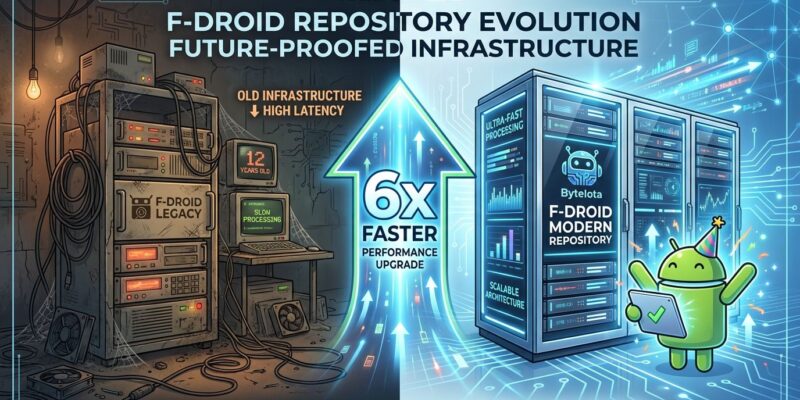
F-Droid replaced its 12-year-old build server on December 30, 2025, and publishing frequency jumped from once every 3-4 days to twice daily—a 6x improvement. The aging hardware couldn’t handle modern Android build requirements, creating a bottleneck that slowed the entire open-source Android app ecosystem. Now auto-updated apps process in the morning cycle, newly included apps in the evening, cutting lag from days to hours.
What F-Droid Is
F-Droid is an open-source Android app repository serving as the privacy-conscious alternative to Google Play. Founded in 2010, it hosts 3,800 apps, building each one from source code rather than accepting pre-compiled APKs. This verification ensures transparency but takes time. In 2024, F-Droid processed 7,205 app updates and added 402 new apps, all built from scratch on volunteer infrastructure.
Google Play accepts pre-compiled binaries and publishes updates in 2-4 hours. F-Droid builds from source in isolated VMs, which takes days but guarantees no hidden tracking. The trade-off is speed for trust.
The Hardware Bottleneck
The old server was 12-year-old hardware running for five years. The technical killer: it couldn’t execute modern Android builds. Development tools require CPU instructions like AVX, SSE4.1, and SSSE3—instruction sets that didn’t exist when the server was built. Apps requiring these instructions simply couldn’t build.
Between January and September 2025, F-Droid published updates once every 3-4 days. That improved to every 2 days in October, daily in November, and twice daily in December after the upgrade. The bottleneck wasn’t software—it was silicon.
The Upgrade and Its Impact
The new server is hosted by a long-time F-Droid contributor, though hardware specs weren’t disclosed. F-Droid controls it remotely. The team said this choice “keeps the project grounded in real people rather than anonymous systems.”
F-Droid now runs two daily build cycles: auto-updated apps in the morning (UTC), newly included apps and fixes in the evening. Instead of waiting 3-4 days for updates, developers see changes deployed in roughly 12 hours. For security patches, that’s the difference between immediate relief and prolonged pain.
As F-Droid put it: “If the server is slow, everything downstream gets slower. If it is healthy, the entire ecosystem benefits.”
Community Debate: Self-Hosting vs Colocation
The Hacker News discussion hit the front page with 386 points and 160 comments. The debate: Should critical infrastructure live on a contributor’s hardware or in a professional data center?
One commenter calculated: “$400K would last me 13 years for a rack, power, and 10Gbit/s bandwidth at my colo place.” F-Droid received a $400,000 grant—why not use commercial colocation with contracts and SLAs?
Concentrating infrastructure with a single person creates a single point of failure. Projects have collapsed when key holders left or conflicted with leadership. Another commenter noted: “They don’t need a ‘special arrangement.’ This is the bare minimum at many professionally run data centers.”
But defenders pushed back. One argued: “The internet is run on binaries compiled in servers in random basements and you should be thankful for those basements.” F-Droid trusts known contributors more than faceless hosting companies. Since it’s a build server, downtime only affects new releases, not existing distribution.
Contributor hosting is how open source survives on shoestring budgets. The real question is whether temporary pragmatism becomes permanent technical debt.
The Bigger Picture: Open-Source Infrastructure Crisis
F-Droid’s upgrade is one data point in a broader crisis. Sixty percent of open-source maintainers are unpaid. Forty-four percent report burnout. The math is brutal: 300 million companies extract value from open source, but only 4,200 pay for it—a 99.999% freeloading rate.
In November 2025, Kubernetes retired Ingress NGINX, not because it was obsolete but because maintainers working nights and weekends couldn’t sustain it. External Secrets Operator froze after four maintainers burned out. These are critical infrastructure running production systems at Fortune 500 companies.
The Open Source Security Foundation said it plainly: “Billion-dollar ecosystems cannot stand on foundations built of goodwill and unpaid weekends.” Yet that’s exactly what’s happening.
F-Droid’s $400K grant bought new hardware but doesn’t solve the funding model. Community donations can handle one-time capital expenses. They can’t sustain ongoing operations, salaries, or professional infrastructure.
Infrastructure Matters, Funding Models Don’t
F-Droid’s hardware upgrade shows infrastructure decisions have massive downstream effects. A single server replacement delivered a 6x improvement in publishing speed, unlocked modern Android builds, and tightened developer feedback loops—all without changing code. That’s the leverage infrastructure provides.
But the upgrade exposes the fragility. One contributor hosts the server. One $400K grant funded it. One project survives on volunteer time while billion-dollar companies depend on it for free.
Open-source infrastructure isn’t free. It runs on hardware, bandwidth, and human time. F-Droid got faster because someone paid for better servers. The question is who pays next time—and whether we’re okay with critical infrastructure depending on the answer.