 By ByteBot
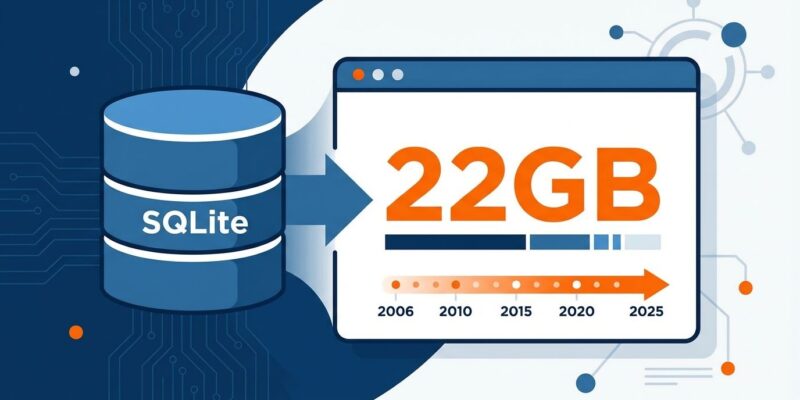
A developer released HackerBook on December 31, 2025 – a complete 22GB SQLite archive containing 20 years of Hacker News data from 2006 to 2025. Within hours, the project hit #6 on Hacker News’ front page with 480 points and 158 comments, creating a meta moment: the tech community celebrating an archive of itself. This isn’t just nostalgia. It’s a showcase of SQLite handling massive datasets entirely in a browser, a preservation effort for two decades of developer discourse, and proof that offline-first architecture is viable at scale.
SQLite in a Browser: How It Actually Works
The clever part isn’t the size – it’s the delivery. HackerBook runs entirely in your browser using SQLite compiled to WebAssembly. However, you’re not downloading all 22GB upfront. Instead, the system fetches only the database “shards” needed for the page you’re viewing. The full archive consists of 80.6GB of raw data compressed into 12.5GB of gzipped, time-based SQLite shards. When you navigate to a discussion from 2015, your browser pulls only that shard using HTTP range requests.
One Hacker News commenter noted the architecture “resembles that brilliant SQLite.js VFS trick using HTTP range headers” from a few years back. Similar patterns exist in PMTiles for map data and DuckDB for querying remote Parquet files. Moreover, seeing it work for a 20-year community archive is different. Users reported HackerBook running “faster than actual HN on mobile.” No backend. No server costs. Just static files and WASM doing heavy lifting.
What You Can Actually Do With 20 Years of HN
Full-text search across two decades of tech discussions is the obvious use case. Want to know when Rust started gaining serious traction in the developer community? Or track how AI sentiment shifted from skepticism to hype to skepticism again? The data’s all there. Furthermore, researchers have already mined Hacker News for insights.
One analysis of 1.8 million headlines from February 2007 to June 2025 found database technology trends, calling HN “a real-time barometer of developer excitement.” Another study found “machine learning” was the most common bigram in HN discussions, with “silicon valley” coming in second. Investors use this data to identify emerging startups and sectors before they hit mainstream radar.
HackerBook makes this research accessible without hitting API rate limits or writing scrapers. Download the archive, run local queries, analyze trends offline. You can even find your own posts from any date in the last 20 years – the “Me” view feature shows your entire posting history. The retention data is telling: 20% of Hacker News users are still active five years after joining. That’s a community worth archiving.
A Community Archiving Itself
The reception on Hacker News itself was warm. One commenter called it “a thoughtful Year End gift.” The timing – December 31, 2025 – felt symbolic. The tagline “All the HN Belong to You” emphasized community ownership.
The discussion thread showcased what developers care about: technical implementation details, potential integrations with Kiwix for offline mobile browsing, and performance optimizations for cross-shard queries. Nevertheless, there were concerns too – Firefox compatibility issues due to SharedArrayBuffer limitations, sequential shard processing slowing some queries, and the GitHub repository initially returning a 404 because the creator forgot to make it public.
This isn’t just about convenience. It’s about data preservation. Developer communities fear data loss when APIs shut down or services change hands. By creating a static, offline-capable archive, HackerBook ensures 20 years of tech community history isn’t hostage to a single company’s API decisions.
The SQLite Renaissance
HackerBook arrives amid growing recognition that SQLite is not a toy database. The perception that SQLite is “just for mobile apps” or “embedded systems” is outdated. Discord, Figma, and Notion run SQLite at production scale. Benchmarks show SQLite can handle 100,000 SELECT queries per second with proper configuration, and in some tests it’s 35% faster than filesystem operations.
The offline-first movement is driving this shift. SQLite compiled to WebAssembly enables full SQL databases with millions of rows running entirely in the browser. Progressive web apps, desktop applications, and even edge computing scenarios benefit from SQLite’s simplicity: no server, no configuration, just a single file. SQLite even has an official Archive format called SQLAR, designed specifically for packaging data like this. HackerBook proves the concept works at scale.
Why do we default to PostgreSQL for everything? For many use cases – especially read-heavy, offline-capable, or edge-deployed applications – SQLite is the better choice. HackerBook demonstrates this perfectly: a 22GB database serving hundreds of concurrent users from static hosting, with zero backend infrastructure.
Trade-offs and Takeaways
To be fair, there are limitations. Firefox users hit SharedArrayBuffer restrictions. Some queries processing shards sequentially take longer than ideal. The database is read-only by design, which makes sense for an archive but limits interactive features. These aren’t failures – they’re design trade-offs.
But the core idea works. SQLite is underrated for data archiving and distribution. Offline-first architecture is viable and powerful. Data preservation matters for understanding tech history. And when communities take ownership of their own data, they create resources that outlast any single platform.
HackerBook is downloadable now. Twenty years of developer conversations, technology debates, startup launches, and framework wars – all in a single SQLite archive that runs in your browser. The fact that the Hacker News community immediately recognized its value says everything about why it needed to exist.