 By ByteBot
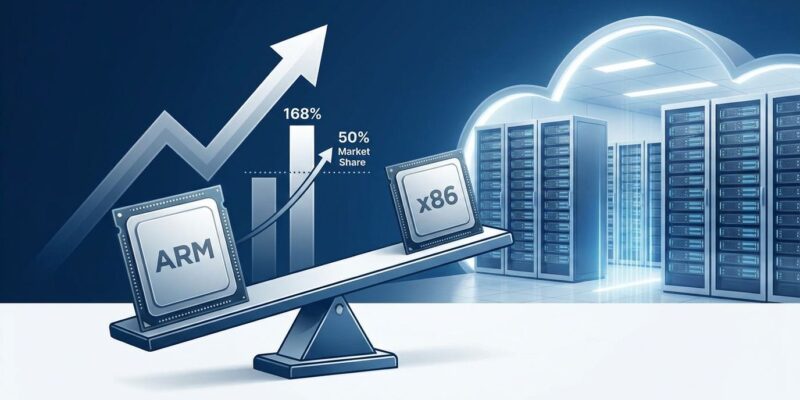
ARM processors hit 50% of hyperscaler compute in 2025, officially ending x86’s four-decade dominance in cloud infrastructure. This isn’t a future prediction—it’s current reality. AWS, Google, and Microsoft all ship more than half their new capacity as ARM-based chips, driven by economics that are impossible to ignore: Netflix saves $15 million annually by migrating video encoding to AWS Graviton, while achieving 20% faster processing. The tipping point is behind us, not ahead. x86 is now the specialized architecture, ARM is the default.
ARM Crushes x86 in 2025 Benchmarks
The performance gap isn’t marginal—it’s shocking. AWS Graviton4 processors deliver 168% higher performance than AMD EPYC for LLM workloads and 162% better than Intel Xeon. For sustained transactional work, Graviton4 beats Intel by 13% and AMD by 8%. These aren’t edge cases—they’re the workloads powering modern cloud infrastructure.
The secret weapon? Memory bandwidth. ARM Graviton3 delivers 115-120 GB/s, nearly double Intel Xeon’s 60-70 GB/s and significantly ahead of AMD EPYC’s 80-90 GB/s. For databases, in-memory caching, and ML inference—the workloads that matter most in 2025—memory bandwidth is the bottleneck. ARM eliminated it.
Real-world results confirm the benchmarks. Airbnb measured 25% performance improvements over x86 for production search workloads on Graviton5. Synopsys EDA tools saw 35% runtime reductions. Honeycomb achieved 36% better throughput per core for their ingest pipeline, with 20-25% lower latency. The pattern is consistent: ARM wins, often by large margins.
Netflix’s $15M Lesson: ARM Cost Savings Are Real
Netflix migrated 70% of its video encoding infrastructure to AWS Graviton3 and saved $15 million annually. The migration delivered 30% lower compute costs and 20% faster processing times while maintaining identical encoding quality. That’s not a tradeoff—it’s a pure economic win.
The per-instance economics explain why. ARM instances cost 18-20% less per hour than equivalent x86 instances. But the real advantage compounds when you factor in performance: a c7i.2xlarge (x86) versus r8g.xlarge (Graviton4) comparison shows Graviton4 delivers 9% better performance at 33% lower cost. Combined, that’s 42% better price-performance. Scale that across thousands of instances and millions of dollars in annual cloud spend, and the ROI becomes undeniable.
The market proves it. Over 90,000 AWS customers run Graviton workloads, including 98% of the top 1,000 EC2 users. AWS reports that Graviton accounts for more than 50% of new CPU capacity deployed for three consecutive years. These aren’t experiments—they’re production migrations at enterprise scale.
ARM Hits 50%: The Architecture Shift is Complete
2025 marks the year ARM crossed 50% of compute shipped to top hyperscalers, according to ARM’s official data confirmed through three quarters of shipments. The shift isn’t limited to AWS. Google ported 30,000 applications to ARM, including YouTube, Gmail, and BigQuery. Microsoft deployed Cobalt 100 and Cobalt 200 processors for both internal services and Azure customers. Oracle offers ARM instances. The entire cloud industry committed to ARM simultaneously.
Meanwhile, x86 crumbles. Intel’s server CPU market share dropped to 62% in mid-2025, down from historical dominance above 80%. Analysts project Intel will fall to 55% by year-end 2025 and below 50% by 2027. AMD is gaining share—rising from 24% to 33% and projected to hit 40% by 2027—but both Intel and AMD are losing ground to ARM’s 70% year-over-year growth rate. The x86 duopoly is fighting each other while ARM takes the market.
Docker Makes ARM Migration Trivial (Except Windows)
The migration complexity myth needs to die. Modern Docker supports multi-platform images: build once with docker buildx, deploy to both ARM and x86 with a single manifest. Many AWS customers complete Graviton migrations “in just hours” according to official testimonials. If you’re running containerized workloads—which is most of the cloud—architecture migration is a non-issue.
Certain workloads see disproportionate gains. Machine learning inference drops costs by 25-35% on ARM due to memory bandwidth advantages. Video encoding sees 30% cost reductions (Netflix’s proof point). Databases run 40% faster on Graviton4 versus Graviton3, with Amazon Neptune benchmarks showing 4.7x write throughput and 3.7x read throughput improvements. Web applications run 30% faster, and large Java applications run 45% faster on Graviton4.
Modern programming languages handle ARM seamlessly. Python, Java, Node.js, Go, Rust, and .NET Core all support ARM64 with minimal friction. Compiled applications need a recompile for ARM64, but the toolchains (GCC, Clang, language-specific compilers) all support ARM as first-class targets.
The one legitimate exception: Windows. AWS doesn’t offer Windows on Graviton instances, which forces .NET Framework applications, Active Directory domain controllers, and legacy Windows services to x86. This is x86’s only real advantage in 2025—not performance, not cost, just platform availability. If Microsoft ships Windows Server for ARM on Azure (Cobalt instances), even this holdout disappears.
x86’s New Role: Specialized, Not Default
The architecture roles have reversed. Building new cloud infrastructure on x86 in 2025 means choosing the legacy path, not the modern one. ARM is the default for new workloads—better performance, lower cost, superior energy efficiency (60% less power consumption per the AWS Graviton spec). x86 survives where Windows is required or legacy dependencies lock you in, but those are constraints, not choices.
Intel and AMD are responding, but slowly. Intel’s Diamond Rapids chips face potential six-month delays. AMD’s EPYC roadmap is strong but focused on beating Intel, not ARM. Neither x86 vendor has shipped a response that slows ARM momentum. The market already decided.
The next two years will cement ARM’s dominance. Analysts project ARM will capture 10-12% of global server CPU revenue within 2-3 years, while Intel drops below 50% market share. Developer tooling, ISV support, and ecosystem maturity all favor ARM now. The question isn’t whether ARM will dominate cloud—it already does. The question is how fast the remaining x86 workloads migrate.
If you’re architecting cloud infrastructure today, default to ARM unless you have a specific reason not to. The data is overwhelming: better performance, lower cost, proven at scale. x86 had its run. The cloud belongs to ARM now.