 By ByteBot
Developers Use AI Daily But Don’t Trust the Output: Stack Overflow 2025 Survey
Stack Overflow’s 2025 Developer Survey, released December 29, exposes a fundamental tension in modern software development: 80% of developers now use AI tools in their workflows, yet trust in AI accuracy has plummeted from 40% to just 29% over the past year. While 65% of developers use AI coding tools at least weekly, this “willing but reluctant” adoption pattern reveals that AI’s integration into development is far messier than vendor marketing suggests.
The “Almost Right, But Not Quite” Problem
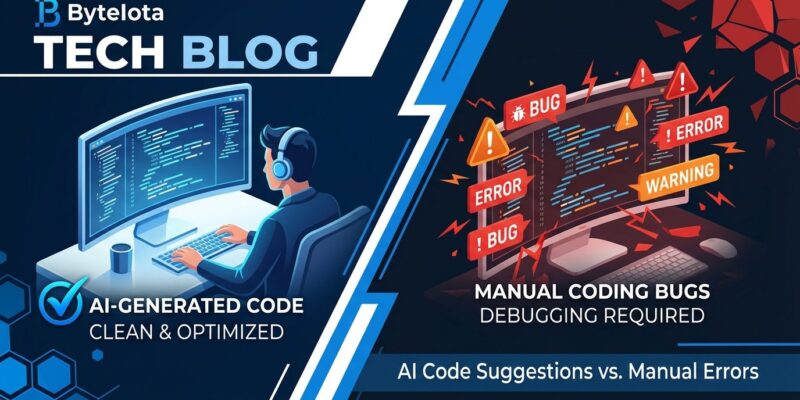
The survey identifies the core frustration: 45% of developers cite AI solutions that are “almost right, but not quite” as their top complaint. This isn’t about obvious bugs that throw errors during compilation. It’s about subtle logic errors that pass initial tests but fail in edge cases, requiring deep code review to catch.
The result? 66% of developers report spending more time fixing flawed AI-generated code than they would have spent writing it from scratch. When trust falters, developers revert to human consultation: 75% say they would ask another person for help rather than rely on uncertain AI answers. This creates a paradox where AI tools are simultaneously indispensable and unreliable.
Even AI Tool Makers Warn Against Over-Reliance
Michael Truell, CEO of Cursor (a leading AI coding IDE), recently warned developers against “vibe coding” – a method where developers “close your eyes and you don’t look at the code at all and you just ask the AI to go build the thing for you.”
His warning is stark: “If you close your eyes and you don’t look at the code and you have AIs build things with shaky foundations as you add another floor, and another floor, and another floor, things start to kind of crumble.”
The Stack Overflow survey backs this up: 72% of professional developers don’t use vibe coding in their work. When even the CEO of an AI coding tool tells you not to rely too heavily on his product, that should tell you something about the current state of the technology.
The Junior Developer Catastrophe No One Talks About
While the trust paradox affects experienced developers, the impact on early-career developers is devastating. A Stanford University study found that employment among software developers aged 22-25 fell nearly 20% between late 2022 and July 2025 – precisely the period when AI coding tools went mainstream.
The numbers are brutal: entry-level tech hiring is down 25% year-over-year, tech internship postings have declined 30% since 2023, and 70% of hiring managers now believe AI can perform intern-level work. Perhaps most telling: 57% trust AI output more than work from recent graduates.
This creates an experience paradox. Entry-level positions now require 2-5 years of experience (up from the historical 1-2 year requirement), yet the opportunities to gain that experience have vanished. Companies expect humans to have years of hands-on experience they’re no longer providing opportunities to gain. With 97% of CS students now using AI during their education, an entire generation may bypass the discovery phase of learning that builds foundational problem-solving skills.
AI Code Quality: The Data Doesn’t Lie
The trust deficit isn’t irrational fear. It’s backed by hard data. An Ox Security report found that AI-generated code contains 1.75x more logic and correctness errors compared to human-written code, along with 1.64x more code quality issues, 1.57x more security vulnerabilities, and 1.42x more performance problems.
The characterization is damning: AI code is “highly functional but systematically lacking in architectural judgment.” Google’s DORA report found that a 25% increase in AI usage leads to a 7.2% decrease in delivery stability. GitClear’s analysis reveals an 8x increase in duplicated code blocks since 2022, with code refactoring dropping significantly.
The ultimate irony: we now have AI-powered code review tools emerging specifically to catch errors in AI-generated code. We need AI to check AI.
The New Developer Reality
AI coding tools aren’t going away. 80% adoption is irreversible, and the technology will improve. But the trust gap reveals an uncomfortable truth: current AI tools are assistants with significant limitations, not autonomous developers.
Microsoft and Google claim approximately 25% of their code is now AI-generated, but their developers clearly maintain skeptical oversight. The smart approach is selective use: autocomplete and boilerplate generation (high trust), debugging assistance (medium trust), and heavy review of full feature generation (low trust).
The profession is evolving. Verification, architecture, and critical thinking are becoming the core competencies, while rote coding becomes increasingly automated. The junior developer crisis, however, remains unsolved and urgent. If companies automate away entry-level work while still expecting years of hands-on experience, where does the next generation of senior developers come from? That’s not a paradox – it’s a looming industry failure.