 By ByteBot
Low-code platforms crossed the mainstream adoption threshold in 2025. Seventy percent of new enterprise applications now use low-code or no-code technologies—a 280% jump from 25% in 2020, according to Gartner. Citizen developers building apps without traditional coding skills outnumber professional developers 4 to 1. Eighty percent of U.S. businesses actively use low-code tools, and 87% of enterprise developers leverage low-code for at least some of their work.
Companies like Ricoh report 253% ROI and payback in seven months. Schneider Electric launched 60 apps in 20 months using low-code platforms. For developers, this shift raises critical questions: What happens when non-developers build most enterprise software? Where do professional skills fit? What are the hidden costs of rapid, template-driven development?
The economics are compelling for specific use cases—90% faster development, $4.4 million in avoided hiring costs over three years. But vendor lock-in affects 83% of migration attempts, 39% of business leaders say low-code can’t solve advanced problems, and security governance remains an afterthought. Low-code is mainstream. That doesn’t mean it’s simple.
The Market Hit Critical Mass
In 2020, less than 25% of enterprise apps used low-code. By 2025, that number hit 70%—a 280% increase in five years. The market grew from $10 billion in 2019 to $28.75 billion in 2024, projected to reach $264.4 billion by 2032 at a 32.2% compound annual growth rate.
Gartner forecasts that 75% of new enterprise applications will use low-code by 2026, and 80% of low-code users will be outside traditional IT departments—up from 60% in 2021. This isn’t a niche tool anymore. If you’re a professional developer and haven’t encountered low-code in your organization, you will soon.
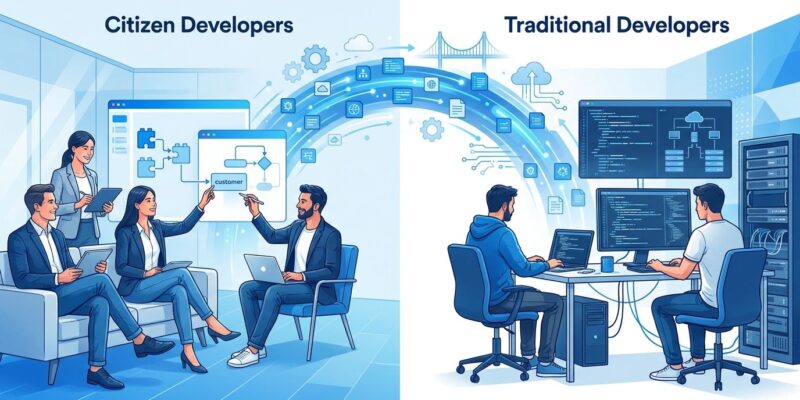
The citizen developer workforce now outnumbers professional developers 4 to 1. Sixty percent of custom apps are built by employees outside the IT department. Forty-one percent of companies have active citizen development programs, with another 20% evaluating options. The shift from “IT builds everything” to “business users build most things” is complete.
The Economics Are Real (For the Right Use Cases)
The ROI data explains why enterprises moved so quickly. Ricoh replaced legacy systems with a low-code platform and achieved 253% ROI with payback in just seven months. Schneider Electric launched 60 apps in 20 months, with most delivered in 10 weeks. Australian bank Bendigo created 25 customer-centered apps in 18 months—considerably less time and much cheaper than hand-coding similar applications.
Generic ROI metrics mirror these case studies: 90% reduction in development time, 70% cost reduction compared to traditional development, and $4.4 million saved over three years by avoiding two developer hires. A Forrester study found OutSystems customers realized 506% ROI over three years, recovering their initial investment in under six months.
But these wins apply to a specific category of applications. Most enterprise software is straightforward: CRUD operations, workflow automation, dashboards, approval processes, data entry forms, and employee portals. These represent roughly 70% of enterprise apps, and low-code platforms excel at building them. The other 30%—performance-critical systems, novel algorithms, complex custom logic, and competitive differentiation features—still require traditional development.
Your organization will push low-code for internal tools, automations, and standard business apps. That’s the right decision. Resist the temptation to hand-code everything. Save engineering time for the 30% that actually matters for competitive advantage: real-time trading platforms, ML model training pipelines, novel recommendation engines, and high-concurrency gaming backends. Low-code can’t build those, and it shouldn’t try.
Hidden Costs Nobody Talks About
Vendor lock-in is severe. Eighty-three percent of data migration projects fail or exceed budget, according to Gartner. Migrating between low-code platforms requires “starting from scratch remodeling everything”—the data model, graphical interface, workflows, and business logic. You can port code from AWS to Google Cloud. It’s painful, but doable. You can’t port a Mendix app to OutSystems without rebuilding from scratch.
Traditional vendor lock-in locks you into cloud providers. Low-code vendor lock-in locks you into higher abstraction layers with proprietary frameworks. The migration barrier is taller.
Customization limits hit quickly. Thirty-nine percent of business leaders report limited customization as a significant challenge. The same percentage believe low-code tools aren’t suitable for advanced problems. Platforms use templated approaches that speed development but limit flexibility. Projects with specific requirements face issues when they outgrow the template.
Security governance is often an afterthought. OWASP identifies top security risks from citizen development: injection flaws, unauthorized data access, security bypasses, and third-party connector vulnerabilities. Citizen developers “typically have little or no understanding of compliance or secure coding,” as one security analysis noted. Many companies assume platform built-in capabilities are sufficient for GDPR and HIPAA compliance. They’re not.
Performance and scalability limits are real. Some platforms struggle with highly complex or large-scale applications due to lack of fine-grained architectural control. Scarce debugging tools force teams to seek specialized technical support for advanced system problems. Without backward compatibility, platform component updates can break functionality.
Everyone celebrates low-code “democratization.” But enterprises are trading explicit technical debt—code complexity—for implicit platform debt: proprietary frameworks, vendor dependencies, and governance gaps. The debt doesn’t disappear. It just moves.
How Developer Roles Are Evolving
Professional developers aren’t being replaced—they’re shifting up the stack. Eighty-seven percent of enterprise developers already use low-code for some work. It’s a tool, not a threat. Frontend work has shifted from writing every line of code to orchestrating systems: integrating AI suggestions, validating low-code components, enforcing design systems, and ensuring security and performance at scale.
The new high-value skills: platform engineering (building custom components and reusable modules), API design (connecting low-code platforms to external systems and legacy infrastructure), governance (setting up guardrails and security policies for citizen developers), and architecture (deciding when to use low-code versus custom development).
If you’re writing CRUD apps from scratch in 2025, you’re doing work a citizen developer can do faster. Shift focus to building the platforms citizen developers use, designing the APIs they consume, governing the apps they create, and architecting the systems that connect everything. Your job isn’t to write every line of code. It’s to ensure the right code gets written—whether by you, a citizen developer, or a low-code platform—and that it all works together securely at scale.
The 70/30 Decision Framework
The question isn’t “Will low-code replace developers?” The real question is: “Which 70% of your apps are boring enough for low-code, and which 30% require actual engineering?” Get that decision right, and low-code becomes a force multiplier. Get it wrong, and you’re trading technical debt for platform debt.
Low-code works for the majority of enterprise apps that don’t differentiate your business: internal tools, workflow automation, standard dashboards, approval processes, and data entry systems. Use it there. Professional developers should focus on the 30% that actually matter—the systems that create competitive advantage, require custom innovation, or demand performance at scale. That’s where engineering skill still wins.
The low-code revolution is real. Seventy percent adoption, $264 billion market, and 4-to-1 citizen developer ratios prove it’s mainstream. The economics are compelling: 253% ROI, 90% faster development, and millions in cost avoidance. But vendor lock-in is severe (83% migration failure rate), customization limits hit at 39%, and security governance gaps persist.
For developers, the path forward is clear: Embrace low-code for the 70% of boring apps, but double down on engineering skills for the 30% that differentiate. Platform engineering, API design, governance, and architecture are the new high-value skills. The code still needs to get written. You’re just deciding the best way to write it.