 By ByteBot
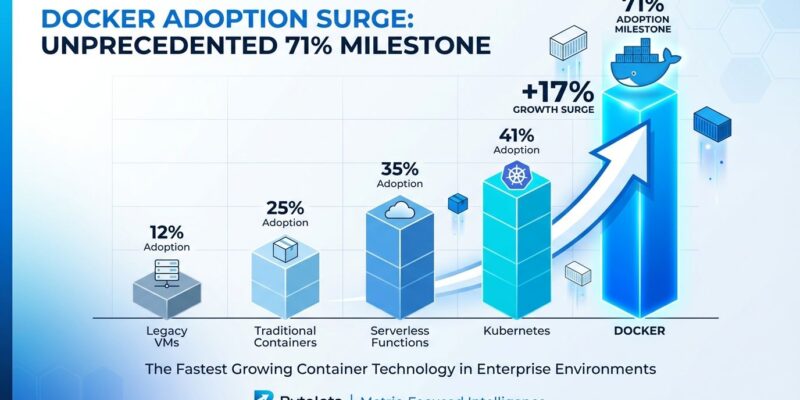
Docker just achieved the largest single-year adoption jump of any technology in Stack Overflow’s 2025 Developer Survey, surging +17 percentage points to reach 71.1% overall adoption and 73.8% among professional developers. In a survey of 49,000+ developers across 177 countries analyzing 314 technologies—published December 29, 2025—Docker’s growth outpaced even Python (+7%) and Redis (+8%), prompting Stack Overflow to declare containers “a near-universal tool.” This isn’t incremental growth. It’s the tipping point where containerization shifts from specialized DevOps skill to baseline infrastructure knowledge, with industry experts predicting Docker will hit 80-90% adoption by 2027, mirroring Git’s trajectory to universal developer competency.
Why Docker’s +17% Jump Matters
The magnitude of Docker’s surge dwarfs every other technology measured. While Python’s +7% growth grabbed headlines in AI circles and Redis climbed +8% on caching demand, Docker’s +17 percentage point jump represents the largest single-year increase in the survey’s history. Among professional developers specifically, adoption reached 73.8%, and among developers using AI tools, it hit 75%.
At 71-74% adoption, Docker crosses a critical threshold. This isn’t “popular tool” territory anymore—it’s approaching the 80-90% universal baseline where job listings simply assume competency rather than list it as a requirement. Think Git at ~95% adoption. Ten years ago, listing Git on your resume meant something. Today, not knowing Git disqualifies you. Docker is on that same trajectory, and the +17% surge signals we’re past the tipping point. Within 2-3 years, Docker literacy will shift from bonus qualification to assumed baseline, fundamentally changing what “full-stack developer” means.
The 92% vs 30% Divide: Docker Adoption Isn’t Universal
Here’s what the headline numbers hide: container usage among IT professionals soared to 92% in 2025 (up from 80% in 2024), but only 30% of developers across all industries use containers. That’s a 62-point gap, and it reveals an inconvenient truth: Docker adoption is architecture-driven, not universally necessary.
The Docker 2025 State of App Dev report explains why. IT industry respondents work with microservice-based architectures 68% of the time versus 31% in other industries. Microservices demand containerization for modularity and scaling. Monolithic applications in finance, healthcare, or retail? Not so much. Docker’s surge is real, but it’s concentrated in cloud-native, microservices-heavy sectors. The remaining 70% in non-IT industries may never need Docker—and that’s fine.
This divide challenges the assumption that “everyone should learn Docker.” If you’re building greenfield microservices on Kubernetes, yes, Docker is table stakes. If you’re maintaining a legacy .NET monolith, containerization might be engineering overhead without proportional benefit. Universal adoption doesn’t mean universal necessity.
Why Now? The Cloud-Native/Kubernetes Convergence
Docker’s 12-year-old technology hitting mass adoption in 2025 isn’t about Docker itself—it’s about the ecosystem maturing around it. Gartner estimates 95% of new digital workloads will be on cloud-native (mostly containerized) platforms by 2025, up from 30% in 2021. Kubernetes adoption is projected to reach 90% of enterprises by 2027 (currently 60%). Since Kubernetes orchestrates containers, Docker skills become mandatory infrastructure knowledge.
CI/CD pipelines have standardized on containerization. GitHub Actions, GitLab CI, CircleCI—all use Docker for build environments. Development workflows shifted dramatically: 64% of developers now use non-local environments as their primary setup (up from 36% last year), and personal remote dev environments or clusters doubled to 22% (from 11% in 2024). Those remote environments? Docker-based.
The convergence is complete. Cloud-native architectures no longer represent bleeding-edge experimentation—they’re consolidated reality. Microservices matured from hype to practice. Kubernetes went from “emerging technology” to enterprise standard. Docker rode that wave, and the +17% surge reflects not Docker innovation, but infrastructure evolution demanding containerization as the foundation layer.
The Contrarian Take: Universal Adoption Doesn’t Mean Optimal Fit
Docker won by becoming the default. But winning by default doesn’t mean winning on merit. According to the 2025 CNCF survey, 40% of developers are exploring alternatives like Podman (which claims 30% faster builds and rootless execution) and containerd (Kubernetes’ default runtime with minimal overhead). Docker Desktop’s licensing changes—paid subscriptions for companies with >250 employees or >$10M revenue—accelerated this exploration.
Podman’s daemonless architecture eliminates Docker’s centralized daemon (a single point of failure requiring root privileges). containerd, as a CNCF graduated project and Kubernetes default, offers production-optimized performance with less overhead. For security-critical environments, Podman’s rootless containers are objectively superior. For Kubernetes production, containerd is more efficient. For simple applications, Docker adds complexity without proportional value.
The debate: Are developers using Docker because they need it, or because everyone else does? Cargo-culting prevails in software. Docker’s 71% adoption signals standardization, but standardization sometimes means “we all made the same mistake together.” A Forrester study shows Docker adopters achieved 66% infrastructure cost reduction and 43% productivity increases—but those gains concentrate in microservices deployments, not simple apps where Docker might be engineering overkill.
What’s Next: Path to 90% or Plateau at 75%?
Industry predictions suggest Docker could hit 80-90% adoption by 2027, mirroring Git’s near-universal status. Market indicators support this: the Docker container market will grow from $6.12B in 2025 to $16.32B by 2030 (21.67% CAGR), with 13+ billion container downloads per month. Educational institutions are adding Docker to CS curricula and bootcamps, normalizing it as baseline developer knowledge.
But what’s holding back the remaining 25-30%? Legacy monoliths that can’t easily containerize. Simple applications where Docker is complexity overhead. Industries outside IT (that 30% vs 92% gap). Companies avoiding Docker Desktop licensing costs. Developers choosing Podman or containerd instead. The question isn’t whether Docker hits 90%, but whether that’s universally beneficial or another case of tech industry groupthink.
The trajectory mirrors Git’s. In 2010, listing Git proficiency mattered. By 2015, employers assumed it. Docker’s +17% surge in 2025 places us at Docker’s 2012-2013 equivalent. By 2027-2028, “Do you know Docker?” won’t be a job interview question—it’ll be an assumed prerequisite. Whether that’s progress or cargo-cult standardization depends on whether you’re building microservices or maintaining monoliths.
Key Takeaways
- Docker’s +17% surge is the largest single-year increase of any technology in Stack Overflow’s 2025 survey (49K respondents, 177 countries)
- 71-74% adoption marks the tipping point from “popular tool” to “baseline skill”—expect 80-90% by 2027 (Git-like ubiquity)
- IT professionals 92% vs all industries 30% reveals Docker adoption is architecture-specific (microservices, cloud-native), not universal necessity
- Kubernetes/cloud-native maturation drives Docker demand: 95% of new workloads cloud-native, K8s adoption 60% → 90% by 2027
- 40% exploring alternatives (Podman, containerd) despite Docker’s dominance—universal adoption doesn’t guarantee universal optimality