 By ByteBot
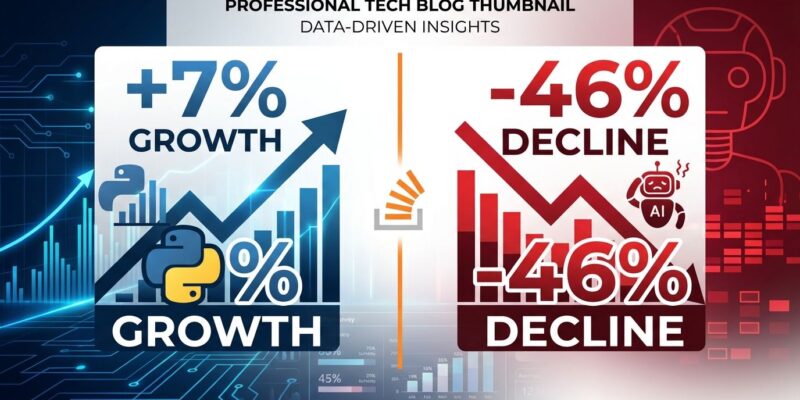
Stack Overflow’s 2025 Developer Survey reveals a striking contradiction. 84% of developers use AI tools. Yet 46% don’t trust their accuracy—up from 31% distrust just one year ago. Here’s the twist. While developers express growing skepticism about AI, they’re simultaneously betting their careers on AI-first technologies. Python adoption jumped 7 percentage points, the largest increase in over a decade. AI and machine learning workloads drive this growth almost entirely. The survey of 49,000+ developers across 177 countries exposes the gap. Developers say they’re skeptical of AI. Yet they adopt Python, FastAPI, and AI-focused infrastructure.
AI Trust Collapses While Usage Climbs
The numbers tell a paradoxical story. Developer trust in AI tool accuracy dropped 10 percentage points year-over-year, falling from 43% to just 33%. Meanwhile, AI tool adoption surged to 84%, up from 76% in 2024. The gap is widening. More developers use AI tools they don’t trust.
The frustrations highlight specific issues. 66% of developers cite “AI solutions that are almost right, but not quite” as their biggest pain point. 45% report that debugging AI-generated code takes more time than writing it themselves. This isn’t theoretical skepticism. It’s a productivity tax developers pay daily. Furthermore, 20% report decreased confidence in their own problem-solving skills. Positive sentiment for AI tools dropped from 70% in 2023-2024 to 60% in 2025.
Yet the usage numbers tell a different story. 82% of developers use OpenAI’s GPT models. 45% of professional developers use Anthropic’s Claude Sonnet. Developers aren’t enthusiastic about AI tools. They’re using them critically out of professional necessity.
The survey also measured attitudes toward “vibe coding”—generating software from AI prompts without writing code yourself. 77% of professional developers reject it. Only 11.9% actively participate. The line is clear. AI assistance is acceptable. However, prompt-based code generation without understanding isn’t professional engineering. Developers draw a hard boundary between using AI tools and relying on them.
Python Surges on AI Career Logic
While developers question AI’s reliability, they’re making a different bet with their careers. Python adoption reached 57.9%, a 7-percentage-point jump from 2024. This marks the largest single-year increase for Python in over a decade. Moreover, among developers learning to code, 71.8% choose Python, up from 66.4% in 2024.
AI and machine learning jobs drive this growth explicitly. AI job postings surged 156% year-over-year. 67% of developers report learning to code for AI in workplace or personal projects. Python’s dominance in AI and ML—with libraries like TensorFlow, PyTorch, and scikit-learn—makes it the pragmatic career choice regardless of AI uncertainty. The survey data shows developers aren’t trusting AI. They’re trusting that AI jobs will continue growing.
The paradox resolves itself through professional pragmatism. Developers distrust AI-generated code. However, they recognize that Python skills for AI infrastructure remain valuable. This isn’t ideological. It’s economic. Python equals AI jobs equals job security, even if the AI tools themselves remain unreliable.
Infrastructure Matures: FastAPI and Redis Surge
Python’s growth drives infrastructure changes. FastAPI adoption among Python developers jumped to 38%, up from 29%. This 5-percentage-point increase ranks among the most significant web framework shifts in the survey’s history. The performance difference explains why. FastAPI handles requests in 17 milliseconds compared to Flask’s 507 milliseconds—a 30x performance advantage. For throughput, FastAPI processes 2,847 requests per second versus Django’s 1,205 RPS.
The enterprise validation shows clearly. Over 50% of Fortune 500 companies now use FastAPI in production, including Uber, Netflix, and Microsoft. Job postings for FastAPI surged 150% year-over-year, concentrated in fintech and AI companies where async-native APIs are non-negotiable. Furthermore, FastAPI’s success proves Python was never fundamentally slow—it was synchronous. Async architecture closes the performance gap with Node.js.
Redis adoption grew 8 percentage points to 28%. The survey describes Redis as “essential for the modern tech stack.” The AI infrastructure connection is direct. RedisVL downloads hit 500,000 in October 2025 alone. Q3 showed a 67% increase versus Q2. Redis provides semantic caching for LLMs, delivering up to 70% cost savings by eliminating redundant calls. Moreover, performance improvements in 2025 included 45% higher throughput and 70% lower latency.
The pattern shows clearly. Python adoption drives demand for high-performance APIs (FastAPI) and low-latency caching (Redis). Infrastructure is maturing to support AI workloads, even as developers question AI’s trustworthiness.
Docker Reaches Universal Adoption
Docker adoption jumped 17 percentage points to 71.1%. This marks the largest single-year increase of any surveyed technology. Meanwhile, among IT professionals, Docker usage hit 92%, up from 80% in 2024. This isn’t gradual adoption. It’s containerization reaching universal status.
The Kubernetes context reinforces the shift. Over 60% of large companies use Kubernetes. Projections show this reaching 90% by 2027. Docker serves as the foundation for the Kubernetes ecosystem. Furthermore, the container market grew from $5.8 billion in 2024 to a projected $31.5 billion by 2030—a 33.5% CAGR.
Docker’s dominance signals that containerization is no longer optional. It’s the deployment default, not a best practice. Developers stopped debating containers. They started accepting them as infrastructure baseline. The “works on my machine” problem is solved—not through persuasion, but through industry-wide capitulation to containers.
What Developers Should Do
The survey data translates into clear career guidance. First, use AI tools critically. 66% of developers report AI code being “almost right, but not quite.” 45% say debugging takes longer than writing code manually. Verify everything. Code understanding remains more valuable than code generation.
Second, learn Python. The 7-point jump and 71.8% adoption among learners signal market direction. AI job postings increased 156% year-over-year. This makes Python the safe career bet regardless of AI tool reliability.
Third, master Docker. At 71% adoption and 92% among IT professionals, containerization is mandatory, not optional. Furthermore, Kubernetes adoption will reach 90% of large companies by 2027. Docker skills are table stakes.
Fourth, consider FastAPI for Python API work. With 38% adoption, 30x performance versus Flask, and Fortune 500 validation, FastAPI represents the modern Python stack for async-native architecture.
Finally, reject vibe coding but embrace AI assistance. 77% of professionals draw the line at prompt-based code generation without understanding. The industry consensus shows clearly. Use AI tools as assistants, not replacements.
The Stack Overflow 2025 survey reveals an industry navigating contradictions. Developers distrust AI but adopt it critically. They question reliability but bet careers on AI-adjacent skills. They reject shortcuts but accept infrastructure complexity. This isn’t hype. It isn’t rejection either. It’s professional pragmatism backed by data from 49,000 developers making real technology choices.