 By ByteBot
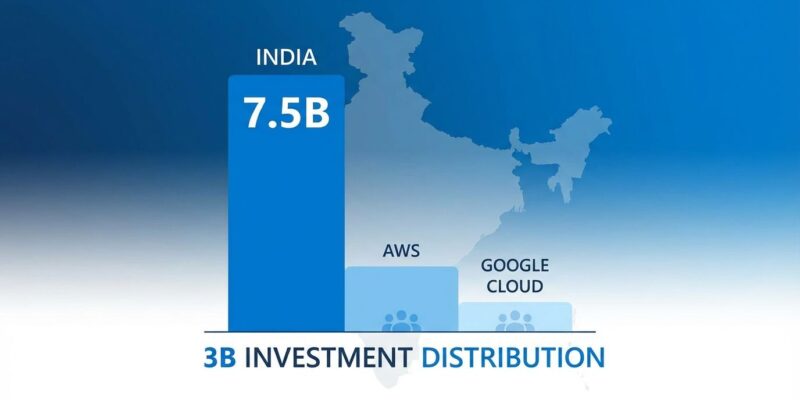
On December 9, 2025, Microsoft announced a $23 billion global AI infrastructure investment—allocating $17.5 billion specifically to India over four years (2026-2029). This is Microsoft’s largest-ever investment in Asia, nearly six times the $3 billion India commitment announced just 10 months earlier in January. CEO Satya Nadella revealed the plans following a meeting with Prime Minister Narendra Modi, positioning India as the centerpiece of Microsoft’s global AI expansion.
The investment focuses on three strategic pillars: hyperscale cloud and AI infrastructure (Scale), workforce development targeting 20 million Indians by 2030 (Skills), and in-country data processing for regulatory compliance (Sovereignty). For developers, this means access to Microsoft’s largest Asian data center region, AI productivity tools that meet strict data localization requirements, and unprecedented free training opportunities.
The $50 Billion India Rush: All Three Cloud Giants Commit in 24 Hours
Microsoft isn’t alone. Within 24 hours of the announcement, AWS and Google Cloud pledged their own massive investments to India’s infrastructure. AWS committed $12.7 billion by 2030 plus an additional $7 billion for Hyderabad data centers, while Google announced $15 billion over five years for a Visakhapatnam AI hub—the world’s largest outside the United States. Combined, the three hyperscalers have pledged over $50 billion to India in under 24 hours.
This concentration of investment signals India has become the #2 global battleground for AI infrastructure after the United States. The competition benefits developers through aggressive pricing (India regions are already among the cheapest globally for both Azure and AWS), rapid infrastructure expansion, and a booming job market as all three providers compete for talent.
Moreover, Microsoft’s $17.5B remains the single largest individual commitment, but the competitive intensity is unprecedented. Consequently, developers working in India or targeting Indian users should plan for a multi-cloud future—vendor lock-in is risky when all three providers are investing at this scale.
Three Pillars: Scale, Skills, and Sovereignty
Microsoft’s $17.5 billion breaks down across infrastructure, workforce development, and compliance capabilities. The Scale pillar funds a new India South Central cloud region in Hyderabad launching mid-2026, featuring three availability zones—roughly equivalent to two Eden Gardens stadiums combined. This will become Microsoft’s largest data center region in India, complementing existing regions in Chennai, Hyderabad, and Pune.
The Skills pillar doubles Microsoft’s training commitment from 10 million to 20 million Indians by 2030. Through the ADVANTA(I)GE India program, 5.6 million people have already been trained since January 2025—putting the initiative ahead of its original 10 million target. The expansion aims to train 3.7 times India’s current 5.4 million IT workforce, creating a massive talent pipeline for AI development.
Furthermore, the Sovereignty pillar addresses India’s strict data localization requirements. Microsoft 365 Copilot will offer in-country data processing by the end of 2025—just weeks away. This means prompts and responses stay within Indian data centers, meeting regulatory requirements while delivering AI productivity tools to enterprises. India joins Australia, the UK, and Japan as the first four countries to receive this capability.
Related: FinOps-Developer Disconnect Burns $44.5B Cloud Waste
Copilot as Strategic Trojan Horse: First-Mover Advantage
By offering Microsoft 365 Copilot with in-country processing before AWS and Google deliver equivalent AI assistants, Microsoft gains a critical first-mover advantage in India’s regulated industries. Government departments, banks, and healthcare providers face strict data localization mandates under India’s AI Governance Guidelines (released November 2025) and Digital Personal Data Protection Rules. These sectors have largely been blocked from adopting AI productivity tools due to compliance concerns.
Microsoft’s in-country Copilot processing removes this blocker entirely. Enterprises can finally deploy AI coding assistants and productivity tools without violating data sovereignty requirements. AWS CodeWhisperer and other competing tools lack equivalent local processing commitments, giving Microsoft a window of exclusivity in the lucrative enterprise segment.
Indeed, the timing is strategic. India’s regulatory framework classifies certain organizations as “Significant Data Fiduciaries” (SDFs) based on data volume, sensitivity, and impact on sovereignty. SDFs face mandatory in-country processing requirements—Microsoft’s Copilot solution positions Azure as the only compliant option for AI-powered development in these regulated environments.
The Geopolitical Angle: H1B Visas vs Infrastructure Investment
A Hacker News commenter captured an often-overlooked dimension: “That’s what happens if you don’t give them H1B visas and Green cards.” As U.S. visa restrictions tighten, tech giants are pivoting from importing talent to investing infrastructure where talent already exists. Microsoft’s nearly 6x investment increase (from $3 billion in January to $17.5 billion in December) reflects this strategic shift.
Satya Nadella’s philosophy reinforces this approach: “I’m a firm believer that ultimately, when it comes to new technology, the rate of diffusion is the winner.” He’s betting that adoption speed in India matters more than technological origin. Rather than bring Indian engineers to Redmond, Microsoft is bringing Redmond-class infrastructure to India.
Additionally, the Skills pillar amplifies this strategy. Training 20 million Indians creates a local talent pipeline that feeds Microsoft’s ecosystem without immigration dependencies. It’s simultaneously a market expansion play and a hedge against U.S. immigration policy uncertainty. For developers, this means India is evolving from an outsourcing destination to a first-class AI innovation hub where cutting-edge work happens locally.
Related: Azure HorizonDB: Microsoft’s 11-Year-Late Challenge to AWS Aurora
What This Means for Developers
The timeline is tight. Microsoft 365 Copilot in-country processing goes live by the end of 2025—just weeks away. Therefore, developers in regulated industries should plan to adopt Copilot immediately once compliance requirements are met. The mid-2026 Hyderabad region launch will deliver Microsoft’s largest Asian infrastructure footprint, offering three availability zones and the full Azure portfolio.
However, free AI training opportunities are already available through ADVANTA(I)GE India, with 14.4 million more slots opening through 2030. Developers looking to upskill in AI/ML should leverage these programs regardless of their cloud provider preference—the training is valuable independent of Microsoft ecosystem lock-in.
The competitive landscape warrants a multi-cloud strategy. With AWS, Google, and Microsoft all investing over $50 billion combined, no single provider will dominate. Cloud costs in India are already among the cheapest globally (around $81/month for comparable instances vs $145 in US/EU regions), and competition will keep pricing pressure favorable to users. Vendor lock-in is riskier than usual given the intensity of the ongoing infrastructure race.
The broader message is clear: India has become a permanent AI development center, not a temporary cost-optimization play. Microsoft’s $17.5 billion bet signals long-term commitment to building cutting-edge AI infrastructure locally. For developers, this creates opportunities to work on sophisticated AI systems without geographic constraints—the AI innovation frontier is no longer limited to Silicon Valley.