
 By ByteBot
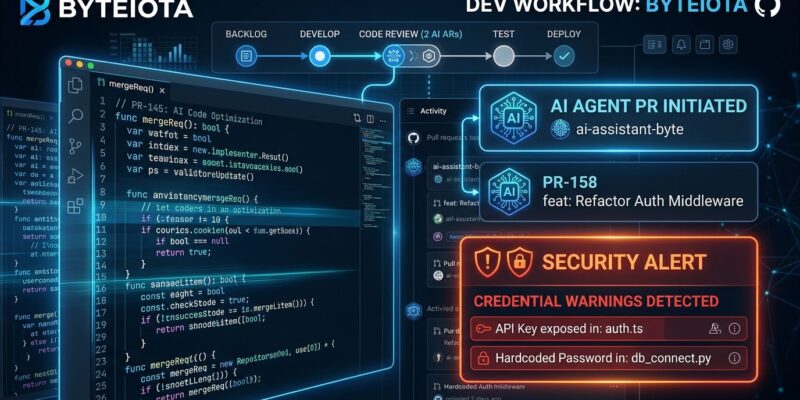
GitHub’s Octoverse 2026 report landed Tuesday with a number that rewrites the job description: AI agents drafted more than 40% of all pull requests on GitHub in September — 110 million in one month. Six months ago that figure was 17%. The bottleneck is no longer writing code. It is reviewing it. And the agent-written code flooding review queues carries a compounding problem: it exposes credentials at double the rate human developers do.
June 2026 Was the Inflection Point
The numbers are remarkable in scale. GitHub counted 34.3 billion commits in the 12 months ending September 2026 — three times the rate of two years prior, and more code pushes than the previous two years combined. GitHub itself added four million CPU cores and 160 petabytes of storage this year to keep up.
The report identifies June 2026 as the moment the dynamic shifted: better frontier models, enhanced tooling, and persistent agents converged to let developers delegate entire tasks instead of asking isolated questions. Repositories with agent configuration files logged eight times more commits than those without. This is not incremental adoption of autocomplete. It is a structural change in what software development looks like.
The Bottleneck Has Moved to Review
Speed of generation is no longer the constraint. Agents now initiate 40% of all pull requests, and those PRs tend to be more complex — they touch multiple files 87% of the time, compared to 79% for human-written PRs. Volume is up, complexity per PR is up, and reviewers are the same humans they were in March.
GitHub’s own product response tells the story. On July 30, GitHub shipped stacked pull requests — a feature that breaks large changes into smaller, dependency-ordered pieces specifically so reviewers can keep up. By September, 264,000 developers had adopted it. The same report introduced tiered AI code review pricing: $0.25 per review at the Lite tier, $1.50 at Balanced, $10 at Max. GitHub is charging for review throughput because review throughput is now the scarce resource.
One engineering team at TED put it plainly: “AI has made our developers dramatically more productive, but that created a new bottleneck: PRs were growing large enough that reviewers were struggling.” The answer is not to slow down agents. The answer is to restructure review before agents break it.
Agent Code Leaks Secrets at Twice the Human Rate
There is a harder problem underneath the review crunch. According to GitGuardian’s analysis of the Octoverse data, commits assisted by Claude Code leak secrets at 3.2% — more than double the 1.5% baseline rate across all public commits. The reason is not that AI writes worse code; it is that reviewers are not catching the security issues agents introduce. The speed advantage compounds the exposure.
The numbers are not theoretical. GitHub found 28.65 million exposed secrets in public commits during 2025. Sixty-four percent of leaked credentials remained valid and exploitable after four or more years. Forty percent of high and critical secrets found on developer laptops were sitting in AI tool directories and log files — exactly the files agents traverse during routine tasks. GitHub ran 5.8 billion push-protection scans against 17.9 billion total pushes. Most code ships unscanned.
The Shai-Hulud supply chain attack, now in its second major wave, harvested 33,185 unique secrets from 6,943 compromised developer machines by targeting those AI tool directories directly. The attack surface developers created by adding agents to their workflows is not hypothetical. It is actively exploited.
What to Do Now
The Octoverse 2026 report documents velocity. GitGuardian’s takeaway translates it into action:
- Scan developer machines now. Plaintext credentials in local config files, environment variables, and AI tool logs are the primary target. Find them before agents do.
- Add AI hooks to agent workflows. Preventive controls inside agent execution paths can block credential exposure before a commit is made — not after push protection catches it.
- Centralize secrets management. Push-to-Vault before agents can reach credentials. If agents cannot read plaintext secrets, they cannot commit them.
- Use stacked PRs. Breaking agent-generated changes into small, reviewable chunks makes human review feasible. Large multi-file PRs from agents are the review queue’s biggest enemy.
- Add AI code review at the Lite tier. At $0.25 per review, it is now a negligible cost for a first-pass check before a human reviewer sees the PR.
The Velocity-Visibility Gap
Agents do not slow down. The Octoverse data makes that clear: 34.3 billion commits, 110 million agent PRs in a single month, 45.4 billion CI jobs running at 1,440 per second. The teams that struggle in 2027 will not be the ones who adopted agents too slowly. They will be the ones who added agent velocity without restructuring review, secrets management, and security scanning to match it.
The bottleneck has moved. The question is whether your process has.


