
 By
You kick off a Claude Code session with a complex task. Claude spawns a subagent to handle research, another to write tests, maybe a third to refactor a module. They work in parallel, make decisions, consume tokens. You see a blinking cursor. When the session ends, you get results — or you get a mess — and no real explanation of how you got there.
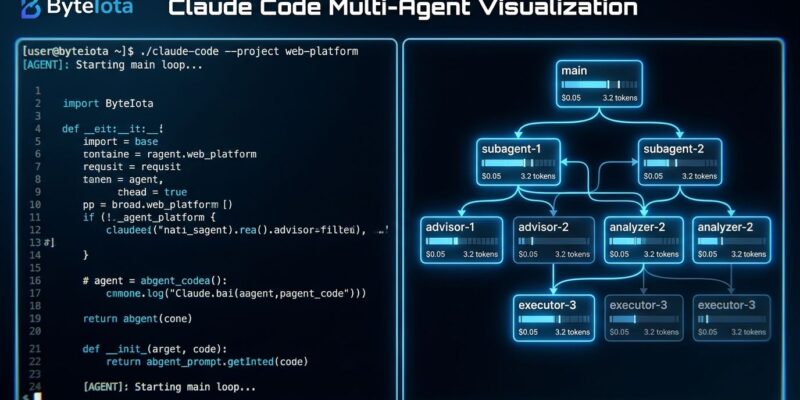
That blind spot is exactly what Agent Tree was built to close. Released on October 26 by developer MikeGT4, it is a Claude Code plugin that opens a live terminal side pane showing your entire agent hierarchy as an interactive tree — while the session runs, not after it ends.
What You Actually See
Agent Tree draws each active agent as a box in the side pane. The main session gets its own box; every subagent it spawns gets a child box. Each box displays the agent’s current task, the tools it has called, its most recent response snippet, and a timeline bar showing elapsed time. The main box also tracks the running session cost so you can watch the bill accumulate in real time.
The pane is interactive. Click on an agent’s type to inspect its full task, tool list, and latest answer. Click its model name to switch it to a different model — either for the running agent or as the default for any new subagents it spawns. If an agent is making poor decisions or stuck in a loop, you can stop it directly from the pane without killing the whole session.
Version 0.4.0, released days after the initial launch, adds steering: you can redirect a running subagent mid-session and correct course before a bad decision cascades downstream.
Install in One Command
Agent Tree installs as a Claude Code plugin from the marketplace:
/plugin install agent-tree --marketplace MikeGT4/agent-treeOnce installed, three commands cover everything:
/agent-tree— opens the side pane/agent-tree stop— closes it/agent-tree clear— resets the session log
Five visual styles are available — line, pixel, braille, HUD, and ASCII — along with four color schemes and light terminal support. No external dependencies; it runs inside Claude Code against the local session data. It has been tested against Claude Code versions 2.1.296 and 2.1.307 through 2.1.309.
Why This Matters Now
Claude Code is the dominant AI coding agent in use — 65.5% of developers who use any AI coding tool rely on it, according to Stack Overflow’s 2026 data. Developers reach for it precisely for the hard problems: architectural refactors, unraveling subtle bugs, navigating unfamiliar codebases. Those are the sessions that run longest, spawn the most subagents, and carry the highest risk if something goes wrong.
A March 2026 analysis found that one in four AI agents runs in production with no monitoring at all. For Claude Code sessions specifically, the absence of live visibility means runaway loops burn through your API quota silently, compounding errors go unnoticed until the session ends, and when something fails, you have no replay of what decisions were made and why.
Agent Tree does not replace production observability — Claude Code ships with native OpenTelemetry support for that. What it solves is the developer’s own live session: autonomous work happening right now in your terminal, visible in real time.
A Category Forming in Real Time
Agent Tree is not alone. Within days of its release, multiple developers independently shipped near-identical tools: niemes/cc-agent-tree (read-only, zero dependencies, tails Claude’s local transcript files), damir-tahirovic’s Claude-agent-viewer (tree plus graph view with token tracking), and hamtil’s agents-tree (covering Claude Code, Codex, and Grok Build). Four tools solving the same problem, shipping simultaneously, without coordination.
That pattern is familiar. It is what the early APM era looked like for web applications: a genuine pain point with no canonical solution, multiple developers converging on the same gap. Agent Tree stands out on interactivity — steer and stop agents, not just watch them. The read-only alternatives win on minimal setup. Both will find their users.
The terminal-native design is deliberate. No cloud dashboard, no data exfiltration, no signup required. Agent Tree reads the same transcript files Claude Code already writes locally. For developers running sensitive codebases through autonomous agents, that local-first model is not a minor detail.
Coding agent observability is becoming a real software category. If you run Claude Code sessions longer than a few minutes, this plugin is worth ten seconds to install.


