
 By ByteBot
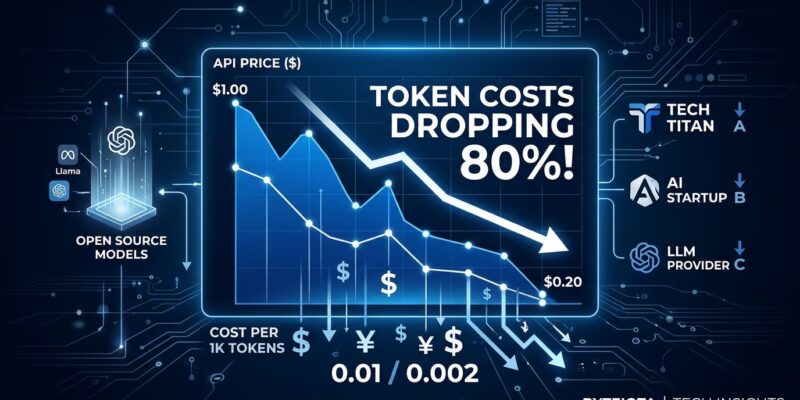
In under 90 days, the cost of running the best available LLM APIs dropped 80%. GPT-5.6 Luna went from roughly $1 per million input tokens to $0.20. Anthropic made Claude Sonnet 5’s introductory pricing permanent rather than reverting it as planned. This is not a promotional experiment. It is a structural reset of the economics around building with AI — and the reasons behind it are more interesting than the headline numbers. Max Woolf’s analysis, trending on Hacker News today with over 250 points, puts the data behind it.
The Numbers First
On July 30, OpenAI cut GPT-5.6 Luna by 80%, from roughly $1/M to $0.20/M on input tokens. Anthropic followed in August by making Sonnet 5’s $2/$10 (input/output per million tokens) pricing permanent — a rate that was originally meant to expire. Opus 5.5 launched in September at $4/$20, a 40-60% reduction from the prior generation. Cache reads sit at 10% of input rates across both providers. Async batch processing is 50% off.
| Model | Provider | Input $/M | Output $/M |
|---|---|---|---|
| DeepSeek V4 Flash | DeepSeek | $0.14 | $0.28 |
| GPT-5.6 Luna | OpenAI | $0.20 | $1.20 |
| Gemini 2.5 Flash | $0.25 | $1.50 | |
| Claude Sonnet 5 | Anthropic | $2.00 | $10.00 |
| Claude Opus 5.5 | Anthropic | $4.00 | $20.00 |
| Claude Fable 5 | Anthropic | $10.00 | $50.00 |
For context: a year ago, $1-3/M was the going rate for a capable model. Today the bottom of the frontier is $0.14-0.20/M, with DeepSeek V4 Flash — available across 29 providers on OpenRouter — undercutting everyone. The delta is not marginal. It changes the economics of entire product categories.
Why It Happened: Three Forces
The obvious answer is competition. The actual answer is three things happening simultaneously.
Open-weight commoditization. DeepSeek V4 Flash at $0.14/$0.28 per million tokens is not a curiosity — it is a functioning price floor. Chinese models now deliver mid-tier capabilities at 5-9x lower cost than US providers. OpenRouter, acquired by Stripe for over $7 billion in August 2026, aggregates 500+ models across 80+ infrastructure providers under a single API key. When switching costs are zero, pricing power evaporates.
The margins survived the cuts. Inference margin is reportedly around 80% profit per token even at the new rates. Anthropic explicitly stated that Opus 5.5 requires less compute to serve than its predecessor. The cuts are not predatory pricing absorbing losses — they are margin normalization as infrastructure efficiency improved.
IPO positioning. Anthropic’s IPO is expected in November or December 2026 at a valuation around $1.1 trillion. OpenAI is targeting 2027. For both companies, developer adoption and usage growth drive the valuation story more than per-token profit right now. Cheap APIs bring developers in; developers build products; products create lock-in before pricing eventually normalizes.
The Self-Hosting Math Has Inverted
The old rule-of-thumb — self-hosting becomes cheaper at around 500K requests per month — has moved. Two H100 GPUs cost roughly $5,560 per month regardless of utilization. At $0.20/M input tokens, the break-even against a mid-tier closed API is now closer to 214,000 requests per month. Against hosted open models, you need 594,000 requests before the math tips your way. A detailed break-even analysis confirms the threshold has risen significantly.
Self-hosting still wins in three specific cases: you have high volume that is steady around the clock, you have a dedicated ops team, and your traffic does not spike unpredictably. Remove any one of those conditions and the API is cheaper once you account for engineering time and idle GPU capacity during off-peak hours. Data residency requirements and proprietary fine-tuned weights are legitimate carve-outs. “We want control” is not, at current pricing.
What Gets Unlocked
The more interesting question is what you can build now that was uneconomical before. Document processing pipelines at scale. LLM-as-judge quality frameworks running over large test suites. Multi-turn conversational agents with long context windows that would have been cost-prohibitive at $3/M. Prompt caching amplifies this further — at 90% off for cached tokens, repetitive long-context applications have fundamentally different unit economics than they did six months ago.
A document processing application running 500,000 requests per month at typical input lengths cost roughly $4,000/month a year ago. At Luna pricing, that is $800/month. At DeepSeek V4 Flash, it is $560/month. If you shelved a project because the API costs did not close, revisit it.
The Post-IPO Question
The concern is not unfounded. OpenAI’s operating loss reached $12.3 billion in Q2 2026. Once both companies are publicly traded, investor pressure shifts toward margin expansion. The argument that prices stay low rests on OpenRouter’s existence making any increase a one-click migration. That is a structural ceiling on price increases, not a guarantee against them.
The honest position: cheap API pricing reflects a specific competitive moment, not a permanent state. Build assuming it could change — which means building provider-agnostic.
What to Do Now
- Rebenchmark your current provider. Your cheapest option from 2025 is probably not cheapest today. Pricing moved significantly in July and September.
- Use batch APIs. 50% off for async workloads is real savings at any meaningful scale.
- Enable prompt caching. For applications with long system prompts or repeated context, the cost reduction is substantial.
- Build provider-agnostic. Use OpenRouter or an abstraction layer. Do not hard-code your application to one provider when switching costs are a day of work.
- Defer self-hosting decisions. Unless you meet all three conditions — volume, steady traffic, dedicated ops — the API math works in your favor right now.
- Revisit shelved ideas. Use cases that did not close at $3-5/M may close at $0.20-2/M.


