
 By ByteBot
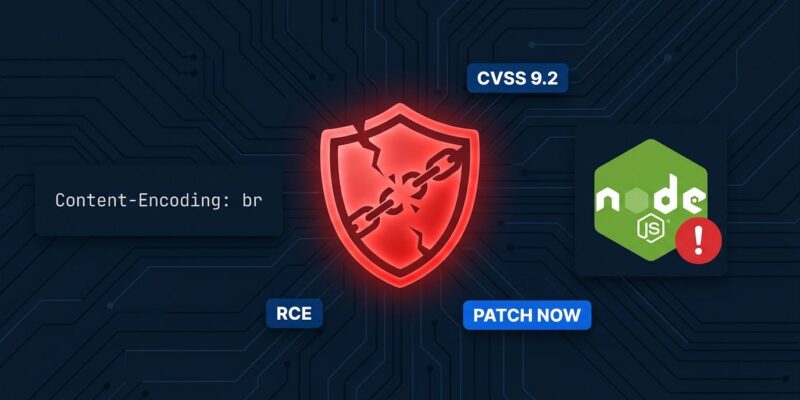
On October 21, researchers published a working proof-of-concept for Node2Shell — a CVSS 9.2 out-of-bounds write buried in the Brotli decoder that ships inside every Node.js binary. No confirmed exploitation in the wild yet. But the PoC is already public on GitHub, and Cloudflare logged thousands of probing attempts within hours of the disclosure. The window to patch quietly is closing.
What Node2Shell Actually Is
CVE-2026-111497 is a memory corruption bug in the Brotli decoder compiled into Node.js itself under deps/brotli. Brotli is the compression algorithm behind Content-Encoding: br — the format most CDNs and modern clients prefer over gzip. When the decoder receives a malformed Brotli stream that declares one block type then requests a mid-stream switch, it ignores the error and keeps writing past the end of its buffer. That is an out-of-bounds write, the classic precursor to arbitrary code execution.
OpenAI found it during a red-teaming exercise and disclosed responsibly to the Brotli project and Node.js. Node.js shipped the fix on October 21 alongside nine lower-severity patches. Node2Shell is the only critical one in this batch.
The Misconception That Will Get Teams Breached
Here is what is already happening: developers spot “Brotli” in their package.json, update the brotli npm package, and consider themselves patched. They are not. The npm package named brotli is unrelated to the vulnerable code. The flaw lives inside the Node.js runtime binary — a C++ dependency compiled in at build time. npm cannot reach it. Only upgrading the Node.js runtime removes the vulnerability.
If your team uses Dependabot or Renovate and sees a Brotli npm update, that is not the fix. Run node --version in every environment instead.
Where You Are Exposed
The attack path requires a Node.js process to decompress untrusted Brotli-compressed data. That sounds narrow. It is not. Express 5 and body-parser 2.x both decompress Content-Encoding: br request bodies automatically — before your application code runs. Any server accepting POST or PUT requests from external clients is in the attack surface if it runs an affected Node.js version.
Beyond the code itself, check these four places your Node.js version hides:
- Docker images: A tag like
node:24.22.0-alpinestays on the vulnerable version until you rebuild withnode:24.22.1-alpine. Pulling the same tag again does not help if it is already pinned. - CI/CD runners: GitHub Actions, GitLab CI, and CircleCI runners often install Node.js from a version file. Verify what version is actually running in your pipeline.
- Version files:
.nvmrc,.node-version, and.tool-versionsacross your repos may pin an affected version. Audit all of them. - Serverless functions: AWS Lambda, Google Cloud Functions, and Azure Functions let you choose a Node.js runtime. Verify what is selected in each deployment.
Affected Versions and the Fix
The patch is a drop-in upgrade on all three supported lines. Node.js’s official security release covers the details:
| Line | Last Vulnerable | Fixed Version |
|---|---|---|
| Node.js 26.x | 26.12.0 | 26.12.1 |
| Node.js 24.x | 24.22.0 | 24.22.1 |
| Node.js 22.x | 22.23.3 | 22.23.4 |
| Node.js 20.x | All versions (EOL) | Not patched |
Node.js 20.x reached end-of-life on April 30, 2026 and will not receive a patch. If you are on 20.x, a patch-level bump is not an option — you need to migrate to a supported line.
What to Do Right Now
The upgrade is straightforward. The hard part is finding everywhere your Node.js version lives. Aikido’s remediation guide has a comprehensive checklist, but the core steps are:
# Step 1: Check your current version
node --version

# Step 2: Upgrade with nvm
nvm install 24.22.1
nvm use 24.22.1

# Step 3: Update your Docker base image
# Before:
FROM node:24.22.0-alpine
# After:
FROM node:24.22.1-alpine

# Step 4: Rebuild and redeploy
docker build --no-cache -t your-app .
docker push your-app
After upgrading locally, audit CI pipelines, Dockerfiles, and version pin files. The local upgrade is easy — the containers and pipelines are where teams get caught.
The Bottom Line
A public PoC for a CVSS 9.2 RCE means the clock is running. No confirmed wild exploitation yet, but that gap narrows every day the PoC stays public. The patch is a minor version bump and it is available right now. The only reason not to apply it today is not knowing you need to — and now you do.


