 By ByteBot
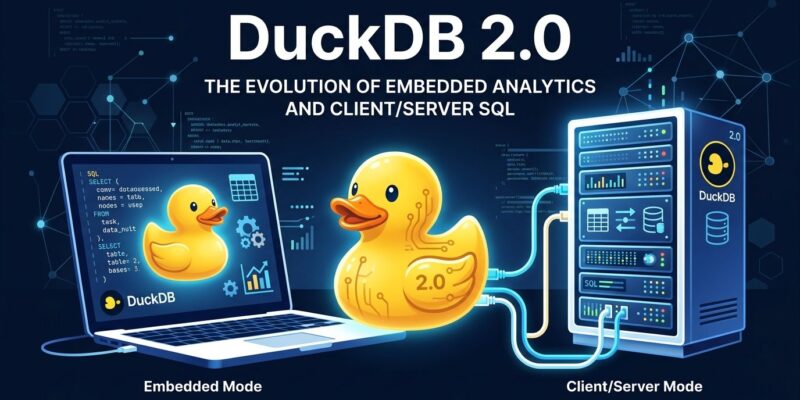
DuckDB built its reputation on a single, unfashionable promise: no server required. Embed it in your process, query your Parquet files, close your laptop. That was the deal. On October 21, DuckDB 2.0 ships — and while the embedded mode isn’t going anywhere, the database now runs as a full network server too. For data engineers who’ve wired DuckDB into their pipelines, this release requires attention before the calendar hits.
The timing adds weight. AWS acquired DuckLabs on August 26, six weeks before 2.0 entered feature freeze. The acquisition sent ripples through the data community — not because the MIT license changed (it didn’t), and not because the DuckDB Foundation lost governance (it didn’t). The anxiety is more philosophical: DuckDB’s whole identity was independence from enterprise infrastructure. Now its core team works for the largest cloud vendor on Earth.
Client/Server Mode: One Binary, Two Modes
The flagship feature of DuckDB 2.0 is its ability to run as a network daemon. Start a server with a single SQL call, attach to it from any DuckDB instance, and execute queries against remote databases as if they were local. The Quack protocol, previously experimental, graduates to v1.0 with this release.
-- On the server
CALL quack_serve(token = 'my_token');

-- From any DuckDB client
ATTACH 'quack:server.example.com' AS qk (TOKEN 'my_token');
CONNECT qk;
SELECT count(*) FROM events;
DISCONNECT;
Multi-version concurrency control and transactional isolation are included, making the server mode suitable for multi-tenant deployments. Query pushdown extends to attached PostgreSQL and MySQL databases — DuckDB can route SQL directly to those engines rather than pulling full tables over the wire.
This does not make DuckDB a PostgreSQL replacement. DuckDB remains a column-oriented OLAP engine built for analytics, not application writes. The value is more specific: one binary that embeds in a development script and scales to a shared analytics server in production, without an operational split between environments. That particular friction has annoyed data teams for years.
Breaking Changes Before October 21
DuckDB 2.0 carries real breaking changes. Python developers need to act before upgrading:
- Python 3.9 is out. Minimum supported version is now Python 3.10.
- Two deprecated modules removed:
duckdb.typingbecomesduckdb.sqltypes, andduckdb.functionalbecomesduckdb.func. Deprecated since 1.4.0. - Relational API rename: The
columnparameter inmin(),max(), andsum()is now calledexpression. - Lambda syntax change: Single-arrow lambda syntax (
x -> x*2) is disabled by default. Pipelines that rely on it will break on upgrade without testing. - Extension maintainers: The C++ extension API is replaced by a stable C API. Extensions must be recompiled — but the new C ABI is stable across DuckDB versions going forward.
The DuckDB 2.0 alpha has been available since September 2. If you haven’t run your workloads against it, you have twelve days.
Performance Gains Worth Noting
Recursive CTEs are 40x faster in DuckDB 2.0. On a single-source reachability benchmark over one million edges, version 1.5.4 took 4.90 seconds. Version 2.0 takes 0.12 seconds. If your pipelines run graph traversals or iterative algorithms, this is not a minor gain.
The async I/O rewrite separates the I/O layer from query processing, letting each scale independently. S3 workloads and large Parquet scans benefit directly. The ICU library has been replaced with native implementations: timezone conversions run 2.2x faster, collation filtering 2.6x faster.
New SQL: Triggers, NEAREST Joins, and More
Triggers arrive in 2.0: BEFORE/AFTER, FOR EACH ROW/FOR EACH STATEMENT, with transition tables. Audit tables are now a native DuckDB pattern. NEAREST joins bring native nearest-neighbor search into SQL for embedding similarity workloads. DML statements now work inside CTEs. The $variable_name syntax replaces verbose getvariable() calls. JSON mutation functions — json_set(), json_insert(), json_replace(), json_remove() — fill a long-standing gap.
Twelve Days to Prepare
DuckDB 2.0 is a well-scoped release. The feature set is coherent — client/server mode, triggers, async I/O, and a stable extension API all point toward an engine designed for production-grade workloads beyond analyst laptops. The official DuckDB 2.0 preview blog covers every change in depth and is worth reading before October 21.
Whether AWS’s involvement shapes DuckDB’s long-term trajectory is a question that won’t be answered by a single version bump. The foundation holds governance, the license is unchanged, and the team’s first post-acquisition release is technically solid. For now, the practical priority is straightforward: test against the alpha, audit your Python code for the breaking changes listed above, and be ready for October 21. The database that refused to be a server just became one — on its own terms, with a 40x performance bonus included.