 By ByteBot
Dead Cells is running natively on a Windows PC — not through a PlayStation 5 emulator, but as a native Windows binary relinked directly from the console’s executable. The open-source project behind it, AnyPS5, hit Hacker News today with 123 comments and crossed 7,000 GitHub stars this week. If that sounds implausible, here is why it works: the PS5 uses AMD’s x86-64 Zen 2 CPU — the same instruction set architecture your desktop already runs.
Not Emulation. Relinking.
Traditional PS5 emulators simulate the console hardware: they model the GPU command processor, the memory controller, the custom audio DSP. It is exhaustive work, and results so far mostly top out at boot screens. AnyPS5 takes a different approach entirely.
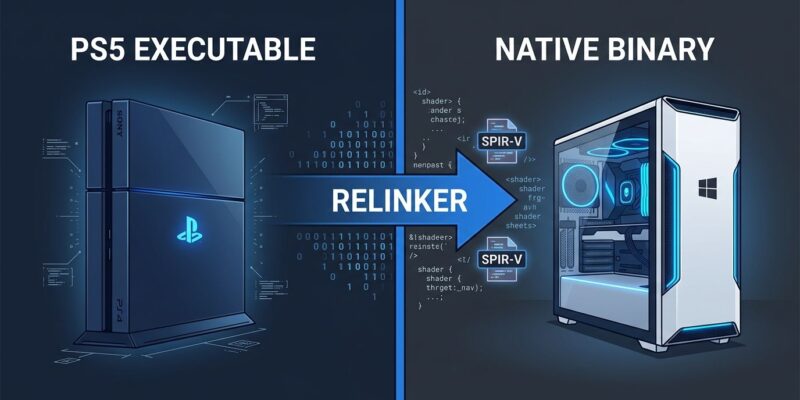
The project has three components. First, a binary relinker that takes a PS5 executable — already compiled to x86-64 Zen 2 — and rewrites its headers and symbol references into a native Windows PE or Linux ELF format. Second, a PRX library layer: a clean-room reimplementation of the PS5’s system libraries (POSIX, libc, libkernel, audio, graphics APIs) as ordinary Windows DLLs the host OS can load. Third, a shader recompiler that translates the PS5’s AMD RDNA shader binaries into SPIR-V, which Vulkan then executes on any modern GPU.
The result: the game binary runs as a native process on your CPU, talking to standard Vulkan for graphics. No emulator layer. No translation overhead. The machine code was always x86-64 — it just needed new headers and a set of reimplemented libraries to feel at home on Windows.
The closest analog is Wine. Wine reimplements the Win32 API so Windows programs run on Linux without a Windows install. AnyPS5 does the same for Sony’s platform SDK. The difference is scope: Win32 is a 30-year-old moving target with decades of Wine compatibility work behind it. Sony’s PS5 SDK is smaller, more focused, and entirely undocumented from the outside.
What Actually Runs
The verified compatibility list is short but real. Dreaming Sarah, a 2D platformer, runs at a stable 60 FPS on a GTX 1050 Ti with an i5-7500. Dead Cells: Return to Castlevania Edition — the first commercial title confirmed running — hits 55–60 FPS indoors at 4K on an RTX 5070 Ti. Community contributor OverkillLabs published the Dead Cells Windows build directly from its PS5 code on September 27. Most larger titles currently reach menus before crashing.
The project has reached 95.88% shader instruction coverage — 1,118 of the PS5’s 1,166 known RDNA shader instructions — and 87% system library coverage. The remaining gaps are mostly in audio, networking, and high-level graphics state management. Those gaps are why large 3D games crash after the menu. They are also what the community is actively filling in.
Sony’s Timing Problem
In March 2026, Bloomberg reported that Sony had reversed its PC porting strategy. PlayStation Studios boss Hermen Hulst confirmed in May: narrative single-player games stay PS5-only. PC ports of Ghost of Yotei, Marvel’s Wolverine, and Saros were cancelled. The stated reason: PC port sales fell three times below the console sales pace.
Six months later, open-source developers are shipping those ports anyway — without Sony’s revenue or permission.
Sony has issued no DMCA takedown, no public statement, and no legal action against AnyPS5 as of today. That tracks with legal history: Sony sued both Bleem! and Connectix over PS1 emulators in 2000 and lost both cases. Clean-room reimplementation for interoperability is fair use. AnyPS5 ships no Sony firmware, no proprietary libraries, no game assets — users are responsible for providing their own game binaries from legally obtained copies.
How Far Is “Done”?
Two games running at 60 FPS is genuinely impressive for a project less than a year old. It is also Year 1. Wine’s first publicly usable release was in 1993; it did not run mainstream Windows software reliably until the mid-2000s. AnyPS5 has the architecture right and an accelerating contributor base — 531 forks, nearly 3,000 new stars in five days. The question is whether that community sustains the decade of library-coverage work this kind of project typically requires.
What makes this easier than it was for Wine: every future console generation will continue using x86-64. The CPU compatibility problem is permanently solved. The library and GPU gaps are finite and shrinking.
Sony stopped bringing PS5 games to PC. The community is doing it for them — and the architecture of the PS5 means it was always going to be more feasible than any previous generation.