 By ByteBot
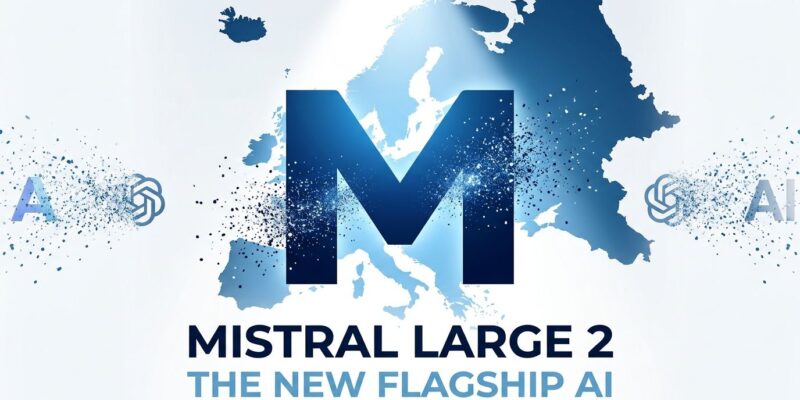
Mistral AI launched the public preview of Mistral Large 4 today, October 6, 2026 — a 1-trillion-parameter multimodal model the community has been calling “Le Chonk” for months. The API is live now on Mistral Studio. The full model weights drop October 27. Trained entirely on European infrastructure, this is the most capable open-weight AI model built outside the US-China orbit, and developers can start using it right now.
What 1 Trillion Parameters Actually Means
The headline number is real, but the number that affects your inference bill is 49 billion — the active parameter count per token during inference. Mistral Large 4 uses a sparse Mixture of Experts (MoE) architecture: 1 trillion total parameters across all expert networks, but only 49 billion activate on any given token. That makes runtime compute roughly equivalent to a 49B dense model, not a 1T monolith. According to the official Mistral announcement, the model was trained from scratch on 3,800 NVIDIA Grace Blackwell GPUs in European data centers.
For context, DeepSeek V4 Pro runs 1.6 trillion total parameters with the same 49 billion active during inference. ML4 and DeepSeek V4 Pro have identical active-compute footprints. However, the real differences are origin (European versus Chinese infrastructure), benchmark characteristics, and compliance posture — not raw inference cost. When someone says “Mistral’s 1T model,” the right mental model is “49B inference cost with 1T total capacity.”
What You Can Use Right Now
The preview API is live at $1.36 per million input tokens and $4.18 per million output tokens. That is cheaper than GPT-6-Astra and Claude Opus 5.5 on input, and competitive on output. Access requires a Mistral Studio account; the model endpoint is mistral-large-4-preview. The 3-week preview window before weights release is intentionally short — Mistral is giving enterprise security and compliance partners time to stress-test before the model goes fully public.
The weights release on October 27 means full self-hosting rights. At approximately 240GB, running ML4 locally requires serious GPU infrastructure — think eight A100 80GB cards minimum, or an equivalent H100 setup. Quantized variants will almost certainly follow within days of the weights release, which will lower that bar substantially for teams with more modest hardware.
Related: Reflection Beam: 501B Open-Weight Model Takes on China — another open-weight frontier model that launched today.
Mistral Large 4 Benchmarks: Where It Wins and Where It Doesn’t
ML4 beats GPT-6-Astra on visual grounding (42% versus 41% on Dense 200), cybersecurity (93% on CyberBench, 82% on vulnerability reproduction tests), and legal benchmarks (Harvey). However, it trails on pure coding: 61.7% on DeepSWE v1.1 versus roughly 74% for GPT-6-Astra and Claude Opus 5.5. That 12-point coding gap is real and worth knowing before routing your entire development workload through ML4. As VentureBeat notes, the model is “competitive with open-weight models but below some proprietary systems” on software engineering tasks.
The cybersecurity benchmark lead deserves an asterisk. Claude Opus 5.5 and similar models often refuse security research tasks outright, which inflates ML4’s relative score in that benchmark category. A more accurate framing: ML4 is the best openly available model for security work that actually attempts the tasks rather than declining them. For teams doing legitimate penetration testing or vulnerability research, that distinction matters considerably more than the raw percentage. Additionally, ML4 scores 59.9% on AutomationBench across 657 business workflows, making it genuinely competitive for enterprise automation.
The EU Sovereignty Angle: More Than a Marketing Claim
ML4 was trained on 3,800 NVIDIA Grace Blackwell GPUs in Mistral’s own European data centers, deployed under European law. For most developers building consumer applications, this is irrelevant. However, for EU public sector organizations, financial institutions, defense contractors, and healthcare providers, using OpenAI or Anthropic’s US-hosted infrastructure creates genuine legal exposure under GDPR and the EU AI Act. ML4 removes that blocker while remaining frontier-class competitive on most workloads. As Mistral researcher Pierre Stock told Euronews, “open-weight models allow people to access models” beyond what “only a few trusted players can take care of the technology.”
Airbus, ASML, and HSBC are among the 125+ enterprises already on Mistral. The company raised a €3 billion Series D at a €21 billion valuation last month — the largest equity round ever raised by a European tech company. Mistral is not positioning ML4 as a political gesture; they are positioning it as a compliance checkbox that happens to be a strong model.
Key Takeaways
- Mistral Large 4 preview API is live today at $1.36/M input, $4.18/M output via Mistral Studio
- The 1-trillion-parameter count means 49 billion active per inference token — same compute footprint as DeepSeek V4 Pro
- Strong benchmarks for cybersecurity, legal, and visual grounding work; trails closed models by ~12 points on pure coding
- Full self-hostable open weights release on October 27, 2026 — approximately 240GB, quantized variants likely to follow
- EU-sovereign training and deployment makes ML4 the first frontier-class option for GDPR and EU AI Act-constrained organizations