 By
Alibaba just open-sourced the AI code review tool it has been running internally for two years across tens of thousands of engineers. OpenCodeReview is not another LLM wrapper. It is a Go-based CLI that wraps a deterministic pipeline around the AI, and on Alibaba’s published benchmark that architectural choice produces 4.7 times higher precision and roughly 14 times fewer tokens compared to running Claude Code directly on the same diff — with the same underlying model.
The Harness Does the Work
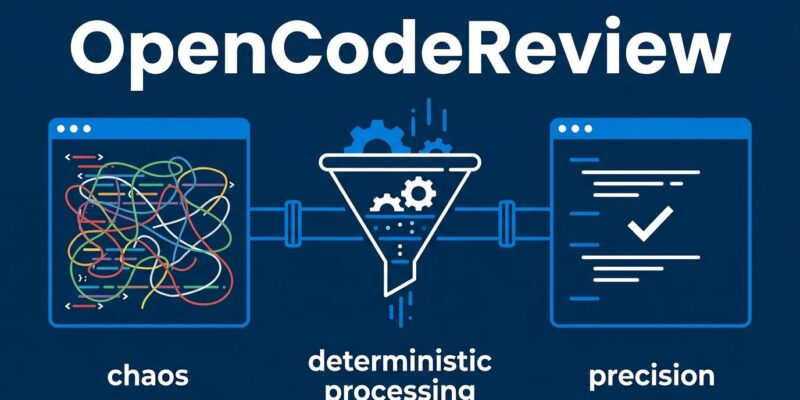
The key insight in OpenCodeReview is not the AI. It is the structure around the AI. The pipeline runs in three stages:
- Deterministic pre-processing. The system selects relevant files, applies hardcoded rule templates for null pointer exceptions, thread safety, XSS, and SQL injection, and bundles related files together before the model ever sees the input. Translation files are paired. Large PRs are split into isolated sub-reviews.
- LLM analysis. The model only reasons over curated, pre-filtered input — not every changed line in the repository.
- Deterministic post-validation. A separate verification module pins every comment to an exact line and validates it against the actual diff before posting. Hallucinated line numbers never make it to your pull request.
The result: structurally fewer false positives, not because the model is smarter, but because the architecture prevents noise from reaching it in the first place.
The Numbers — and the Caveat
Alibaba’s AACR-Bench tested 200 real pull requests across 50 repositories in 10 languages, validated by 80 engineers against 1,505 ground-truth issues. Both tools ran the same underlying model: Claude-4.6-Opus.
| Tool | Precision | Recall | F1 | Tokens | Time |
|---|---|---|---|---|---|
| Open Code Review | 33.9% | 20.0% | 25.1% | 385K | 1m 23s |
| Claude Code | 7.2% | 28.9% | 11.6% | 5,664K | 13m 06s |
The precision and token story is compelling. The recall story is not. OpenCodeReview catches 20% of the issues that expert engineers flagged; Claude Code catches 28.9%. Both miss the majority. OpenCodeReview is a noise filter, not a comprehensive auditor — and Alibaba says so explicitly. The tool is designed to favor precision over recall.
One caveat: an independent reviewer reported roughly 12% precision on a smaller set of 10 PRs. The maintainers attributed it to a tool-call bug since fixed, but no follow-up benchmark has been published. Treat Alibaba’s numbers as directional, not definitive.
What It Catches
OpenCodeReview ships with hardcoded rule templates across ten languages: Java, Go, Python, JavaScript, TypeScript, C#, F#, Ruby, Kotlin, and Scala. The rules are deterministic — they catch what they are designed to catch every time, independent of model quality. Go gets specific checks for ignored errors, typed nils in interfaces, and sync.Mutex copies. The Apache-2.0 license means you can extend the ruleset for your own conventions.
Setup: Three Commands
Requirements: Git 2.41 or later, and an API key compatible with OpenAI or Anthropic (or any compatible endpoint including Qwen, DeepSeek, and OpenRouter).
npm install -g @alibaba-group/open-code-review
ocr config provider
ocr config model
ocr review
For branch comparison: ocr review --from main --to feature-branch. For full-file audits outside a PR: ocr scan. JSON output is supported for downstream pipeline integration. If your team already uses Claude Code, Codex, or Cursor, Delegation Mode routes through your existing agent — no separate API key required.
GitHub Actions in Ten Lines
The simplest CI integration references the composite action directly from the Alibaba repository:
name: AI Code Review
on:
  pull_request:
    types: [opened, synchronize, reopened]
jobs:
  review:
    runs-on: ubuntu-latest
    permissions:
      contents: read
      pull-requests: write
    steps:
      - uses: alibaba/open-code-review@main
        with:
          github_token: ${{ secrets.GITHUB_TOKEN }}
GitLab CI and Gerrit are also supported. An OpenTelemetry integration exposes latency metrics for observability on review throughput. JetBrains and VS Code plugins are available if you prefer IDE-level feedback over CI.
Where This Fits in Your Workflow
The practical case for OpenCodeReview is speed: 1 minute and 23 seconds on average. At that pace it sits between git push and human review, catching structural bugs — the null dereference, the missing input sanitization, the copied mutex — before your teammate has to. It does not replace that review. It reduces the noise they are reading through.
Compared to SaaS alternatives like CodeRabbit or Greptile, OpenCodeReview is Apache-2.0 licensed and entirely self-hosted. Your code does not leave your infrastructure. You choose the model. You control the rules. That distinction matters for teams with data residency requirements and for organizations that have already spent one too many months trusting a third-party SaaS with their codebase — only to watch it disappear or reprice.
The repository is at alibaba/open-code-review and is actively maintained — v1.12.11 shipped on September 29, the day before this was written. Two years of internal battle-testing at Alibaba’s scale is a meaningful proxy for reliability. The benchmark caveat stands, but the architecture is sound, the setup takes minutes, and the token savings on a busy PR queue will show up in your billing the same day you enable it.