 By ByteBot
F-Droid shipped version 2.0 on September 24 — its biggest update in ten years, rebuilt from the ground up in Kotlin and Jetpack Compose after 14 beta releases and an independent security audit. The timing is pointed: Google’s developer verification mandate goes live on September 30, six days from now, and it threatens the exact model F-Droid runs on.
What Actually Changed in F-Droid 2.0
The previous interface had been largely unchanged since 2015. The 2.0 rewrite is not a cosmetic refresh — the entire client codebase was rewritten in modern Android standards. The new three-tab layout (Discover, Search, My Apps) replaces the older fragmented navigation. Search now indexes app descriptions, categories, and translated content instead of matching only on app names, with full Chinese, Japanese, and Korean language support added.
The biggest behavioral change is automatic background updates. F-Droid 2.0 leverages Android’s pre-approval API — an install mechanism the EU’s Digital Markets Act effectively forced Google to open — so apps can be approved and queued for update without a pop-up dialog each time. Pull-to-refresh is gone because it is no longer needed. The first independent security audit in F-Droid’s history, conducted by the Open Technology Fund’s Security Lab in partnership with Convocation, ran alongside the 2.0 development cycle.
What You Lose in the Upgrade
The panic feature — which previously let users wipe apps instantly when facing physical coercion — has been removed in 2.0 and will return in a future release. If you depend on it, hold off on upgrading. The app-hiding disguise (previously made F-Droid appear as a calculator) now only changes the icon and name; the app remains visible in Android settings. Tor auto-detection is gone; the project recommends switching to a Tor VPN and configuring proxy settings manually. F-Droid Privileged Extension support is dropped, and Android 6 is no longer supported — Android 7 or later is required.
Six Days Before the Crackdown
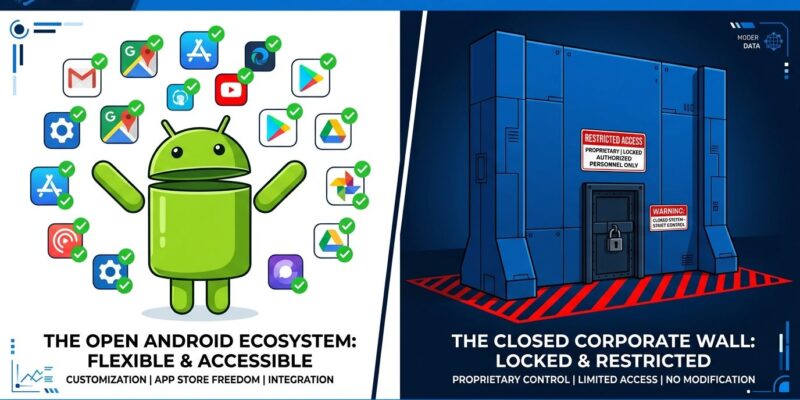
The release date is not coincidental. On September 30, Google begins enforcing developer verification in Brazil, Indonesia, Singapore, and Thailand. Certified Android devices in those four countries will block standard installs of apps from developers who have not registered their identity with Google and paid a $25 fee. The global rollout follows in 2027.
F-Droid operates without user accounts and relies on anonymous contribution — its model is structurally incompatible with Google’s requirement. Marc Prud’hommeaux, an F-Droid board member, put it plainly: “the developer registration decree will end the F-Droid project and other free/open source app distribution sources as we know them today.” Hans-Christoph Steiner, F-Droid’s technical lead, added: “Google is clearly shifting the management of Android from the technical people to the competition lawyers. They have to defend those immense monopoly profits.”
The ironies stack up. The pre-approval install API that makes F-Droid 2.0’s automatic updates work exists because EU regulators forced Google to open it under the Digital Markets Act. Europe handed F-Droid a better install experience at the same time Google is making F-Droid’s distribution model restricted in four other countries.
The Community Is Watching
F-Droid 2.0 hit number one on Hacker News within hours of the announcement, with 1,019 points and 276 comments. Reactions split predictably: developers who had switched to third-party clients like Droid-ify and NeoStore are cautiously returning; others noted that bulk app updates now require individual clicks rather than a single batch action, a regression from the old behavior. A vocal minority downgraded to v1 over the new Material Design aesthetics. The Keep Android Open coalition is pushing for increased adoption as a direct counter to Google’s September 30 deadline.
The Bottom Line
F-Droid 2.0 is the best version of F-Droid that has ever shipped. The Kotlin rewrite, the automatic updates, the improved search, the security audit — this is what a decade of deferred maintenance finally catching up looks like, and it is genuinely good work from a volunteer-run project. But the September 30 deadline is a distribution problem, not a client quality problem. A better app store experience does not change the fact that Google can make F-Droid apps effectively uninstallable on certified devices with a policy decision. The client refresh matters. Winning the distribution fight requires more than that.