 By ByteBot
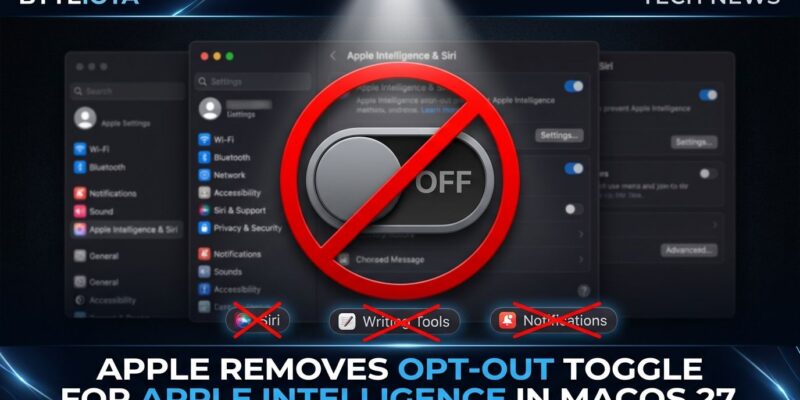
macOS 27 Golden Gate shipped this month without the master toggle to disable Apple Intelligence — and users who had explicitly turned it off in macOS 26 discovered the upgrade re-enabled it anyway. Roughly 17 GB of AI model files returned. Multiple Siri background processes resumed. The single switch that made all of it go away no longer exists. Apple didn’t announce the change. They just removed the option.
For developers and enterprise IT admins, this isn’t a theoretical privacy complaint. It’s an operational fact: every Mac running macOS 27 now runs Apple Intelligence, whether the user wants it or not. The previous opt-out doesn’t carry over. Apple’s own documentation confirms there is no longer a single control that disables Apple Intelligence as a whole.
Apple Intelligence in macOS 27: What You Can No Longer Disable
In macOS 26 (Tahoe), disabling Apple Intelligence was a single toggle: System Settings → Apple Intelligence & Siri → off. Turning it off deleted the AI model files and stopped the associated background processes. The choice was clean and respected.
macOS 27 replaces that with a 10-screen patchwork of feature toggles. Apple’s official guidance in the Apple Community walks through disabling Siri, notification summaries, message summaries, mail suggestions, journal prompts, and per-app learning — individually, across System Settings and app-level menus, for 70+ apps. None of this removes the underlying model files. None of it prevents Apple’s AI inference layer from running at the OS level.
Security researcher Mysk confirmed the pattern extends to iOS 27: “Some features like Writing Tools can also send data off-device for processing through Private Cloud Compute.” Private Cloud Compute is Apple’s technically sophisticated answer to privacy — encrypted, ephemeral, no logging. However, the architecture doesn’t change the consent question. You can trust Apple’s privacy engineering and still object to removing the right to say no.
The Enterprise Problem That Needs to Be Louder
The loudest coverage of this story focuses on consumer privacy. The quieter story is enterprise IT. Apple’s own documentation states that MDM-based disabling of Apple Intelligence in macOS 27 “requires supervision” — meaning full device enrollment under Apple Business Manager’s supervised mode, which most organizations don’t run on developer machines. Standard enterprise MDM profiles cannot cleanly disable Apple Intelligence across a fleet of Macs.
For engineering teams, this means developer machines running macOS 27 have persistent AI background processes competing for CPU and memory — processes that the team explicitly chose not to run. CI machines with tight disk allocation didn’t ask for 17 GB of forced model storage. Performance benchmarks run against a noisier baseline. Reproducibility takes a hit. And the IT admin who needs to answer “can we disable this for compliance reasons?” has no good answer.
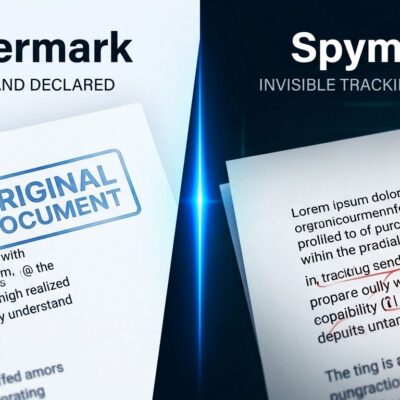
Related: Spymarks, Not Watermarks: The Hidden Trackers in Your AI Outputs
This Is a Pattern, Not a Product Decision
It is tempting to treat this as an Apple-specific story. It isn’t. Microsoft shipped Windows Recall as default-on in 2024 — a feature that took a screenshot of your screen every few seconds — and only switched it to opt-in after sustained security and privacy backlash. Google ships AI features as default-on across Android and Chrome, with opt-outs buried deep enough that most users never find them. Now Apple has removed the opt-out entirely.
As developer David Bushell wrote this week: “The AI industrial complex does not do consent.” At billion-user scale, defaults are indistinguishable from mandates. When every major platform converges on default-on AI simultaneously, the industry isn’t making product decisions. It’s setting policy — without a vote, without a sunset clause, and increasingly without an exit.
Industry analysts tracking this pattern note that competitive pressure to set defaults before regulators do is real. The EU AI Act’s high-risk provisions became fully enforceable in August 2026, but they don’t directly govern how operating systems present AI features to end users. The opt-out architecture Apple removed was a voluntary protection — and there is no regulatory requirement that it return.
How to Disable Apple Intelligence in macOS 27 (What Still Works)
Partial mitigations exist, and knowing them is better than nothing. Apple’s official feature-by-feature guide covers the visible surface: notification summaries, message recommendations, writing tools, Siri suggestions. It’s incomplete, but it reduces exposure. For storage reclamation, community reports describe a workaround — change Siri’s language to an unsupported locale (e.g., English Australia with an American English voice) — which reportedly causes macOS to skip downloading AI model files. It’s unsupported and may not survive future updates, but it works for now.
Enterprise IT teams facing compliance requirements should evaluate whether full MDM supervision enrollment is justified for developer fleets. It’s significant overhead. For most teams, the practical path is documented feature disabling combined with monitoring Private Cloud Compute traffic patterns at the network level. Neither is a clean solution. That’s the point.
Key Takeaways
- macOS 27 removes the master Apple Intelligence toggle. The previous opt-out does not carry over from macOS 26 on upgrade.
- Approximately 17 GB of AI model files and multiple background processes now run by default on every macOS 27 installation.
- Enterprise MDM cannot globally disable Apple Intelligence without full device supervision enrollment — a significant barrier for most developer machine fleets.
- The pattern — Microsoft Recall, Google AI defaults, now Apple — points to an industry-wide shift toward non-optional AI at the OS layer.
- Partial mitigations exist (feature-by-feature disabling, locale storage hack), but neither constitutes a complete opt-out.