 By
By The AI coding assistant you already use to write code can now produce a finished video — script, voice narration, footage, music, subtitles, and final render — from a single plain-language prompt. That is the actual premise of OpenMontage, an open-source project by developer calesthio that crossed 29,000 GitHub stars and held the #1 trending slot on GitHub for most of its launch week. No Sora subscription. No Runway bill. No API key required to start.
This Is Not a Clip Generator
Before the hype lands wrong: OpenMontage is not competing with Sora, Runway, Pika, or Veo. Those tools are clip generators — you prompt them, they return 5 to 10 seconds of video. That is the full product. OpenMontage is the production layer that sits above them. It writes the script, decides whether to call a clip generator or pull free archival footage, narrates with an offline voice engine, scores and edits the timeline, burns subtitles, and delivers a finished cut.
The architecture is genuinely unusual. There is no hidden code orchestrator running behind the scenes. Your coding assistant — Claude Code, Cursor, Copilot, Windsurf, or Codex — reads YAML pipeline manifests and Markdown skill files and executes the production directly. The agent is the intelligence. Python handles only tool calls and file persistence. This means OpenMontage is effectively a 700-file instruction set that teaches your coding assistant to direct films.
How a Production Actually Runs
OpenMontage includes 12 production pipelines covering animated explainers, documentary montages pulling from Archive.org, NASA, and Wikimedia Commons, Ghibli-style anime sequences, product ads, sci-fi trailers, TikTok shorts, and reference-grounded productions where you paste a YouTube short and get a plan to recreate it. Each pipeline breaks down into stages: research, scripting, asset generation, voice direction, editing, subtitles, music, and final composition.
At each stage, the agent scores available providers across seven dimensions — task fit (30%), output quality (20%), control features (15%), reliability (15%), cost efficiency (10%), latency (5%), and continuity (5%) — and picks the best match automatically. Every provider choice is logged in an auditable decision trail. A budget guard runs cost estimation before execution, enforces spend caps, and requires per-action approval when configured thresholds are hit. The agent does not silently burn money.
Getting started requires Python 3.10+, Node.js 18+, and FFmpeg — the same stack most backend developers already have. Setup is three commands:
git clone https://github.com/calesthio/OpenMontage.git
cd OpenMontage
make setup
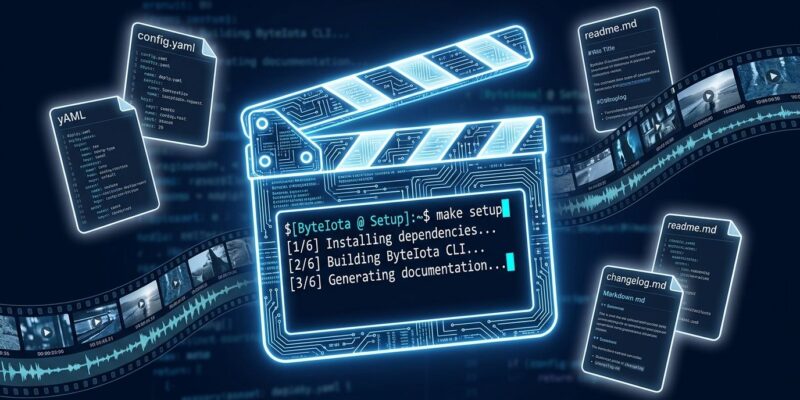
make setup installs Python dependencies, Remotion’s Node packages, and Piper TTS, the offline voice engine. Then open the folder in your coding assistant and tell it what you want to produce.
The Free Stack Is Real
The zero-API-key claim holds up under scrutiny. The default stack uses Piper TTS for voice (fully offline), free stock footage from Archive.org, NASA, Wikimedia Commons, Pexels, and Pixabay, Remotion for video composition, and FFmpeg for rendering. You get complete produced videos — voice, footage, cut, titles — without paying a single provider.
When you want better output, optional premium integrations include Kling, Runway Gen-4, Google Veo 3, ElevenLabs, Suno for music, and FLUX for images. For teams with GPU hardware, local models — WAN 2.1, Hunyuan 1.5, LTX-Video, and CogVideo 5B — run with zero per-render cost. Add credentials in .env. Every key is optional.
This matters for more than cost. Running entirely on local tools and open archives means no data leaves your environment, output is reproducible, and the pipeline works in air-gapped situations. That is a real differentiator against every cloud-only video service.
The Honest Tradeoffs
Three things to know before you clone the repo.
The license is AGPL-3.0. If you modify OpenMontage and run it as a networked service, you must release the source. For individual developers and internal teams, this is fine. For companies building proprietary products on top of it, this is a hard stop — Google’s internal policy forbids AGPL use entirely.
The setup is not a one-click experience. Python, Node, FFmpeg, and a capable agent workflow are prerequisites. The post-render self-review (ffprobe plus frame extraction and audio analysis) catches broken renders automatically, but creative quality still depends on which providers you configure, what footage is available, and the editorial calls you make at approval gates. This is not a fully autonomous system — approval checkpoints exist by design, and good output still requires your judgment.
Output varies. The free stack produces real videos, but the gap between “technically a video” and “polished production” widens without premium providers. Documentary montages on archival footage punch above their weight. Anime and sci-fi pipelines want a GPU or a paid video API to reach their ceiling.
What This Signals
OpenMontage is interesting as a product. It is more interesting as an architectural pattern. A complex, multi-stage creative workflow expressed entirely as YAML manifests and Markdown skill files that any capable coding agent can execute — that pattern transfers. The same structure could produce podcast episodes, interactive demos, or marketing automation pipelines. The question is what developers build when the instruction set for video production is already in a GitHub repo they can fork today.