 By
By AI coding agents have solved the generation problem. They have not solved the intent problem. Your team can run ten parallel Codex sessions and produce a thousand lines of plausible, compiling code per day — or pile up a queue of unread PRs while engineers burn their attention on context switches and nothing actually ships. EasySpecs.ai, which opened public access on September 12, is betting the fix is not better code review. It is a spec review gate that runs before AI writes a single line.
The Bottleneck Everyone Is Pretending Is a Velocity Win
The numbers on this are brutal. LinearB’s 2026 analysis of 8.1 million pull requests found that developers using AI assistants feel 20% faster but are actually 19% slower — a 39-point gap between perceived and real productivity. AI-assisted pull requests at the 75th percentile run 2.6x larger than unassisted ones, and agentic AI pull requests wait 5.3x longer for reviewer pickup. More code shipped. More code stalled in review.
CloudBees’ 2026 State of Code Abundance report found 81% of enterprise technology leaders reporting a rise in production incidents tied to AI-generated code. Only 48% of developers say they always verify AI output before committing. The agents are fast. The trust layer is not keeping up.
OpenAI ran into this directly. When it published the Symphony orchestration spec in April, it noted that engineers could supervise only three to five parallel Codex sessions before context switching wiped out the productivity gains. The bottleneck was not agent capability. It was human attention and undefined intent.
What EasySpecs Actually Does
EasySpecs connects to your repository — GitHub, GitLab, Azure DevOps, or Bitbucket — and builds a functional knowledge tree of your codebase: features, views, services, data models, infrastructure, and tests. This is not documentation generated once and forgotten. It is a live map that becomes the foundation for every change request that follows.
When a change request arrives, the platform turns it into a structured spec with explicit in-scope and out-of-scope decisions, plus a list of unresolved items. Those unresolved items do not silently pass. They are marked blocked until someone makes a call. This sounds obvious, but it is the part most teams skip when they dump a prompt into their AI agent and hope for the best.
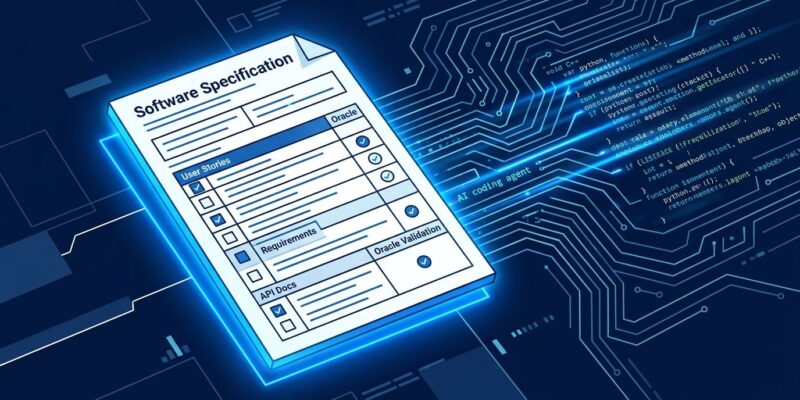
Each spec ships with two kinds of validators. Oracles are pass-or-fail conditions a machine can run — automated checks that verify output against stated requirements. Rubrics are judgment criteria a human or AI reviewer scores against, for decisions that cannot be reduced to a binary. Product managers can read the resulting spec without opening a file. That alone matters when your PM and your agent need to agree on what “done” means.
The Integration Story Is the Real Feature
A spec that lives in a Notion page is a monument to good intentions. EasySpecs routes approved specs into the tools where engineering work actually happens. Specs push to Jira and Linear for project management. They push to VS Code, Cursor, and Antigravity through IDE extensions. And they push to Claude Code, Codex, and GitHub Copilot as read-only context over MCP — so the agent starting a task already knows the intent, constraints, and acceptance criteria before it writes a line.
Anthropic’s 2026 Agentic Coding Trends Report found that teams mastering context engineering complete tasks 55% faster and produce 40% fewer errors. The MCP spec feed is not a nice-to-have. It is how you close the gap between what you wanted and what the agent built.
Spec-Driven Development Is Infrastructure Now
Spec-driven development was a discipline before it became tooling. In 2026 it has become infrastructure. AWS Kiro generates requirements, design, and task files before an agent touches code. OpenAI Symphony uses issue trackers as a continuous dispatch plane. GitHub Copilot Workspace and Google Antigravity both ship spec-first modes. The industry has concluded that vibe coding at scale does not work.
EasySpecs positions itself differently from the IDE-native players. It is vendor-neutral, upstream of all agents, and designed to be the spec ledger for teams running a heterogeneous mix of AI tools. The oracle and rubric model makes specs machine-verifiable, not just human-readable. Spec debt — the cost of imprecise intent fed into high-velocity agents — is the new tech debt. EasySpecs is betting teams will pay to manage it before it compounds.
The Practical Verdict
EasySpecs launched nine days ago. The product is real, the integration map is credible, and the pricing is accessible: €5 per repository per month at launch (normally €10), with bring-your-own API keys from OpenAI, Anthropic, or Google.
The harder question is not whether the tool works. It is whether your team will write specs at all. Spec-driven workflows consistently report 3–10x higher first-pass success rates from AI agents on non-trivial tasks — but only when specs are actually written. A new platform does not fix a team that still ships intent as a Slack message and hopes the agent figures it out. If you are already practicing some form of spec-first development, EasySpecs is worth an evaluation. If you are not, start there before you buy the tooling.