 By ByteBot
Zed opened Delta to the public on September 16. The pitch is direct: pull requests were designed for humans working at human pace, and agents are not doing that. The branch/commit/PR loop is now the bottleneck. Delta is Zed’s bet on what replaces it.
The Problem Isn’t Agent Code Quality
GitHub handles roughly 275 million commits every week in 2026 — that’s more code than the platform processed in all of 2025 combined. Between May 2025 and April 2026, GitHub suffered 257 incidents, 48 of them major outages, roughly one significant disruption per week. The platform had to revise its capacity growth target from 10x to 30x mid-year because agentic development workflows outpaced every forecast.
The infrastructure strain is a symptom. The deeper problem is that 73% of engineering teams now use AI coding tools daily (up from 41% in 2025), and the bottleneck is no longer generating code — it’s reviewing, understanding, and handing it off. An agent can produce hundreds of commits in an afternoon. The PR model asks a human to catch up by reading a diff with no context about why decisions were made.
What Delta Actually Is
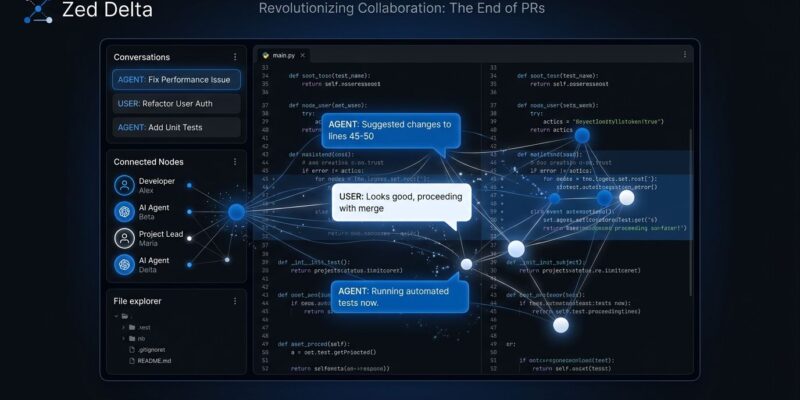
Delta replaces the pull request with a thread: a persistent, multiplayer workspace that contains your code edits, the agent’s reasoning, and your teammates’ comments as a single linked record. Instead of opening a branch and submitting a PR, you invite a teammate into your active agent session. They see the same worktrees you do, can fork an isolated review subthread to examine specific changes, and push accepted edits back — all without a separate branch or PR.
Underneath this sits DeltaDB, Zed’s new version control layer. DeltaDB is CRDT-based, which means multiple humans and agents can edit the same files concurrently without merge conflicts. More importantly, it records every edit at sub-commit granularity — down to the character level. When an agent makes a change, the prompt that triggered it, the agent’s reasoning, and the resulting edit are stored as a single auditable record. You can trace exactly why a line exists.
DeltaDB does not replace Git. It layers on top of Git between commits, so existing repositories and workflows continue working. Branches in Delta are nearly free because the worktree is virtualized — you can branch from any delta, including mid-agent-run.
Zed Is Already Using It
Zed’s own team of 33 people has disabled GitHub Pull Requests on the Delta repository entirely. They have merged 570 changes to main through Delta. Zed builds and ships Delta using Delta. That’s the best stress test available: a small, fast-moving team running a daily development workflow on a tool that replaces their previous daily development workflow.
The 570 merges-with-no-PRs number deserves context. This isn’t a toy project or a demo repo. It’s the production codebase for a tool Zed is betting on commercially. The team could have kept GitHub PRs as a safety net. They didn’t.
The Race to Replace GitHub
Zed is not alone in this bet. Cursor launched Origin in August 2026, a Git-hosting platform embedded inside the Cursor editor. Origin is closer to “GitHub inside your editor” than a workflow reinvention — it still uses pull requests, with agents auto-subscribing to the PRs they create. Useful, but a different hypothesis.
GitLab’s Project Switch (private beta) focuses on bandwidth efficiency — letting agents query the server for exactly what a task needs instead of cloning full repos. Entirely different problem from Delta.
Thomas Dohmke, who ran GitHub until 2025, launched Entire with a $60M seed round in February 2026. Entire’s first product is Checkpoints, a CLI that captures agent reasoning and prompts on every Git commit — a governance and auditability layer, not a code review workflow. Complementary to Delta, not a competitor.
Delta’s differentiator: it is the only one built around threads as the atomic unit of collaboration, with sub-commit history linked to conversation. The others are iterating on the existing GitHub model. Delta is discarding the PR entirely.
Who Should Try It Now
Delta is free during the beta, available on macOS, Linux, Windows, and web. No credit card required; a two-week Pro trial includes $5 in AI credits. Your existing Zed account applies.
Try it now if you’re already running Zed daily and use AI agents heavily. The free beta is low-risk, and getting first-hand familiarity before paid plans arrive matters.
Wait if your team is deep in GitHub or GitLab with established CI/CD pipelines. Delta won’t absorb your full GitHub workflow in beta. It’s a new approach, not a drop-in replacement.
The PR isn’t dead yet. But Delta’s public beta is the first credible argument that it should be, backed by a team that’s already living without one.