 By ByteBot
RTK, a single Rust binary that promises to slash LLM token consumption by 60-90%, has crossed 80,000 GitHub stars on the strength of one idea: install one tool, watch your Claude Code bill crater. The pitch is clean. The install is one command. The benchmark results are something else entirely. Independent teams spending over $1,500 in real API calls found that RTK’s reported 89% token reduction produces zero reduction in actual billing — and in some cases makes things more expensive. That is not a reason to ignore RTK. It is a reason to understand what it actually does before you add it to your workflow.
What RTK Does
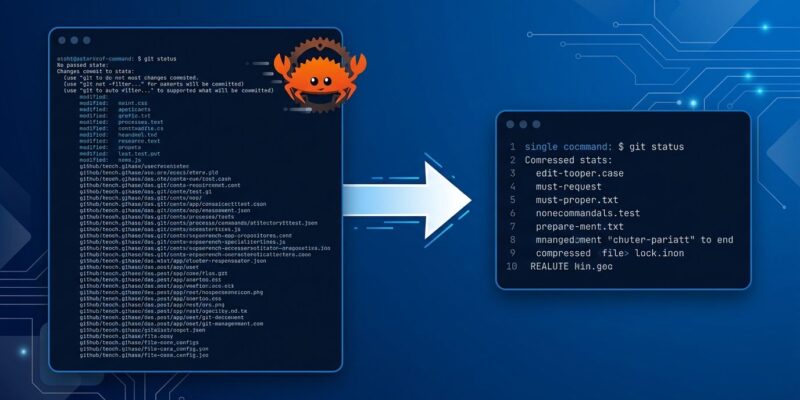
RTK sits between your shell and your AI coding assistant. When Claude Code (or Cursor, or Copilot) runs a Bash command, RTK intercepts the output before the model sees it and applies four compression strategies: boilerplate filtering, similar-line grouping, smart truncation, and deduplication. A verbose cargo test run that normally dumps 400 lines becomes a 40-line summary. A git status with a large diff gets stripped down to what changed. RTK on GitHub lists over 100 supported commands including git, cargo, pytest, docker, kubectl, eslint, tsc, and prisma.
Setup for Claude Code is a single command:
rtk init -gThat installs a PreToolUse hook that rewrites all Bash commands to RTK equivalents automatically. You do not need to change how you work — the hook handles interception transparently. One important limitation: the hook only fires on Bash tool calls. Claude Code’s native Read, Grep, and Glob tools bypass RTK entirely. Use shell equivalents (cat, rg, find) or call rtk read and rtk grep directly to cover those paths.
Why the Bill Does Not Drop
Here is the part the README does not lead with. RTK calculates its “gain” as raw output bytes minus filtered bytes, divided by four. That is an estimate of tokens compressed at the moment of execution. It is not what you are billed for.
In a typical agentic Claude Code session, terminal output accounts for roughly 7% of total input tokens. The other 93% is your system prompt, conversation history, and tool outputs — the vast majority of which arrives as cached reads. Anthropic prices cache reads at one-tenth the cost of fresh input. RTK compresses the 7% that costs full price on the first turn and is then cached cheaply on every subsequent turn. The math does not add up to invoice savings.
Quesma’s $1,500 benchmark ran 1,740 test attempts across Claude Code on Fable 5.0 and OpenCode on DeepSeek V4 Pro. Their conclusion: RTK reported 89% fewer tokens and produced no reduction in the actual bill.
The Extra-Turns Problem
JetBrains’ SkillsBench found something worse: RTK was 7.6% more expensive at low reasoning effort (p=0.004). Compress the output enough and the model loses detail it needed. It asks for clarification. It retries. One extra agent turn can cost more than everything RTK compressed in that session. On DeepSeek specifically, RTK reduced per-turn input by 7% but increased total turns by 18%. Net result: +17% more expensive overall.
This is the tradeoff the stars-and-claims framing obscures. Token compression and API cost are not the same variable.
Where RTK Genuinely Helps
None of this means RTK is worthless. It means you need to know what problem you are solving.
- Local models (Ollama, self-hosted): No prompt caching means compressed output stays compressed on every turn — this is where RTK’s math actually holds.
- Verbose pipelines: Test suites printing thousands of lines, Docker compose logs, full build output — compression here reduces real noise.
- Context window pressure: Fitting more of a long session into a limited context window matters regardless of price.
- Autonomous agent loops: Less noise across many turns means better signal and fewer quality-degrading distractions for the model.
The Verdict
RTK is worth installing if you use Claude Code heavily, but recalibrate your expectations. You are not cutting your Anthropic invoice by 80%. You are reducing noise in your agent’s context — which has real value in the right workflows: fewer hallucinations from irrelevant output, lower risk of context overflow, cleaner signal in long sessions.
The 80,000-star trajectory reflects a real anxiety — AI coding bills feel opaque and high — more than a proven solution. RTK’s install story is clean, its compression is real, and the context quality argument is legitimate. Just do not expect your bill to reflect what rtk gain reports. For a deeper look at what the community found, the Hacker News thread on RTK’s benchmark results is worth reading before you commit to the workflow.