 By ByteBot
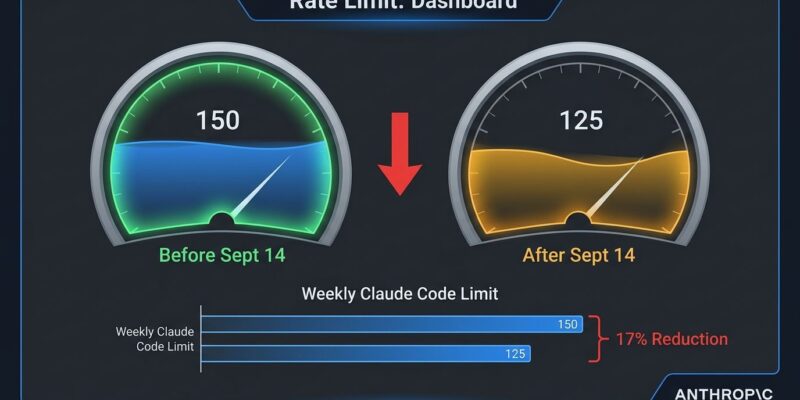
Starting today, September 14, every Claude Code subscriber on Pro, Max, Team, or seat-based Enterprise has 17% less weekly capacity than they did yesterday — and Anthropic is calling it a raise. The company’s 50% temporary usage boost, in place since May 13, expired overnight. Its replacement is a “permanent 25% increase” measured against a baseline that hasn’t been active for four months. The announcement is technically accurate. The headline behavior is not.
Claude Code’s New Weekly Limit: The Math Anthropic Buried
The numbers are not complicated. Anthropic’s original weekly limit represents a baseline of roughly 100 units. In May, a temporary 50% boost pushed that to 150 units — the figure developers have been planning around since spring. Starting today, the new permanent limit lands at 125 units: 25% above the original 100, but 17% below the 150 developers actually have right now. As BleepingComputer reported, Anthropic eventually confirmed this plainly: “Compared to today, this works out to a 17% reduction in weekly limits on Claude Code.”
That clarification appeared after the company deleted its original announcement thread and reposted following community pressure. Developer Theo Browne was among those who called out the framing gap — the announcement led with “+25%” using an inactive baseline as the reference point, without surfacing the effective loss until readers pushed back. According to coverage in IBTimes, the backlash centered not on the cut itself but on the framing — and developers described Anthropic’s original messaging as condescending.
When a temporary allowance runs for four months, it stops being temporary in any meaningful sense. Teams size sprints around it. CI pipelines depend on it. Calling its removal a “raise” because a different number also went up is the kind of math that erodes trust, not limits.
What Changed and What Didn’t
The weekly cap is the only thing cut. Everything else either stayed the same or improved alongside today’s reduction. The 5-hour rolling window limits — the throttle many developers blame for mid-session slowdowns — are completely unchanged. As QCode.cc explains in detail, these are separate throttles, and confusing them with the weekly cap has been a persistent source of frustration among Claude Code users.
Anthropic did ship three improvements alongside the reduction. The auto mode permission classifier, which runs in the background to approve or block actions before prompting you, no longer counts against your weekly usage. Sessions can now auto-continue when limits reset, reducing the friction of manually restarting stopped workflows. Additionally, developers can now purchase extra usage beyond their weekly cap at API rates, giving heavy users an overflow valve that previously didn’t exist. These are real improvements. They don’t cancel out the capacity reduction, but they narrow the effective gap for workflows that rely on auto mode.
Related: Claude Fable 5.1: Three Breaking API Changes to Fix Now
Why Heavy Users Feel This Most
The 17% reduction isn’t distributed evenly across use cases. A single Claude Code agent command generates 8 to 12 internal API calls, with full conversation history carried forward on every step. By the 15th command in an active session, a single request can reach 200,000 input tokens. Heavy agent users on Max 5x have reported burning through their entire daily allocation in under an hour of actual work — translating to roughly 12 usable days per month out of 30.
For those users, moving from 150 to 125 units means re-scoping workflows that took months to calibrate. Background agent jobs and scheduled automation hit weekly caps fastest and benefit least from the mitigation changes. The auto mode classifier exemption helps interactive work; it does almost nothing for batch-style coding pipelines.
What To Do Now
Run /usage inside Claude Code before doing anything else. It gives you the authoritative reading of your current weekly consumption versus your new limit — more reliable than any estimate based on session counts or token budgets. Many developers who believe they’re hitting the weekly cap are actually hitting the 5-hour rolling window, which resets independently and isn’t affected by today’s change.
For background or scheduled work, the Batch API carries no weekly cap and is the right tool for workloads that don’t need real-time responses. For developers running heavy interactive sessions daily, $20 per month at Claude Sonnet 5 API rates buys roughly 2 million output tokens with no weekly reset — compare that against what your current subscription plan delivers after today’s cut. Cursor moved to API-rate billing earlier this year for exactly this reason: predictable costs without the cliff-edge reset cycle.
Related: Anthropic Python SDK 1.0: Fix the Silent Observability Break
The Bigger Trust Pattern
This is not the first time Anthropic’s communication with Claude Code developers has caused friction. In June 2026, a developer reverse-engineered Claude Code and found hidden detection logic that modified system prompt behavior — date formatting and character encoding — for users routed through Chinese AI proxies, without disclosure. Anthropic removed the code after the public disclosure, but the incident established a credibility deficit that rate limit messaging now has to overcome.
The September 14 announcement was technically accurate and practically misleading in the same breath. MindStudio’s analysis put it plainly: “Each technically-defensible headline that omitted the user’s comparison date eroded the assumption that usage announcements described the same reality.” Anthropic has “exciting changes” planned for usage visibility and control, per their statement — with no specifics attached. Clearer numbers, measured against the baseline users actually experience, would do more for trust than any amount of product roadmap language.
Key Takeaways
- Today’s “permanent 25% increase” is a 17% cut from what Claude Code Pro, Max, Team, and Enterprise users actually have — Anthropic confirmed this after community pushback forced a restatement.
- Run
/usageimmediately to measure your actual weekly consumption; most mid-session throttling is the 5-hour rolling window, which is unchanged. - Auto mode’s permission classifier no longer counts against weekly limits — a real improvement that partially offsets the capacity reduction for interactive workflows.
- Background and scheduled agent jobs should move to the Batch API, which carries no weekly cap.
- Heavy daily users should compare metered API billing to their current subscription — $20/month at Sonnet 5 API rates often delivers more capacity without the reset cycle.