 By
By macOS 27 Golden Gate shipped today, and it arrives with an unusual combination of hard deadlines and genuine good news. It is the first macOS that runs exclusively on Apple Silicon — Intel Macs cannot install it, full stop — and it is simultaneously the last macOS with full Rosetta 2 support. That means every developer with Intel-dependent software now has exactly one OS cycle to sort it out before macOS 28 removes the compatibility layer entirely. The good news is that Golden Gate ships native Linux containers without Docker Desktop, and Xcode 27 cleans up the simulator situation that has frustrated developers for years.
Intel Macs Are Done
macOS 27 is Apple Silicon only. If your machine runs an Intel processor, you cannot install it — no workaround, no compatibility mode, no exception. Four Macs that ran macOS 26 Tahoe are newly excluded: the 2019 16-inch MacBook Pro, the 2020 13-inch MacBook Pro, the 2020 27-inch iMac, and the 2019 Mac Pro. If your team still has Intel holdouts, those machines are now on a legacy OS track. They stay on Tahoe, which Apple will patch for security, but the feature timeline has diverged.
This is not a surprise — Apple telegraphed the transition clearly — but “we knew it was coming” and “it has now happened” are different states requiring different responses. Check your fleet before you upgrade anyone.
Rosetta 2: You Have One Year Left
macOS 27 is the last macOS with full Rosetta 2. In macOS 28, the translation layer is gone — Apple retains a narrow exception for older unmaintained games, but that does not apply to your production software. Golden Gate makes the countdown visible: it no longer auto-installs Rosetta, and every Intel app launch now triggers a warning. Apple has also added an audit tool: Settings > General > About > Intel-Based Apps lists every app on your machine still depending on Rosetta.
To check a specific app manually: open Finder, navigate to the app, press Cmd+I, and check the Kind field. Application (Apple Silicon) is safe. Application (Universal) is safe. Application (Intel) stops working when macOS 28 ships next year. MacRumors has a full guide on using the Intel-Based Apps checker.
Run the audit today. For every Intel-only app in your stack, you have three options: find a native Apple Silicon version, contact the vendor and push for one, or plan to replace the tool. One year is enough time if you start now. It is not enough time if you treat this as next year’s problem.
Apple Ships Its Own Container CLI
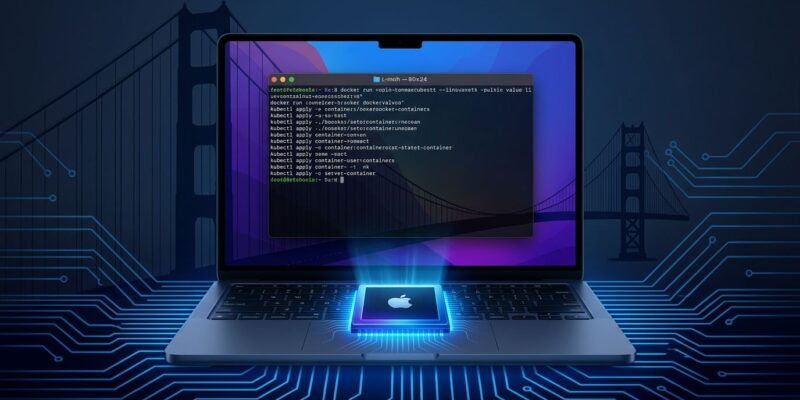
The most underreported story in Golden Gate is that Apple now ships a native Linux container tool. The container CLI (github.com/apple/container) is open-source, written in Swift, and built on Apple’s Virtualization.framework. It runs standard OCI images in lightweight Linux VMs with sub-second startup times — including full systemd support, which Docker Desktop has historically handled awkwardly on macOS.
Installation is straightforward: download the signed package from the GitHub releases page and run it. Basic usage follows Docker conventions:
container run --name web --cpus 2 --memory 2g -p 8080:80/tcp nginx:latestFor teams paying Docker Desktop commercial licenses purely for local development, this is worth evaluating seriously. Apple’s tool is free, open-source, and optimized for Apple Silicon. It does not replicate Docker’s full ecosystem — no Compose equivalent out of the box, no GUI — but for running Linux containers locally against production-identical images, it is fast and costs nothing. The tool shipped as 1.0.0 in June alongside macOS 26; Golden Gate refines it further.
Xcode 27: Simulator Is Gone, Device Hub Is In
Xcode 27 ships with Golden Gate and consolidates a long-standing friction point: the standalone Simulator app is gone, replaced by Device Hub. It is a single window managing both simulators and physical devices, with quick actions for screenshots, rotation, and home. If you have ever juggled multiple Simulator windows during testing, the consolidation is overdue.
Xcode 27 also integrates AI coding agents from Anthropic, Google, and OpenAI directly into the workflow. These are not autocomplete features — agents plan features, edit across multiple files, run tests, and surface crash diagnostics. The multi-provider approach is notable: Apple is not locking developers to one model vendor, which gives teams flexibility to use existing agreements or choose based on task performance. AppCoda has a thorough breakdown of what’s new in Xcode 27.
System Python and Ruby: Still Not Your Python
macOS 27 removes Python 2 entirely. The system still ships Python 3.9.6 and Ruby 2.6, but both are frozen copies that exist for Apple’s internal scripts, not for your applications. Python 3.9 reached upstream end-of-life in October 2024; Ruby 2.6 in April 2022. Apple explicitly marks the system Ruby as deprecated.
Use pyenv, rbenv, or mise to manage your own runtimes. Do not install packages against system Python. If your project has any hardcoded references to /usr/bin/python3, fix them before you upgrade. This advice has been true for years; Golden Gate is a good forcing function to finally act on it.
Before You Upgrade: A Short Checklist
- Run the Intel-Based Apps audit first: Settings > General > About > Intel-Based Apps. Know what you are dealing with before the warning popups start.
- Update menu bar utilities: Bartender, Ice, Hidden Bar, and similar tools broke on beta 1 due to the menu bar’s new single-window rendering. Most have been updated — confirm you are on the latest version before upgrading.
- Docker Desktop users: Your existing installation continues to work. Evaluate Apple’s container CLI separately; switching is not urgent.
- Intel Mac users: You cannot upgrade. Stay on macOS 26 and expect continued security patches.
- Fix system Python references: Any hardcoded
/usr/bin/python3references in scripts or CI configs should be cleaned up now.
Golden Gate is a solid release with a clear message embedded in it: Apple Silicon is the platform, native is the target, and the Rosetta bridge has exactly one more year of guaranteed weight. The full macOS 27 release notes are on Apple’s developer site for anyone who wants the complete picture. Plan accordingly — the clock on Intel-only software is now officially ticking.