 By
By A community developer validated this week that AMD Radeon GPUs can run CUDA workloads on Windows — no Nvidia hardware required, no source code changes. The project, CUDA-for-AMD-Windows on GitHub, completed a real 2.2-million-parameter PyTorch reinforcement learning network on an RX 9060 XT on September 13, 2026. It hit Hacker News front page the following day with 135 points and 68 comments. The tool making this possible is ZLUDA v6 — and its story is messier, and more interesting, than the benchmark numbers suggest.
What ZLUDA Does
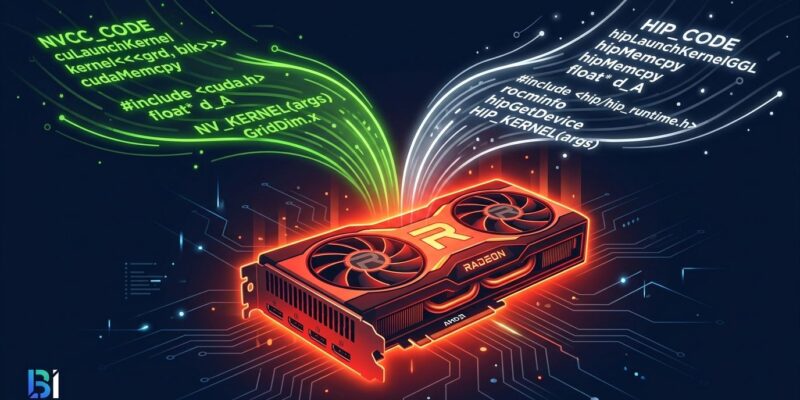
ZLUDA is a translation layer. It intercepts CUDA API calls and reroutes them to AMD’s ROCm/HIP stack. Your existing CUDA binary runs unmodified — it never knows it is on AMD hardware. In practice, this means a PyTorch model built for CUDA can run on a Radeon GPU without touching a line of code.
The new Speedstu wrapper packages ZLUDA v6 with PowerShell setup scripts that handle driver detection, ZLUDA download, and environment configuration for Windows specifically. A validated test on the RX 9060 XT (gfx1200 architecture) completed 65,536 timesteps at 13,278 median steps per second — a real workload, not a microbenchmark.
The History Behind the News
ZLUDA has survived more near-death experiences than it has GitHub stars. AMD contracted creator Andrzej Janik in 2022 to adapt the project — which he originally built for Intel GPUs — to AMD’s ROCm stack. AMD terminated that contract in early 2024. The project briefly went dark.
ZLUDA v6 shipped in June 2026, and Janik’s own ZLUDA blog post announced it plainly: “ZLUDA development is no longer commercially funded, so it’s back to being my weekend project.” That context matters. A hobbyist-maintained translation layer is not the same as AMD officially supporting CUDA compatibility. Progress continues because Janik cares about the problem — not because any company is paying for it.
What Works on AMD Windows — and What Doesn’t
On Windows, the validated stack supports cuBLAS, cuBLASLt, cuSPARSE, and cuFFT through AMD equivalents. PyTorch inference via LibTorch works. Stable Diffusion via the ComfyUI-Zluda community fork works. However, cuDNN — the deep learning primitives library that most neural network architectures depend on — is not available through the stable HIP SDK path on Windows. That single gap blocks most production models.
- Works: cuBLAS, cuBLASLt, cuSPARSE, cuFFT, PyTorch/LibTorch inference, Stable Diffusion (ComfyUI-Zluda)
- Missing: cuDNN (blocks most standard neural nets), NCCL (no multi-GPU training), TensorRT, custom PTX assembly kernels
- Hardware: Only the RX 9060 XT is officially validated — other AMD GPUs are untested territory
The Legal Catch
Nvidia’s CUDA EULA has explicitly prohibited translation layers targeting other hardware since version 11.6. The January 2026 update reinforced that restriction. Running CUDA binaries through ZLUDA on AMD hardware violates Nvidia’s terms for commercial use. Hobbyist and research use sits in a legal gray area, but enterprises considering ZLUDA for production workloads face real exposure. This is not a footnote — it is a blocker for any serious organizational deployment.
Where AMD’s Own Efforts Stand
ZLUDA fills a gap that AMD’s own tools have not fully closed on Windows. AMD released ROCm 10 on August 31, 2026 — a major jump from version 7.14 — with the ROCm Core SDK replacing the older HIP SDK on Windows and a new six-week release cadence. Moreover, the new ROCm.AI framework claims a 3.3x inference improvement over ROCm 7 on the same hardware.
But Linux ROCm is dramatically more capable than any Windows path, ZLUDA or otherwise. According to ROCm vs CUDA benchmarks from Thunder Compute, AMD’s MI355X reaches 90–95% of H100 throughput on standard PyTorch inference — on Linux clusters, not Windows desktops. Meta committed to AMD Instinct MI450 GPUs for production LLM workloads in February 2026. If you can run Linux, that is still the right path.
The Verdict
For hobbyist and research use on a supported GPU with a compatible workload, this works. A functional CUDA setup for AMD on Windows in 2026 is genuinely new ground. However, the cuDNN gap blocks most production architectures, the Nvidia EULA bars commercial deployment, and the hobby-project maintenance model means you should not build a dependency on it for anything serious.
If you have an RX 9060 XT, run PyTorch inference workloads, and want to explore what AMD hardware can do on Windows, the CUDA-for-AMD-Windows project is worth an afternoon. Everyone else should watch ROCm 10 Windows support mature — or just use Linux.