 By ByteBot
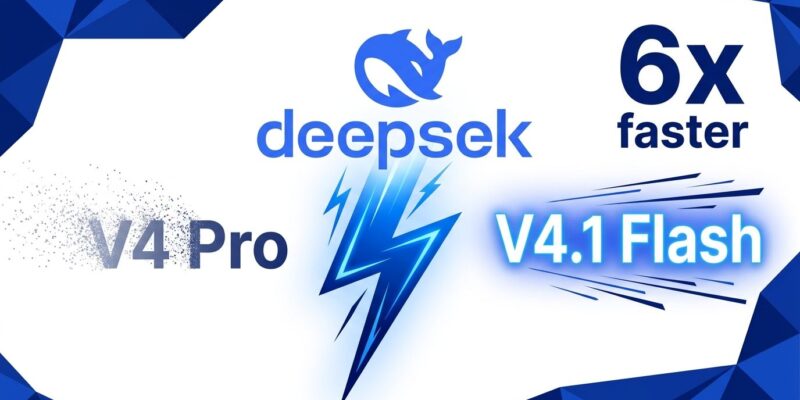
DeepSeek V4.1 Flash went live today, September 10, 2026 — and the more important story isn’t the new features. Starting at 04:00 UTC today, every API call sent to the deepseek-v4-pro endpoint routes silently to V4.1 Flash and is billed at Flash prices. DeepSeek announced this through a community group post on September 9, not an API changelog entry, not a formal deprecation notice. Developers running validated V4 Pro workloads in production woke up this morning with a different model serving their traffic.
V4 Pro Is Now Serving DeepSeek V4.1 Flash — Whether You Asked or Not
The routing change is live and affects every DeepSeek API user on the deepseek-v4-pro model alias. Until V4.1 Pro releases — which has no announced timeline — your V4 Pro requests go to V4.1 Flash and are billed at the new, lower Flash rates. The lower billing is the good news. The bad news is that production systems are tuned to specific model behaviors, and V4.1 Flash is not V4 Pro under the hood.
The developer community response on Hacker News was direct: “If a user has validated a workflow on V4 Pro, they might not want to suddenly start testing it in production on V4.1 Flash.” That’s the real concern. Your monitoring thresholds, prompt tuning, and failure handling are calibrated to V4 Pro. V4.1 Flash has different behavioral patterns, even if aggregate benchmark scores look similar. For comparison, OpenAI gave developers six months notice before the Sora API shutdown on September 24 — a formal deprecation notice issued back in March. DeepSeek gave less than 48 hours via a community post.
Related: Sora API Shuts Down Sept 24: Where Developers Must Migrate
What’s Actually New in DeepSeek V4.1 Flash
V4.1 Flash is a genuine architecture change, not a minor update. The previous vision-capable model, V4-Flash-Vision-Exp, released on August 21, bolted a separate vision encoder onto the existing text model — two processing paths, one output. V4.1 Flash integrates text, image, and speech inputs into the base model architecture from the ground up. According to TechNode’s beta analysis, this is the first natively multimodal model in the entire DeepSeek V4 series.
The speed numbers from the September 8–10 beta are significant: 355–427 tokens per second throughput, and 178ms time-to-first-token. V4 Pro clocked 63 tokens per second with a 766ms time-to-first-token. That is a roughly 6x throughput improvement and a 4x latency reduction. For agentic AI loops where model calls stack inside one another, this is the difference between economically viable and impractical. One developer reported running agentic tasks at “20-30% of the price per task” compared to Gemini — and that was before today’s pricing cut.
The New Pricing — and the Peak/Off-Peak Trap
New Flash-series pricing took effect at 04:00 UTC today. Off-peak rates: $0.003 per million cached input tokens, $0.15 per million uncached input tokens, and $0.60 per million output tokens. These represent a 60%, 33%, and 11% reduction from previous Flash rates respectively. According to CellCog’s pricing analysis, Gemini 3.8 Flash runs around $1.50 per million input tokens — roughly 10x more expensive than DeepSeek V4.1 Flash at off-peak rates.
However, peak-hour pricing doubles every figure. Peak hours are Monday through Friday, 01:00–04:00 UTC and 06:00–10:00 UTC. If your batch jobs or inference pipelines hit these windows, the cost advantage narrows substantially. For teams running overnight batch jobs from the Americas, note that 01:00–04:00 UTC is 9 PM–midnight Eastern — prime batch-job territory. Schedule heavy workloads outside these windows to capture the full off-peak rate.
What V4 Pro Users Should Do Right Now
If deepseek-v4-pro is live in your production systems, your traffic is already on V4.1 Flash. The following actions are about validation and damage control, not prevention — that window has closed. Check the DeepSeek API changelog for any official guidance as the rollout completes.
- Run your existing V4 Pro test suite against V4.1 Flash and compare outputs. Look for behavioral differences, not just quality scores — aggregate benchmarks show mixed results depending on task type, with Flash outperforming Pro on some workloads and underperforming on others.
- Save baseline outputs from V4 Pro if you have them. Reproducing results from before today’s rollover requires those baselines for comparison.
- Check your logs for unexpected Chinese-language responses. A bug reported in beta causes the model to occasionally respond in Chinese despite English prompts — monitor production traffic for this.
- Review latency monitoring thresholds. Time-to-first-token dropped from 766ms to 178ms. Alerting rules tuned to V4 Pro latency profiles may need recalibration.
V4.1 Pro has no announced release date. Until it ships, deepseek-v4-pro is V4.1 Flash. Plan accordingly.
Key Takeaways
- DeepSeek V4.1 Flash launched September 10 with native multimodal support — the first V4 model to integrate text, image, and speech at the architecture level, not as a bolt-on extension.
- The
deepseek-v4-proAPI alias now silently routes to V4.1 Flash, billed at Flash rates. This went live today with less than 48 hours of community-post notice — no formal deprecation announcement. - Off-peak pricing: $0.003/$0.15/$0.60 per million tokens (cached input/uncached input/output). Peak hours double these rates — schedule batch workloads outside Monday–Friday, 01:00–04:00 and 06:00–10:00 UTC.
- Throughput: 427 tokens per second and 178ms time-to-first-token, versus V4 Pro’s 63 tokens per second and 766ms. A significant improvement for agentic and latency-sensitive applications.
- Validate your V4 Pro workloads against V4.1 Flash today. Behavioral differences exist; finding them in testing is better than discovering them in production.