 By ByteBot
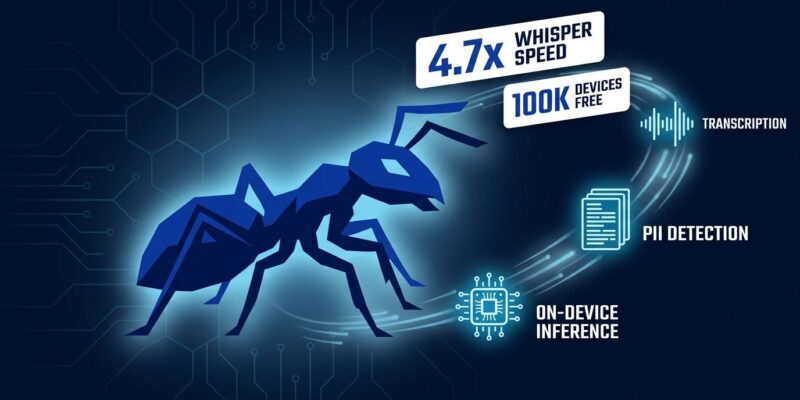
Desert Ant Labs launched yesterday — September 8, 2026 — with 18 specialized on-device AI models and native SDKs for Swift, Kotlin, and JavaScript. The headline model, Voz, transcribes 10 minutes of audio in 2 seconds on an iPhone — 4.7x faster than OpenAI’s Whisper — and nothing leaves the device. No tokens. No API keys. No cloud bills. The free tier covers 100,000 monthly active devices per SDK platform, making this immediately practical for most teams shipping real apps.
The Benchmarks Hold Up
Voz hits 298x realtime on an iPhone 17 Pro. That is not a typo — 30 minutes of audio processes in about six seconds. On an M3 Ultra, it reaches 319x realtime. Moreover, Voz includes word-level timestamps out of the box, something Whisper users have historically needed extra tools to get right.
The size-to-accuracy ratios are where Desert Ant makes its real argument. Their Tongue model — a 2MB language identifier — correctly identifies 84 languages with 0.933 accuracy. The leading alternative at 293MB achieves 0.887. A 147x size reduction for a better result. Similarly, Redact (PII detection) runs at 12MB and catches 88.8% of personal data in 27 languages. The cloud-backed GLiNER-PII catches 91.1% — at 2.3GB. In contrast, for most production apps, a 2.5% accuracy difference is an acceptable trade-off for a 192x size reduction that eliminates data transmission entirely.
Furthermore, Clear, the audio enhancement model, deserves its own mention. A 9MB model converts a laptop recording to studio quality in 1 second on an iPhone 16 Pro — 302x realtime — while consuming 470x less energy than the equivalent Claude Sonnet API call. Consequently, these are not demo models. They run under production constraints on current hardware.
Related: Microsoft MAI-Transcribe-2: 10x Faster, /bin/bash.10/hr
Why These Models Exist
Desert Ant Labs did not start as an AI lab. The founders built Detail, a video editing app, and kept hitting the same wall: cloud APIs were too slow and too expensive for the on-device experience they wanted. Dolby for audio enhancement. Whisper for transcription. Cloud-based video summarization for the auto-edit feature. Every round-trip added latency and cost they could not absorb at scale.
So they trained their own models. Clips — now their video summarization product — came directly from Detail’s auto-edit feature and runs 10x faster than Claude Sonnet on the same task. Clear replaced their cloud Dolby dependency. They are shipping Detail 6 with iOS 27 as a fully on-device app, dogfooding the entire stack. That origin matters. These are tools that had to work in a shipping product under real cost and latency constraints — not research demos optimized for benchmark papers.
Additionally, the broader market agrees with the approach. According to Desert Ant Labs’ launch post, NVIDIA research indicates 40 to 70% of agent model calls could use small specialized models instead of large cloud LLMs. However, Desert Ant is targeting exactly that gap — and doing it with models small enough to ship inside your app bundle.
Desert Ant Labs SDK: Models, Platforms, and Pricing
The full launch includes 12 stable models and 6 in beta, spanning audio, vision, and text. Stable models include Voz (transcription), Clear (audio enhancement), Redact (PII detection), Tongue (language identification), Clips (video highlights), Uhm (filler word detection), Ear (spoken language detection), and Align (word-level timestamp alignment). Meanwhile, beta models add Schemer (text-to-JSON extraction), Toxic (hate speech detection), and Moderator (content review).
SDK availability covers iOS and macOS via Swift, Android via Kotlin, and browser via JavaScript. All models are published on Hugging Face with full benchmark methodology, and source SDKs are available on GitHub. The free tier requires no tokens and no login — 100K monthly active devices per SDK platform, unlimited inference per user. Furthermore, a CLI tool is available for Mac-based testing before SDK integration.
Who Should Act Now, Who Should Wait
For mobile developers — particularly iOS apps handling audio, video, or sensitive text — this is worth evaluating today. SDK integration is described as a few lines of code, the free tier covers real-scale apps, and the privacy story is clean. Therefore, there is no data governance headache, no GDPR compliance question about cloud transmission. The models and benchmarks are public on Hugging Face; test them against your specific audio samples before committing.
For backend and Python developers, wait. The most common complaint in the Hacker News discussion (310 points, 84 comments on launch day) is the absence of a Python SDK. The company has confirmed it is coming — no timeline given. As a result, Desert Ant’s on-device AI models are effectively mobile-only in practice until that ships. Follow the GitHub repository for updates.
Key Takeaways
- Desert Ant Labs launched September 8 with 18 on-device AI models — audio, vision, and text — free up to 100K monthly active devices, no cloud required
- Voz transcribes at 4.7x Whisper’s speed with word-level timestamps; Clear audio enhancement runs 470x more energy-efficiently than equivalent cloud API calls
- Models were production-tested in Detail, the founders’ own video editing app, before being spun out as a standalone SDK product
- No Python SDK yet — this is a mobile-developer launch; backend teams should monitor GitHub for Python support before committing
- All models are on Hugging Face, SDKs on GitHub — evaluate benchmarks against your specific use case before integrating