 By ByteBot
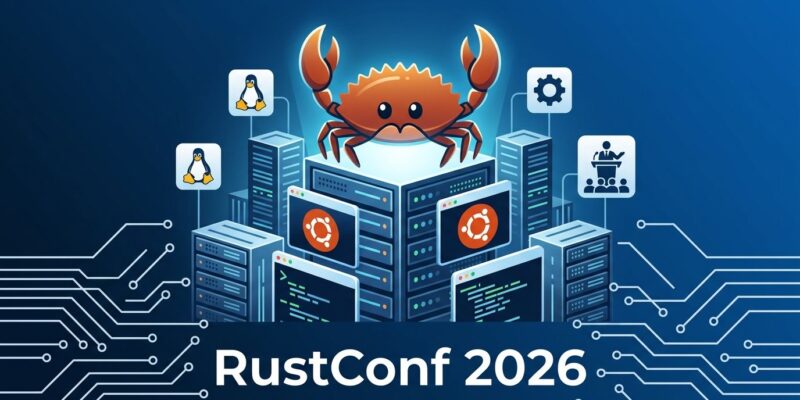
RustConf 2026 opens in Montreal today — the 10th annual gathering of the Rust community. A decade ago, this conference was 200 developers in a Portland room, arguing about whether memory safety was worth the borrow checker’s pain. This week, Canonical’s VP of Engineering is keynoting on how Ubuntu ships Rust-rewritten system tools to millions of servers under a 15-year LTS guarantee. The language won. The question now is how fast everyone else catches up.
Ubuntu 26.04 LTS Is the Most Important Rust Story of 2026
Jon Seager takes the RustConf 2026 stage to walk through Canonical’s Rust journey — and it is worth paying attention. When Ubuntu 26.04 LTS shipped in April, it became the first major Linux distribution to ship Rust-rewritten critical system tools with long-term enterprise support backing. That is not a pilot program. That is a commitment.
The headliners: sudo-rs and uutils coreutils. sudo-rs is not a port of the existing C codebase — it is a redesign. Canonical asked what sudo would look like if you designed it today, after 30 years of security lessons. The answer is a smaller attack surface, memory-safe by construction, and built to be auditable. uutils coreutils brings the same logic to the Unix tools developers run thousands of times a day.
There are caveats: cp, mv, and rm still run on GNU coreutils due to unresolved TOCTOU issues. Canonical is not pretending the migration is complete. What matters is the commitment — a 15-year support window tells enterprises this bet is backed. Next on the list is ntpd-rs, targeting Ubuntu 28.04 as the default time synchronization tool. The oxidation of Ubuntu’s core is a deliberate, sequenced program, not a rewrite-everything sprint. JetBrains has a thorough breakdown of the technical tradeoffs if you want to go deeper on the Canonical roadmap.
Linux Kernel: “Experimental” Is Off the Label
Linux 7.0, released April 12, 2026, quietly removed the “experimental” designation from Rust support in the kernel. That label had been a hedge. Removing it is a statement. Rust is now a first-class language in the Linux kernel — and the Linux 35th anniversary coverage put a number to the reason why: memory safety bugs drove roughly 80% of kernel CVEs.
The next milestone is practical: a GCC-based Rust compiler that can target Linux kernel compilation is expected this month. That removes the bootstrapping dependency on the LLVM toolchain, which matters for distributions that ship GCC as their primary compiler. The kernel’s Rust adoption is no longer a community experiment — it is a security strategy.
Government policy is catching up. CISA and the NSA have issued guidance pushing memory-safe languages across federal software supply chains. The policy pressure and the kernel’s technical reality are converging at exactly the moment RustConf is meeting in Montreal.
The Rust 2027 Edition Preview: Stability Signals
RustConf includes a preview of what the Rust 2027 edition is shaping up to be — and the story it tells is that the hard work is mostly done. Editions are opt-in, backward compatible, and run on a three-year cycle: 2021, 2024, 2027. The big-ticket features — async closures (1.85), GATs, const generics, Polonius (now on nightly) — have shipped or are in the final stabilization stretch.
The 2027 edition discussion is about ergonomic cleanup, not new foundations. The Rust internals discussion on the 2027 edition is readable and candid: the community is deciding which ergonomic improvements are worth an edition-gated change vs. which can ship as backward-compatible additions. Deprecations from the 2024 edition are getting finalized. This is what a maturing language looks like — not reinvention, but precision.
If you are evaluating whether to bet on Rust for a multi-year project, the edition trajectory is one of the best signals available. The language is not going to upend its foundations every few years. The instability period is behind it.
The Closing Keynote No One Is Talking About
The most strategically significant event at RustConf 2026 is not the Canonical keynote. It is the closing conversation between Rebecca Rumbul (Rust Foundation) and Deb Nicholson (Python Software Foundation) — two foundation leaders representing two of the most widely used programming languages in the world, sitting down to talk about cross-ecosystem interoperability and governance.
This matters because Python and Rust need each other. Python is the dominant language for AI and data science. Rust is the memory-safe systems layer that Python’s performance-critical components are increasingly running on — tokenizers, cryptographic libraries, data parsers. PyO3 and Maturin have made Rust-backed Python extensions practical for production teams. The conference session “Bringing Rust into Python” is a project update, not a concept pitch.
The fact that the two foundations are having this conversation publicly, at the largest Rust event of the year, signals that cross-ecosystem collaboration is being institutionalized — not just practiced ad hoc by individual projects.
Ten Years In
RustConf 2026 is worth following closely — not because Rust is new and exciting, but because this is the year the community shifted from proving the language to operating it. About 70% of current Rust users started in the last three years. The founders are no longer the majority. RustConf is where they brief everyone else on what has been built and what comes next.
The conference runs through September 11 with sessions available online. If you use anything that touches a Linux system, runs in a browser, or processes Python data at scale, someone in Montreal this week is probably maintaining something in your stack.