 By
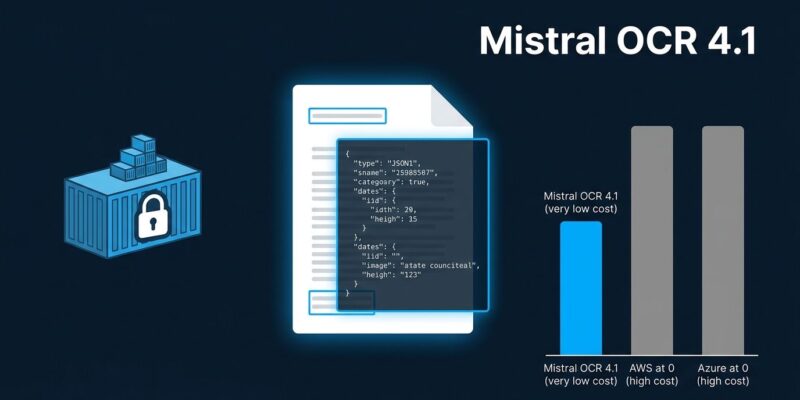
By If your document ingestion pipeline still routes through AWS Textract or Azure Form Recognizer for structured extraction, you have been paying $30–$50 per 1,000 pages for capabilities that Mistral now bundles at $4. This week, Mistral updated its model aliases so that any production pipeline calling mistral-ocr-latest automatically runs OCR 4.1 — no code changes required. If you have not evaluated Mistral’s document AI stack, the time is now.
What Changed in 4.1
OCR 4.1 shipped in July and became the default on Mistral’s developer platform in August. The September news is the alias update: mistral-ocr-latest and mistral-ocr-4 now both resolve to 4.1. For production teams, this matters — Mistral is treating minor version bumps as backwards-compatible upgrades. Your invoices and contracts that went through the old pipeline get better output starting now, with no deployment required on your end.
The substantive addition in 4.1 is block-level confidence score granularity. The OCR API’s confidence_scores_granularity parameter previously offered only page and word levels. The new block option returns both page-level and block-level scores, including average and minimum content confidence alongside a block-type confidence value.
That might sound like plumbing. For anyone building agentic pipelines, it is the feature that separates reliable document ingestion from a system that silently corrupts downstream data. An agent extracting fields from a scanned insurance form needs to know when OCR confidence on a given block is 0.43, not process it as though it were 0.97. Block-level confidence is what makes human-in-the-loop escalation possible at the right granularity.
Pricing: Where Mistral Wins and Where It Does Not
The pricing story has nuance that most comparisons skip. Here is the honest breakdown:
| Service | Structured Extraction | Batch | Self-hosted |
|---|---|---|---|
| Mistral OCR 4.1 | $4 / 1K pages | $2 / 1K pages | Yes |
| AWS Textract (forms) | $50 / 1K pages | No discount | No |
| Azure Doc Intelligence (custom) | $30 / 1K pages | No discount | No |
| AWS Textract (plain text) | $1.50 / 1K pages | — | No |
The caveat worth stating: if you need plain text extraction with zero structure, AWS and Azure charge $1.50 per 1,000 pages — cheaper than Mistral’s $4. The crossover is the moment you need bounding boxes, block classification, or confidence scores. At that point, Mistral’s flat rate beats Textract’s $50 forms tier by more than 12x. Financial AI firm Rogo benchmarked OCR 4 against leading agentic document parsers on chart-dense financial documents and reported equivalent accuracy at 8x lower cost and 17x lower latency.
The Self-Hosting Option Cloud Vendors Cannot Match
This is Mistral’s actual differentiator. OCR 4 ships as a single Docker container deployable on a single GPU. Documents never leave your infrastructure. AWS and Azure offer no equivalent — every document processed goes through their API endpoints.
For healthcare teams processing medical records under HIPAA, legal firms handling privileged documents, financial institutions with SOC 2 requirements, and European companies subject to GDPR or the EU AI Act, this is not a nice-to-have. It is a procurement requirement. And it closes an important loophole: selecting an “EU region” on AWS or Azure does not fully resolve US CLOUD Act exposure, because legal jurisdiction follows the company’s headquarters, not the server location.
Enterprise self-hosting runs on a capacity-based license rather than per-page billing. At high volumes, that math shifts substantially.
What It Handles
OCR 4.1 accepts PDF, DOC, PPT, and OpenDocument formats. It returns structured JSON with paragraph-level bounding boxes, block type labels (titles, tables, equations, signatures), and confidence scores. The model supports 170 languages across 10 language groups, with the largest accuracy advantage in low-resource and specialized languages where AWS and Azure degrade most sharply.
On benchmarks: Mistral claims a 72% average win rate in a blind human evaluation across 600-plus real-world documents in 12-plus languages. On the public OlmOCRBench leaderboard, OCR 4 ranks roughly third, not first. The vendor numbers are directional. The Rogo financial benchmark is more useful because it tests on domain-specific documents. Evaluate on your own data before committing.
Integration
The API call is straightforward:
from mistralai import Mistral

client = Mistral(api_key="YOUR_KEY")
response = client.ocr.process(
    model="mistral-ocr-latest",
    document={"type": "url", "url": "https://example.com/invoice.pdf"},
    confidence_scores_granularity="block"
)
# response includes: bounding_boxes, block_labels, per-block confidence_scores
The response object includes bounding boxes, block labels, and confidence scores per block. Beyond the direct API, OCR 4.1 is available through Amazon SageMaker, Microsoft Foundry, and Mistral Studio. Snowflake integration is on the roadmap.
Who Should Switch
If you are processing documents that need structure — invoices, contracts, forms, financial statements — and currently on Textract forms or Azure custom extraction, the math is clear. At 1 million pages per month, that is $50,000 on AWS Textract versus $4,000 on Mistral’s API, or potentially less on the self-hosted capacity model.
If your workload is plain text with no structure requirements, stay on AWS or Azure’s $1.50 tier. Mistral does not win that comparison.
For teams building agentic document pipelines with compliance requirements, the self-hosted option deserves a serious evaluation even if per-page API pricing were identical. The compliance angle alone justifies the test.