 By
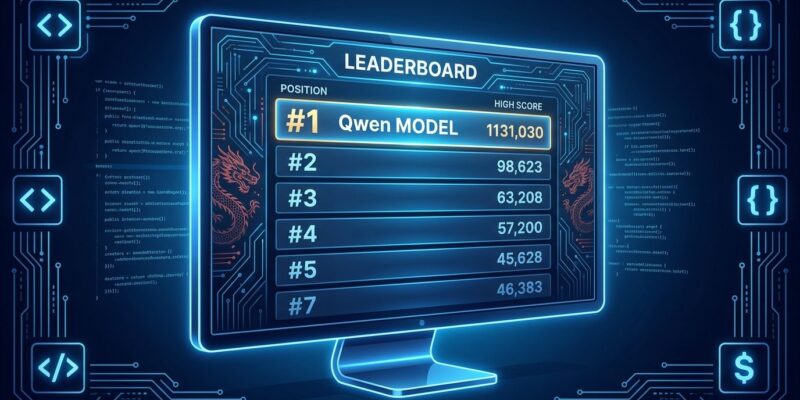
By Alibaba’s Qwen team swapped a model ID on their API today — no blog post, no press release, no announcement tweet. Just a new model ID: qwen3.8-max-0902. Then the coding leaderboard reshuffled. Qwen3.8-Max-0902 debuted at #1 on Arena.ai’s Code Arena: WebDev with 1,691 points, edging Claude Opus 5 by 3 points at the same price. That’s the news. What you do with it requires a little more thought.
What the 0902 Snapshot Actually Changed
Qwen3.8-Max launched in August as a 2.4 trillion parameter Mixture-of-Experts model with 95B active parameters per query and a 1M-token context window. The 0902 update doesn’t change the base architecture — it’s a post-training upgrade focused specifically on coding and what Alibaba calls “Cowork”: agentic, multi-tool, long-horizon task execution. Pricing stayed flat at $2.00 per million input tokens and $6.00 per million output tokens.
The benchmark improvements are not incremental. TerminalBench 3.0 jumped from 11.3 to 29.0 — more than doubled. DeepSWE 1.1 went from 56.6 to 69.3. QwenSWEbench V2 climbed from 55.1 to 70.0. JobBench, which measures professional task completion across real-world domains, rose from 53.4 to 64.0. All eight programming benchmarks improved. That’s not a patch — that’s a meaningful coding-focused training run that worked.
The Leaderboard Position Is Real — With One Asterisk
Arena.ai’s Code Arena: WebDev combines live human voting with automated evaluation — it’s not a vendor benchmark. Qwen’s #1 position (1,691 pts) above Claude Opus 5 Max (1,688 pts) and Kimi K3 Max (1,674 pts) was confirmed by Arena.ai directly. The category breakdown is solid: #1 in Data & Analytics and Consumer Product, #2 in Gaming and Simulations, #3 in Content Creation Tools.
The asterisk: several of the broader benchmark numbers Alibaba published — particularly comparisons on proprietary evals like SWE-Atlas QnA — are self-reported. Yotta Labs flagged that independent replication is still pending for some claims. The Arena.ai position is real. Some of the surrounding numbers are still vendor-run and awaiting outside confirmation.
Where Claude Opus 5 Still Leads
CellCog’s analysis of today’s release put it plainly: “Same Price, Much Better at Coding and Office Work, Still Behind Opus 5.” That’s accurate for most agentic backend benchmarks. Claude Opus 5 leads on multi-step autonomous coding tasks, office-work evaluations, and SWE-bench Pro. The 0902 update closes some of those gaps — Qwen now outperforms Opus 5 on QwenSWEbench V2 — but Claude holds the edge on the harder software engineering suites.
If your workflow involves Claude Code doing deep backend refactoring or extended autonomous coding sessions, today’s data doesn’t give you a compelling reason to switch. If your work sits at the front-end, web app, or data visualization layer, the picture is different.
Should You Switch? A Tiered Answer
Front-end and web development teams: Test it now. The Code Arena: WebDev leaderboard is purpose-built for this use case, and the score is independently verified. The pricing advantage — output at $6.00/M vs Claude Sonnet 5’s $15.00/M — compounds significantly on generation-heavy workloads.
Backend and agentic pipeline teams: Wait. The jumps in TerminalBench and DeepSWE are real, but Claude Opus 5 still holds the advantage on the benchmarks that matter most for autonomous multi-step coding. Hold for independent benchmark replication before restructuring a production agentic stack.
Cost-sensitive teams doing API-heavy work: The pricing math is worth running regardless of where you land on benchmarks. Qwen3.8-Max-0902 at $2.00/$6.00 vs Claude Sonnet 5 at $3.00/$15.00 is a substantial gap on output-heavy tasks. The model handles OpenAI-compatible API calls out of the box. Claude Code users can point to it with three environment variable changes via a provider like APIVALE.
The Pattern Worth Watching
Alibaba didn’t announce this update. They pushed a new model ID and let the leaderboard do the talking — a calculated move that forces immediate, independent validation via Arena.ai instead of pre-release hype. Three points above Claude Opus 5 is a narrow margin, but the trajectory of the Qwen line over the past year is harder to dismiss. Open-weight competition from China has closed the gap with closed-source Western models faster than most predicted, and today’s update is another data point in that trend.
Test it against your own workloads. Benchmark numbers are starting points, not verdicts. The API is live today and the price hasn’t moved.